
生理浓度的短链脂肪酸可诱导体外中性粒细胞胞外诱捕网的形成。
Physiological concentrations of short-chain fatty acids induce the formation of neutrophil extracellular traps in vitro.
机构信息
Laboratorio de Inmunología, Departamento de Fisiología, Centro Universitario de Ciencias de la Salud, Universidad de Guadalajara, Guadalajara, Jalisco, Mexico.
Centro de Investigación en Inmunología y Dermatología, Centro Universitario de Ciencias de la Salud, Universidad de Guadalajara, Guadalajara, Jalisco, Mexico.
出版信息
Int J Immunopathol Pharmacol. 2020 Jan-Dec;34:2058738420958949. doi: 10.1177/2058738420958949.
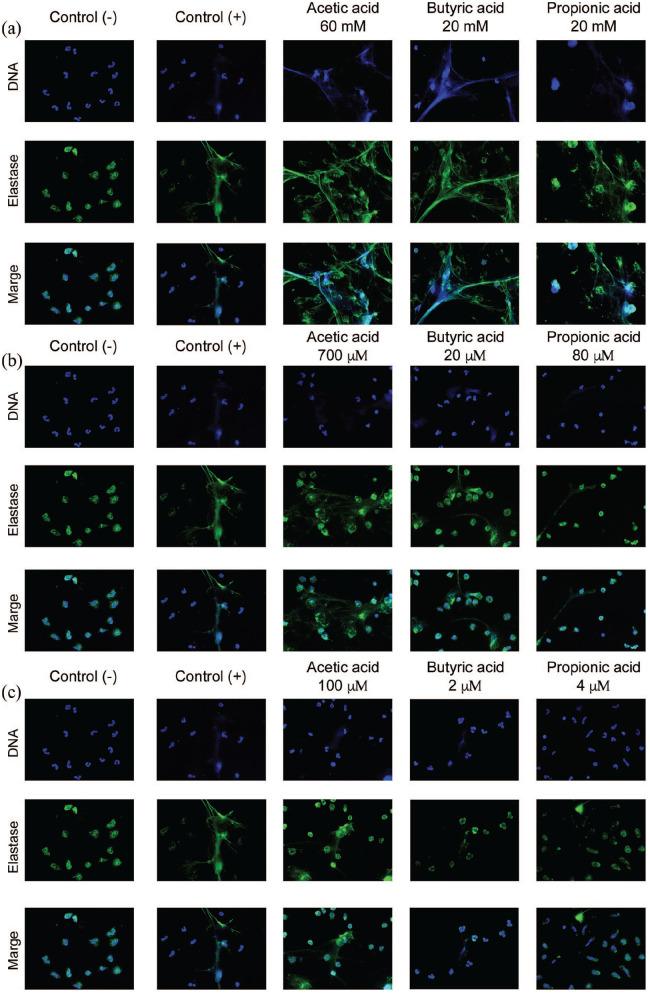
Neutrophils represent the first line of host cellular defense against various pathogens. The most recently described microbicidal mechanism of these cells is the release of neutrophil extracellular traps (NET). Currently, a wide range of chemical and biological stimuli are known to induce this response; however, the effect of short-chain fatty acids (SCFAs) on the induction of NET is still unknown. SCFAs are produced mainly by bacterial fermentation of dietary fiber and are found in host tissues and blood. This study aimed to determine whether physiological levels of SCFAs can induce the formation of NET. Previously reported concentrations of SCFAs (as found in the colonic lumen and peripheral blood in postprandial and basal states) were used to stimulate the neutrophils. In order to determine the signaling pathway utilized by SCFAs, we tested the inhibition of the Free Fatty Acid 2 Receptor (FFA2R) expressed in neutrophils using CATPB, the inhibitor of FFA2R, genistein, an inhibitor of the downstream Gα/q11 proteins and DPI, an inhibitor of the NADPH oxidase complex. The SCFAs at colonic intestinal lumen concentrations were able to induce the formation of NET, and when tested at concentrations found in the peripheral blood, only acetic acid at 100 μM (fasting equivalent) and 700 μM (postprandial equivalent) was found to induce the formation of NET. The administration of the competitive inhibitor against the receptor or blockade of relevant G protein signaling and the inhibition of NADPH oxidase complex decreased NET release. SCFAs stimulate NET formation in vitro and this effect is mediated, in part, by the FFA2R.
中性粒细胞是宿主细胞防御各种病原体的第一道防线。这些细胞最近被描述的杀菌机制是释放中性粒细胞胞外诱捕网(NET)。目前,已知广泛的化学和生物刺激物可诱导这种反应;然而,短链脂肪酸(SCFAs)对 NET 诱导的影响尚不清楚。SCFAs 主要由膳食纤维的细菌发酵产生,存在于宿主组织和血液中。本研究旨在确定生理水平的 SCFAs 是否能诱导 NET 的形成。先前报道的 SCFAs 浓度(如在餐后和基础状态下在结肠腔和外周血中发现的浓度)用于刺激中性粒细胞。为了确定 SCFAs 利用的信号通路,我们使用 CATPB(中性粒细胞中表达的游离脂肪酸 2 受体(FFA2R)的抑制剂)、genistein(下游 Gα/q11 蛋白的抑制剂)和 DPI(NADPH 氧化酶复合物的抑制剂)测试了抑制表达在中性粒细胞中的 FFA2R。结肠肠腔浓度的 SCFAs 能够诱导 NET 的形成,而在外周血中测试时,只有 100 μM(空腹等效物)和 700 μM(餐后等效物)的乙酸被发现能够诱导 NET 的形成。针对受体的竞争性抑制剂的给药或阻断相关 G 蛋白信号转导以及 NADPH 氧化酶复合物的抑制降低了 NET 的释放。SCFAs 体外刺激 NET 形成,这种作用部分是由 FFA2R 介导的。



 Zotero 插件