Delgado-Rizo Vidal, Martínez-Guzmán Marco A, Iñiguez-Gutierrez Liliana, García-Orozco Alejandra, Alvarado-Navarro Anabell, Fafutis-Morris Mary
Physiology, Universidad de Guadalajara , Guadalajara , Mexico.
Front Immunol. 2017 Feb 6;8:81. doi: 10.3389/fimmu.2017.00081. eCollection 2017.
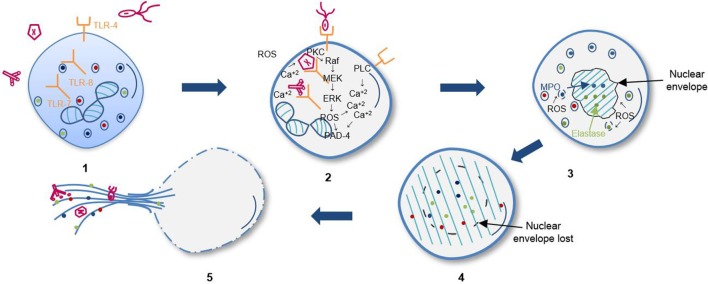
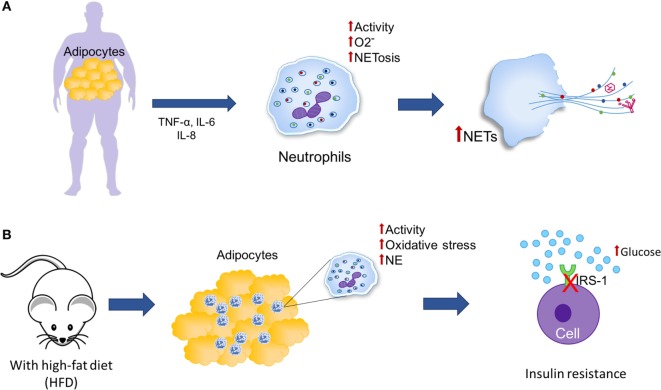
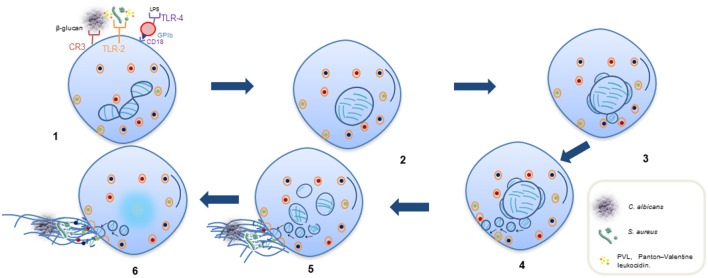
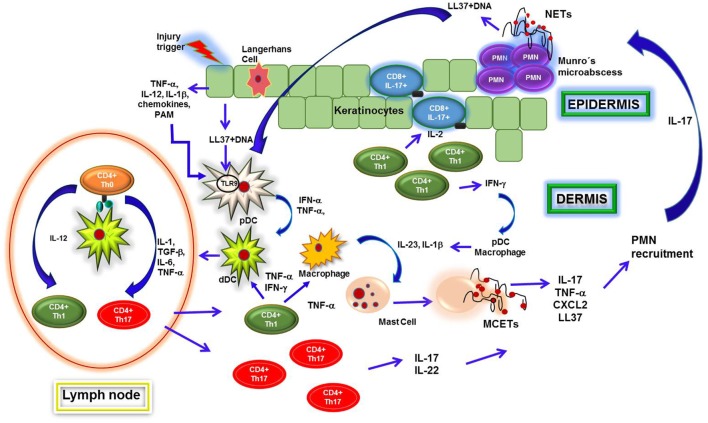
In addition to physical barriers, neutrophils are considered a part of the first line of immune defense. They can be found in the bloodstream, with a lifespan of 6-8 h, and in tissue, where they can last up to 7 days. The mechanisms that neutrophils utilize for host defense are phagocytosis, degranulation, cytokine production, and, the most recently described, neutrophil extracellular trap (NET) production. NETs are DNA structures released due to chromatin decondensation and spreading, and they thus occupy three to five times the volume of condensed chromatin. Several proteins adhere to NETs, including histones and over 30 components of primary and secondary granules, among them components with bactericidal activity such as elastase, myeloperoxidase, cathepsin G, lactoferrin, pentraxin 3, gelatinase, proteinase 3, LL37, peptidoglycan-binding proteins, and others with bactericidal activity able to destroy virulence factors. Three models for NETosis are known to date. (a) , with a duration of 2-4 h, is the best described model. (b) In vital NETosis with nuclear DNA release, neutrophils release NETs without exhibiting loss of nuclear or plasma membrane within 5-60 min, and it is independent of reactive oxygen species (ROS) and the Raf/MERK/ERK pathway. (c) The final type is vital NETosis with release of mitochondrial DNA that is dependent on ROS and produced after stimuli with GM-CSF and lipopolysaccharide. Recent research has revealed neutrophils as more sophisticated immune cells that are able to precisely regulate their granular enzymes release by ion fluxes and can release immunomodulatory cytokines and chemokines that interact with various components of the immune system. Therefore, they can play a key role in autoimmunity and in autoinflammatory and metabolic diseases. In this review, we intend to show the two roles played by neutrophils: as a first line of defense against microorganisms and as a contributor to the pathogenesis of various illnesses, such as autoimmune, autoinflammatory, and metabolic diseases.
除了物理屏障外,中性粒细胞被认为是免疫防御第一道防线的一部分。它们存在于血液中,寿命为6 - 8小时,也存在于组织中,在组织中它们可以存活长达7天。中性粒细胞用于宿主防御的机制包括吞噬作用、脱颗粒、细胞因子产生,以及最近描述的中性粒细胞胞外陷阱(NET)产生。NETs是由于染色质解聚和扩散而释放的DNA结构,因此占据浓缩染色质体积的三到五倍。几种蛋白质附着在NETs上,包括组蛋白和30多种初级和次级颗粒的成分,其中具有杀菌活性的成分如弹性蛋白酶、髓过氧化物酶、组织蛋白酶G、乳铁蛋白、五聚素3、明胶酶、蛋白酶3、LL37、肽聚糖结合蛋白,以及其他具有杀菌活性、能够破坏毒力因子的成分。迄今为止已知三种NETosis模型。(a)是描述最清楚的模型,持续时间为2 - 4小时。(b)在有核DNA释放的存活NETosis中,中性粒细胞在5 - 60分钟内释放NETs,而不表现出核膜或质膜的丧失,并且它独立于活性氧(ROS)和Raf/MERK/ERK途径。(c)最后一种类型是有线粒体DNA释放的存活NETosis,它依赖于ROS,在粒细胞巨噬细胞集落刺激因子(GM - CSF)和脂多糖刺激后产生。最近的研究表明,中性粒细胞是更复杂的免疫细胞,能够通过离子通量精确调节其颗粒酶的释放,并能释放与免疫系统各种成分相互作用的免疫调节细胞因子和趋化因子。因此,它们可以在自身免疫以及自身炎症和代谢性疾病中发挥关键作用。在这篇综述中,我们打算展示中性粒细胞所起的两种作用:作为对抗微生物的第一道防线,以及作为各种疾病(如自身免疫性、自身炎症性和代谢性疾病)发病机制的促成因素。