Chen Chia-Yu, Liang Shih-Hsin, Su Yung-Yeh, Chiang Nai-Jung, Wang Hui-Ching, Chiu Chang-Fang, Chen Li-Tzong, Bai Li-Yuan
Division of Hematology and Oncology, Department of Internal Medicine, China Medical University Hospital, Taichung, Taiwan.
Department of Internal Medicine, Dalin Tzu Chi Hospital, Buddhist Tzu Chi Medical Foundation, Chia-Yi, Taiwan.
PLoS One. 2020 Dec 29;15(12):e0244487. doi: 10.1371/journal.pone.0244487. eCollection 2020.
In pancreatic cancer, toxicities associated with current chemotherapeutic regimens remain concerning. A modified combination of gemcitabine, S-1, and leucovorin (GSL) was used as the first-line treatment for newly diagnosed locally advanced or metastatic pancreatic adenocarcinoma patients.
GSL was administered every 2 weeks-intravenous gemcitabine 800 mg/m2 at a fixed-dose rate of 10 mg/m2/min on day 1 and oral S-1 (80-120 mg/day) plus leucovorin 30 mg twice daily on days 1-7. We retrospectively analyzed the feasibility of GSL and patient outcomes in three medical centers in Taiwan.
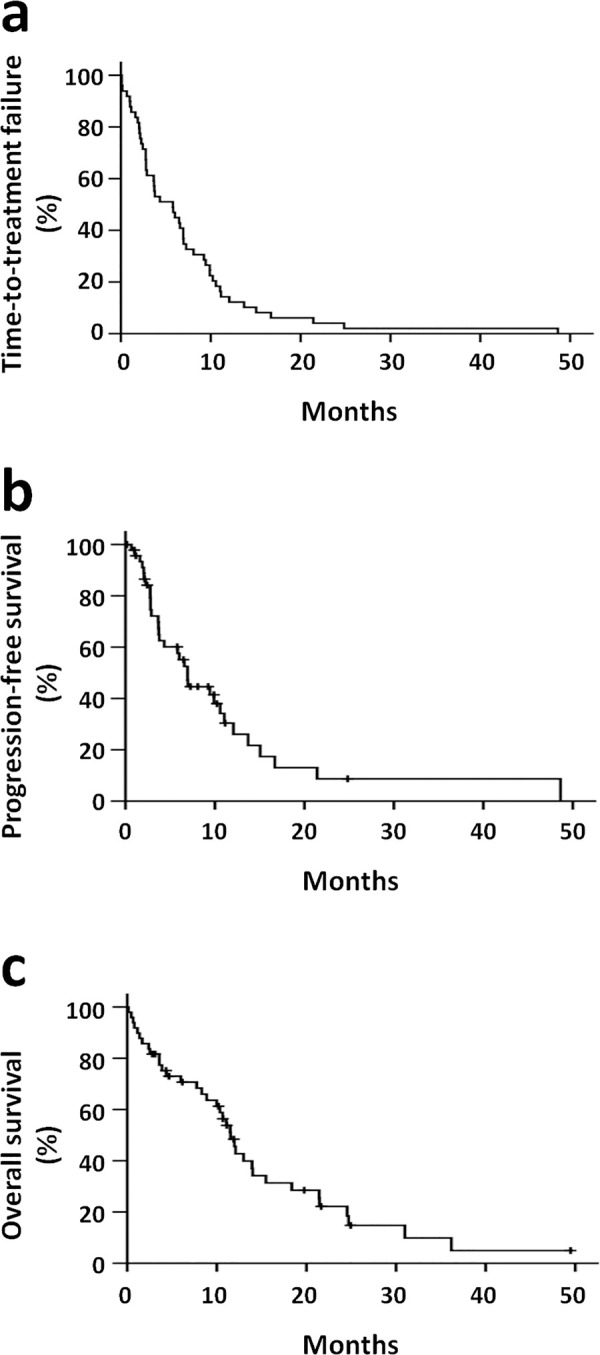
Overall, 49 patients received GSL with a median follow-up of 24.9 months from May 2015 to March 2019. The median patient age was 68 years (range, 47-83 years), with a marginally higher number of females (57.1%). Among the 44 patients who underwent image evaluation, 13 demonstrated a partial response (29.5%) and 17 presented with stable disease (38.6%). The partial response rate and stable disease rate was 26.5% and 34.7%, respectively, in the intent-to-treat analysis. The median time-to-treatment failure was 5.79 months (95% C.I., 2.63-8.94), progression-free survival was 6.94 months (95% C.I., 5.55-8.33), and overall survival time was 11.53 months (95% C.I., 9.94-13.13). For GSL treatment, the most common grade 3 or worse toxicities were anemia (18.3%), neutropenia (6.1%), nausea (4.1%), and mucositis (4.1%). Treatment discontinuation was mostly due to disease progression (65.3%).
The modified GSL therapy can be a promising and affordable treatment for patients with advanced and metastatic pancreatic cancer in Taiwan. A prospective trial of modified GSL for elderly patients is currently ongoing in Taiwan.
在胰腺癌中,当前化疗方案相关的毒性仍然令人担忧。一种改良的吉西他滨、S-1和亚叶酸(GSL)联合方案被用作新诊断的局部晚期或转移性胰腺腺癌患者的一线治疗。
每2周给予GSL——第1天静脉注射吉西他滨800mg/m²,固定剂量率为10mg/m²/分钟,第1 - 7天口服S-1(80 - 120mg/天)加亚叶酸30mg,每日2次。我们回顾性分析了台湾三个医疗中心GSL的可行性和患者预后。
总体而言,从2015年5月至2019年3月,49例患者接受了GSL治疗,中位随访时间为24.9个月。患者中位年龄为68岁(范围47 - 83岁),女性数量略多(57.1%)。在44例接受影像评估的患者中,13例显示部分缓解(29.5%),17例病情稳定(38.6%)。在意向性分析中,部分缓解率和病情稳定率分别为26.5%和34.7%。中位治疗失败时间为5.79个月(95%置信区间,2.63 - 8.94),无进展生存期为6.94个月(95%置信区间,5.55 - 8.33),总生存期为11.53个月(95%置信区间,9.94 - 13.13)。对于GSL治疗,最常见的3级或更严重毒性为贫血(18.3%)、中性粒细胞减少(6.1%)、恶心(4.1%)和粘膜炎(4.1%)。治疗中断主要是由于疾病进展(65.3%)。
改良的GSL疗法对于台湾晚期和转移性胰腺癌患者可能是一种有前景且经济实惠的治疗方法。台湾目前正在进行一项针对老年患者的改良GSL前瞻性试验。