Choi Jun Hwan, Kim Bo Ryun, Nam Kwang Woo, Lee Sang Yoon, Beom Jaewon, Lee So Young, Suh Min Ji, Lim Jae-Young
Department of Rehabilitation Medicine, Regional Rheumatoid and Degenerative Arthritis Center, Jeju National University Hospital, Jeju National University College of Medicine, Jeju 63241, Korea.
Department of Physical Medicine and Rehabilitation, Korea University Anam Hospital, Seoul 02841, Korea.
J Clin Med. 2020 Dec 23;10(1):18. doi: 10.3390/jcm10010018.
The purpose of this study was to investigate the effectiveness of a home-based fragility fracture integrated rehabilitation management (H-FIRM) program following an inpatient FIRM (I-FIRM) program in patients surgically treated for hip fracture.
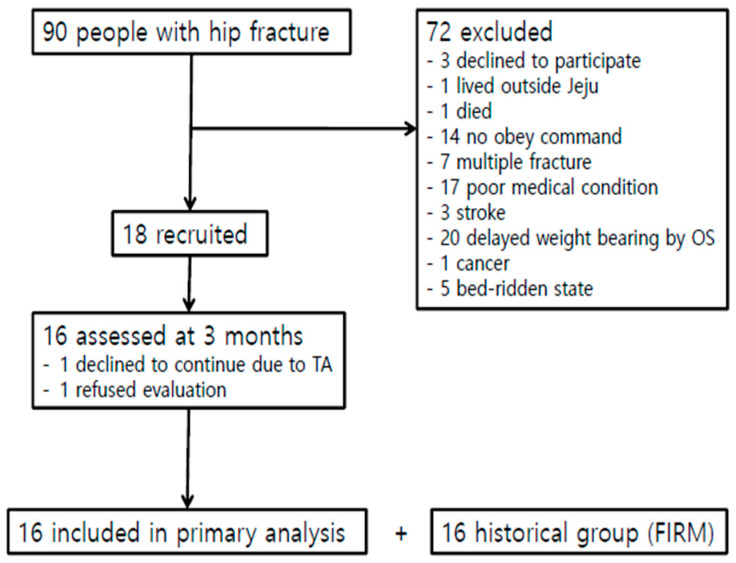
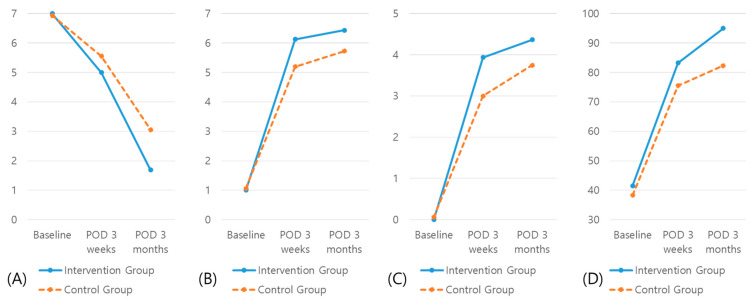
This nonrandomized controlled trial included 32 patients who underwent hip surgery for a fragility hip fracture. The patients were divided into two groups: a prospective intervention group ( = 16) and a historical control group ( = 16). The intervention group performed a nine-week H-FIRM program combined with the I-FIRM program. The historical control group performed the I-FIRM program only. Functional outcomes included Koval's grade, Functional Ambulatory Category (FAC), Functional Independence Measure (FIM) locomotion, Modified Rivermead Mobility Index (MRMI), 4 m walking speed test (4MWT), and the Korean version of Modified Barthel Index (K-MBI). All functional outcomes were assessed one week (before I-FIRM), three weeks (before I-FIRM), and three months (after H-FIRM) after surgery.
Both groups showed significant and clinically meaningful improvements in functional outcomes over time. Compared with the control group, the intervention group showed clinically meaningful improvements in Koval's grade, FAC, FIM locomotion, MRMI, 4MWT, and K-MBI from baseline to three months.
H-FIRM may be an effective intervention for improving functional outcomes in older people after fragility hip fractures.
本研究旨在调查髋部骨折手术治疗患者在接受住院骨折综合康复管理(I-FIRM)计划后,家庭式脆性骨折综合康复管理(H-FIRM)计划的有效性。
这项非随机对照试验纳入了32例因脆性髋部骨折接受髋关节手术的患者。患者分为两组:前瞻性干预组(n = 16)和历史对照组(n = 16)。干预组实施为期九周的H-FIRM计划并结合I-FIRM计划。历史对照组仅实施I-FIRM计划。功能结局包括科瓦尔分级、功能步行分类(FAC)、功能独立性测量(FIM)运动能力、改良里弗米德运动指数(MRMI)、4米步行速度测试(4MWT)以及韩国版改良巴氏指数(K-MBI)。所有功能结局在术后1周(I-FIRM前)、3周(I-FIRM前)和3个月(H-FIRM后)进行评估。
随着时间推移,两组在功能结局方面均显示出显著且具有临床意义的改善。与对照组相比,干预组从基线到3个月时在科瓦尔分级、FAC、FIM运动能力、MRMI、4MWT和K-MBI方面显示出具有临床意义的改善。
H-FIRM可能是改善老年脆性髋部骨折患者功能结局的有效干预措施。