German Center for Neurodegenerative Diseases (DZNE), site Rostock/ Greifswald, Ellernholzstr. 1-2, 17489, Greifswald, Germany.
Institute for Community Medicine, Department of Epidemiology and Community Health, University Medicine Greifswald, Greifswald, Germany.
BMC Geriatr. 2020 Dec 29;20(1):540. doi: 10.1186/s12877-020-01957-2.
The outbreak of the Corona virus is a challenge for health care systems worldwide. The aim of this study is to analyze a) knowledge about, and feelings related to the Corona-pandemic. Describe b) loneliness, depression and anxiety and, c) the perceived, immediate impact of the lockdown on frequency of social contacts and quality of health care provision of people with cognitive impairment during social distancing and lockdown in the primary care system and living at home in Germany.
This analysis is based on data of a telephone-based assessment in a convenience sample of n = 141 people with known cognitive impairment in the primary care setting. Data on e.g. cognitive and psychological status prior to the pandemic was available. Attitudes, knowledge about and perceived personal impact of the pandemic, social support, loneliness, anxiety, depression, change in the frequency of social activities due to the pandemic and perceived impact of the pandemic on health care related services were assessed during the time of lockdown.
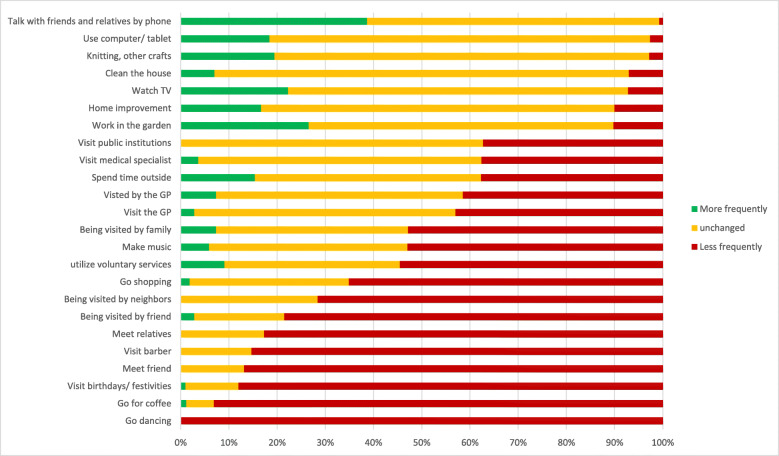
The vast majority of participants are sufficiently informed about Corona (85%) and most think that the measures taken are appropriate (64%). A total of 11% shows one main symptom of a depression according to DSM-5. The frequency of depressive symptoms has not increased between the time before pandemic and lockdown in almost all participants. The sample shows minimal (65.0%) or low symptoms of anxiety (25%). The prevalence of loneliness is 10%. On average seven activities have decreased in frequency due to the pandemic. Social activities related to meeting people, dancing or visiting birthdays have decreased significantly. Talking with friends by phone and activities like gardening have increased. Utilization of health care services like day clinics, relief services and prescribed therapies have been reported to have worsened due to the pandemic. Visits to general practitioners decreased.
The study shows a small impact of the pandemic on psychological variables like depression, anxiety and loneliness in the short-term in Germany. There is a decrease in social activities as expected. The impact on health care provision is prominent. There is a need for qualitative, in-depth studies to further interpret the results.
新冠病毒的爆发对全球医疗体系构成了挑战。本研究旨在分析:a)人们对新冠疫情的了解和感受;b)孤独感、抑郁和焦虑;c)在社交距离和封锁期间,德国初级保健系统中认知障碍患者的社会接触频率和医疗服务质量的即时影响。
该分析基于对 n=141 名在初级保健环境中患有已知认知障碍的患者进行电话评估的便利样本数据。在大流行之前,我们获得了有关认知和心理状况的数据。评估了大流行期间的态度、对大流行的了解和个人感知影响、社会支持、孤独感、焦虑、抑郁、因大流行而改变的社交活动频率以及大流行对医疗保健相关服务的感知影响。
绝大多数参与者对新冠病毒有足够的了解(85%),大多数人认为采取的措施是恰当的(64%)。根据 DSM-5,共有 11%的人出现一种主要抑郁症状。在几乎所有参与者中,大流行前和封锁期间的抑郁症状频率没有增加。样本显示出轻微(65.0%)或低(25%)的焦虑症状。孤独感的患病率为 10%。平均有 7 项活动因大流行而减少频率。与人际交往、跳舞或参加生日有关的社交活动显著减少。通过电话与朋友交谈以及园艺等活动有所增加。报告称,由于大流行,日间诊所、救助服务和规定疗法等医疗服务的利用率恶化。看全科医生的次数减少了。
本研究表明,在德国,新冠疫情在短期内对抑郁、焦虑和孤独等心理变量的影响较小。正如预期的那样,社交活动有所减少。医疗服务的提供受到显著影响。需要进行定性、深入的研究来进一步解释结果。