Department of Internal Medicine, Kyung Hee University Hospital at Gangdong, Kyung Hee University School of Medicine, Seoul, Korea.
Division of Gastroenterology, Department of Internal Medicine and Gastrointestinal Cancer Center, Kangbuk Samsung Hospital, Sungkyunkwan University School of Medicine, Seoul, Korea.
Gut Liver. 2021 Jan 15;15(1):85-91. doi: 10.5009/gnl19334.
BACKGROUND/AIMS: Risk prediction models using a deep neural network (DNN) have not been reported to predict the risk of advanced colorectal neoplasia (ACRN). The aim of this study was to compare DNN models with simple clinical score models to predict the risk of ACRN in colorectal cancer screening.
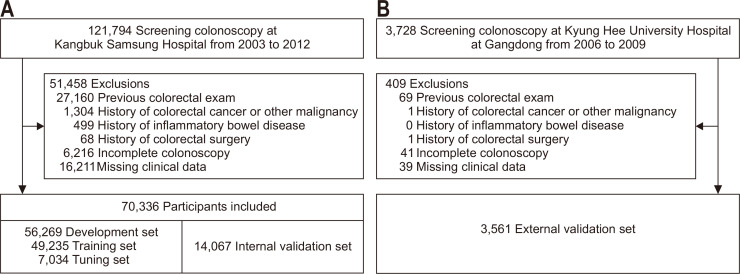
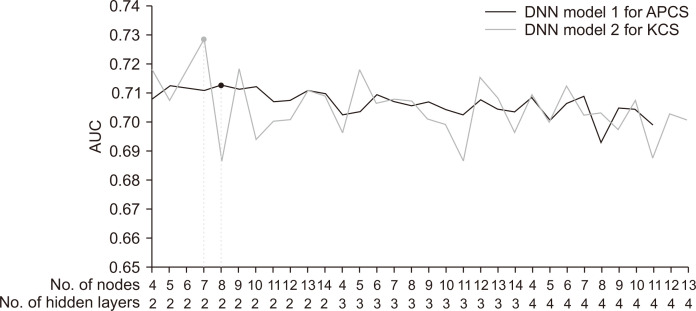
Databases of screening colonoscopy from Kangbuk Samsung Hospital (n=121,794) and Kyung Hee University Hospital at Gangdong (n=3,728) were used to develop DNN-based prediction models. Two DNN models, the Asian-Pacific Colorectal Screening (APCS) model and the Korean Colorectal Screening (KCS) model, were developed and compared with two simple score models using logistic regression methods to predict the risk of ACRN. The areas under the receiver operating characteristic curves (AUCs) of the models were compared in internal and external validation databases.
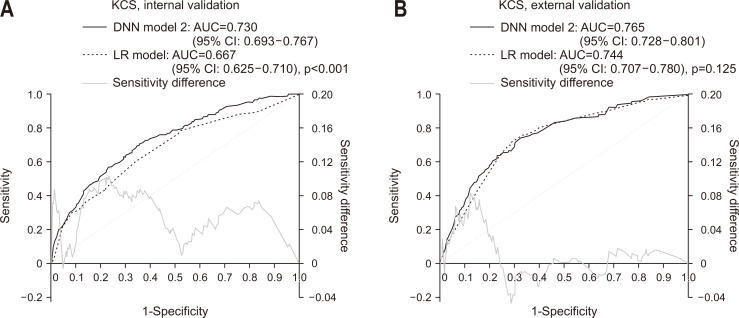
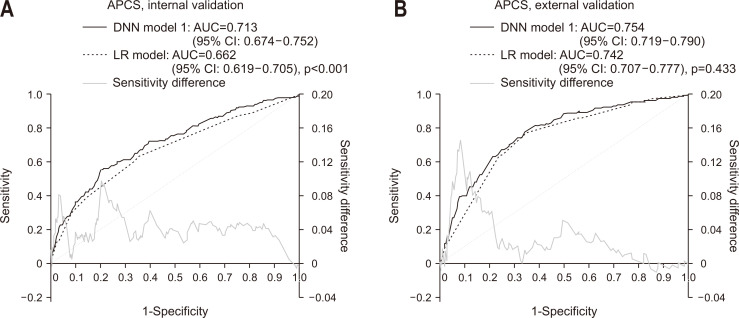
In the internal validation set, the AUCs of DNN model 1 and the APCS score model were 0.713 and 0.662 (p<0.001), respectively, and the AUCs of DNN model 2 and the KCS score model were 0.730 and 0.667 (p<0.001), respectively. However, in the external validation set, the prediction performances were not significantly different between the two DNN models and the corresponding APCS and KCS score models (both p>0.1).
Simple score models for the risk prediction of ACRN are as useful as DNN-based models when input variables are limited. However, further studies on this issue are warranted to predict the risk of ACRN in colorectal cancer screening because DNN-based models are currently under improvement.
背景/目的:使用深度神经网络(DNN)的风险预测模型尚未用于预测高级结直肠肿瘤(ACRN)的风险。本研究旨在比较 DNN 模型与简单的临床评分模型,以预测结直肠癌筛查中 ACRN 的风险。
使用来自 Kangbuk Samsung 医院(n=121794)和 Kyung Hee 大学 Gangdong 医院(n=3728)的筛查结肠镜检查数据库来开发基于 DNN 的预测模型。开发了两个 DNN 模型,即亚太结直肠筛查(APCS)模型和韩国结直肠筛查(KCS)模型,并使用逻辑回归方法将其与两个简单的评分模型进行比较,以预测 ACRN 的风险。在内部和外部验证数据库中比较了模型的接收者操作特征曲线(AUC)下的面积。
在内部验证集中,DNN 模型 1 和 APCS 评分模型的 AUC 分别为 0.713 和 0.662(p<0.001),DNN 模型 2 和 KCS 评分模型的 AUC 分别为 0.730 和 0.667(p<0.001)。然而,在外部验证集中,两个 DNN 模型与相应的 APCS 和 KCS 评分模型之间的预测性能没有显著差异(均 p>0.1)。
当输入变量有限时,用于预测 ACRN 风险的简单评分模型与基于 DNN 的模型一样有用。然而,由于目前正在改进基于 DNN 的模型,因此需要进一步研究该问题,以预测结直肠癌筛查中 ACRN 的风险。