Academic Center of Osaki Citizen Hospital, Osaki 989-6183, Japan.
Respiratory Medicine, National Hospital Organization Wakayama Hospital, Wakayama 644-0044, Japan.
Int J Chron Obstruct Pulmon Dis. 2020 Dec 22;15:3385-3396. doi: 10.2147/COPD.S277782. eCollection 2020.
Patients with chronic obstructive pulmonary disease (COPD) have decreased physical activity (PA) compared with healthy adults. As lower PA is associated with increased mortality, improving PA is an important objective for COPD management. This large-scale, multicenter, non-interventional, cross-sectional study examined the activity status of COPD patients in Japan and explored factors related to PA.
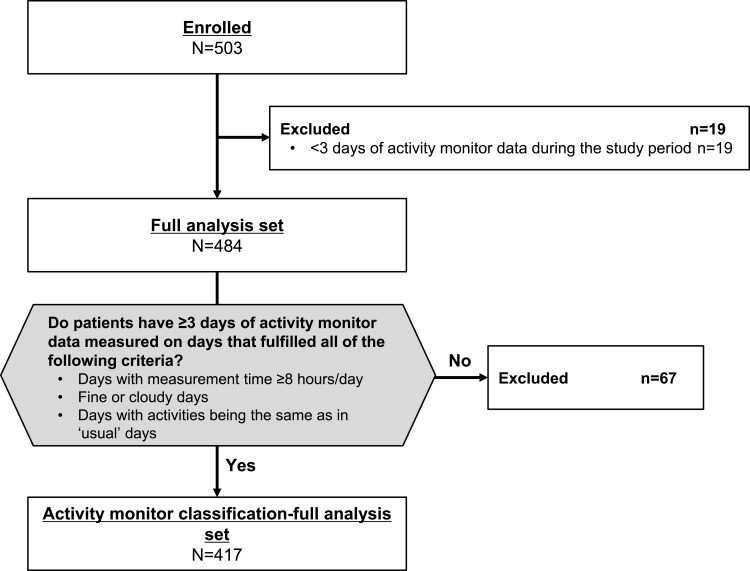
Outpatients aged ≥40 years with confirmed COPD diagnosis and pulmonary function test data were enrolled. Primary study outcomes were measurement of daily steps (over 14 consecutive days, using an activity monitor), assessment of activity time by activity intensity (using metabolic equivalents [METs]), and evaluation of correlation between PA and patient characteristics. Secondary outcomes included further investigation of the influence of patient characteristics on PA.
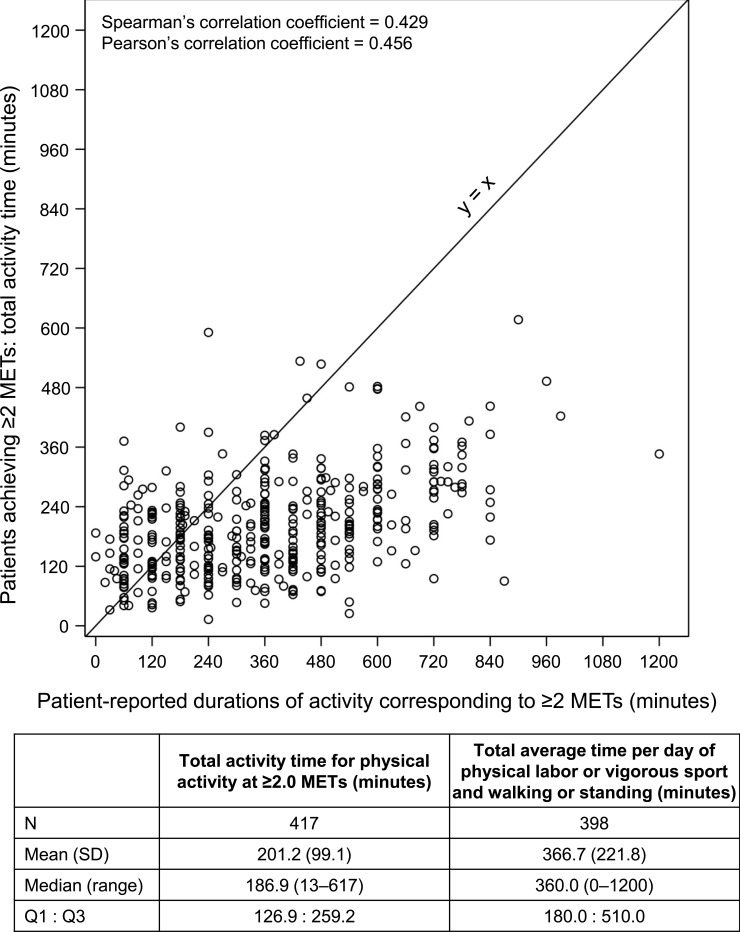
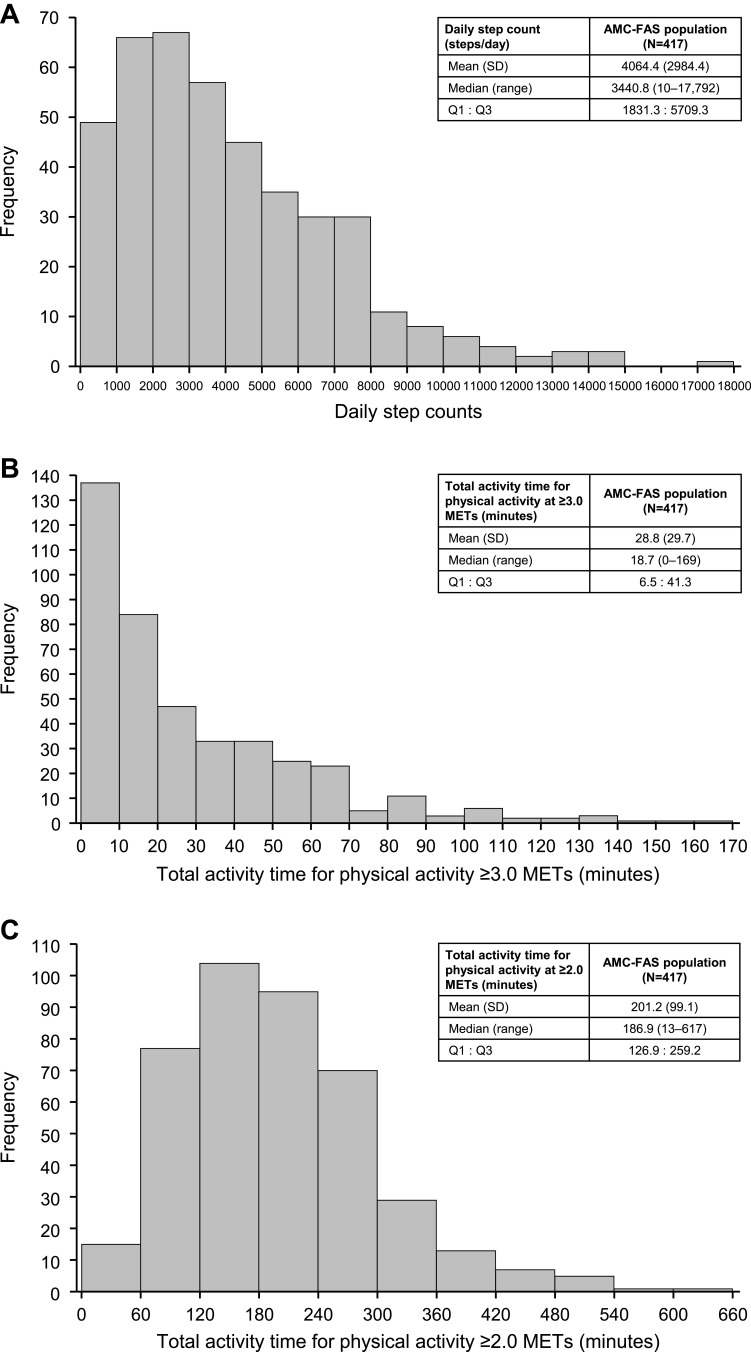
Data from 417 patients with Global Initiative for Chronic Obstructive Lung Disease (GOLD) stages I (29.5%), II (43.9%), III (23.5%), and IV (3.1%) were evaluated. Median (Q1, Q3) daily step count was 3440.8 (1831.3, 5709.3). Median (Q1, Q3) durations of PA at ≥3 (moderate-to-vigorous) and ≥2 METs (light-to-vigorous) were 18.7 (6.5, 41.3) and 186.9 (126.9, 259.2) minutes, respectively. For >30% of patients, time spent in ≥3 METs activity was ≤10 minutes. Unemployment was significantly correlated with reduced activity time (≥3 and ≥2 METs) and step count. Severe GOLD stage was significantly correlated with reduced activity time (≥3 and ≥2 METs). High modified Medical Research Council (mMRC) dyspnea score was significantly correlated with reduced activity time (≥3 METs) and step count. Patients tended to overestimate the time spent in activities requiring ≥2 METs in their subjective reports compared with activity monitor measurements.
Reduced PA was observed in the Japanese COPD patients with the majority of them being GOLD stage I/II. Employment status, GOLD stage, and mMRC dyspnea score could help identify patients at risk of reduced PA.
NCT03642613 (ClinicalTrials.gov); UMIN000032962 (UMIN-CTR, umin.ac.jp).
与健康成年人相比,慢性阻塞性肺疾病(COPD)患者的体力活动(PA)减少。由于较低的 PA 与死亡率增加有关,因此提高 PA 是 COPD 管理的重要目标。这项大规模、多中心、非干预性、横断面研究检查了日本 COPD 患者的活动状态,并探讨了与 PA 相关的因素。
招募年龄≥40 岁、确诊 COPD 且有肺功能检查数据的门诊患者。主要研究结局为连续 14 天使用活动监测器测量每日步数(超过 14 天)、使用代谢当量(METs)评估活动强度的活动时间、以及评估 PA 与患者特征之间的相关性。次要结局包括进一步调查患者特征对 PA 的影响。
评估了来自全球慢性阻塞性肺病倡议(GOLD)I 期(29.5%)、II 期(43.9%)、III 期(23.5%)和 IV 期(3.1%)的 417 例患者的数据。中位(Q1,Q3)每日步数为 3440.8(1831.3,5709.3)。≥3(中到剧烈)和≥2 METs(轻到剧烈)的 PA 持续时间中位数(Q1,Q3)分别为 18.7(6.5,41.3)和 186.9(126.9,259.2)分钟。对于>30%的患者,花费在≥3 METs 活动上的时间≤10 分钟。失业与活动时间(≥3 和≥2 METs)和步数减少显著相关。严重的 GOLD 分期与活动时间(≥3 和≥2 METs)减少显著相关。高改良医学研究委员会(mMRC)呼吸困难评分与活动时间(≥3 METs)和步数减少显著相关。与活动监测器测量相比,患者在主观报告中倾向于高估需要≥2 METs 的活动所花费的时间。
日本 COPD 患者的 PA 减少,大多数患者为 GOLD Ⅰ/Ⅱ期。就业状况、GOLD 分期和 mMRC 呼吸困难评分有助于识别 PA 降低的风险患者。
NCT03642613(ClinicalTrials.gov);UMIN000032962(UMIN-CTR,umin.ac.jp)。