Overeem Nico J, Hamming P H Erik, Grant Oliver C, Di Iorio Daniele, Tieke Malte, Bertolino M Candelaria, Li Zeshi, Vos Gaël, de Vries Robert P, Woods Robert J, Tito Nicholas B, Boons Geert-Jan P H, van der Vries Erhard, Huskens Jurriaan
Molecular Nanofabrication Group, MESA+ Institute for Nanotechnology, Faculty of Science and Technology, University of Twente, P.O. Box 217, 7500 AE Enschede, The Netherlands.
Complex Carbohydrate Research Center, University of Georgia, 315 Riverbend Road, Athens, Georgia 30602, United States.
ACS Cent Sci. 2020 Dec 23;6(12):2311-2318. doi: 10.1021/acscentsci.0c01175. Epub 2020 Nov 12.
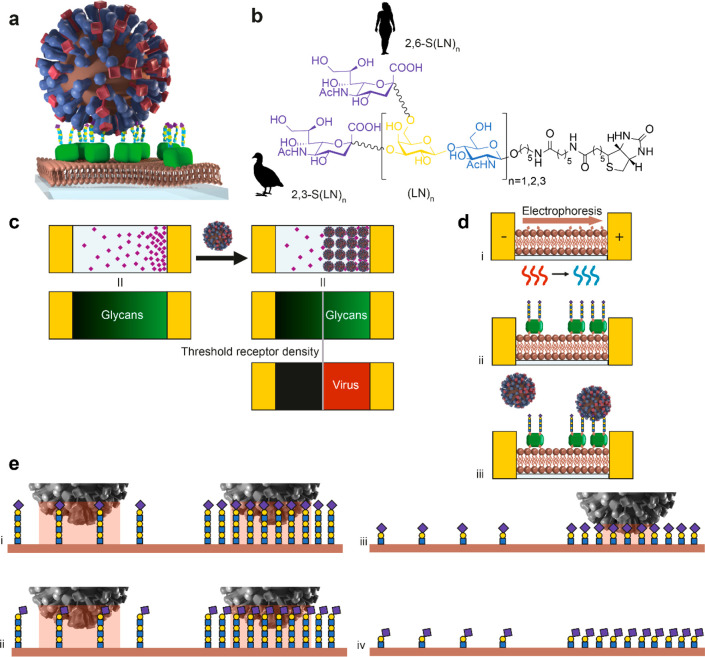
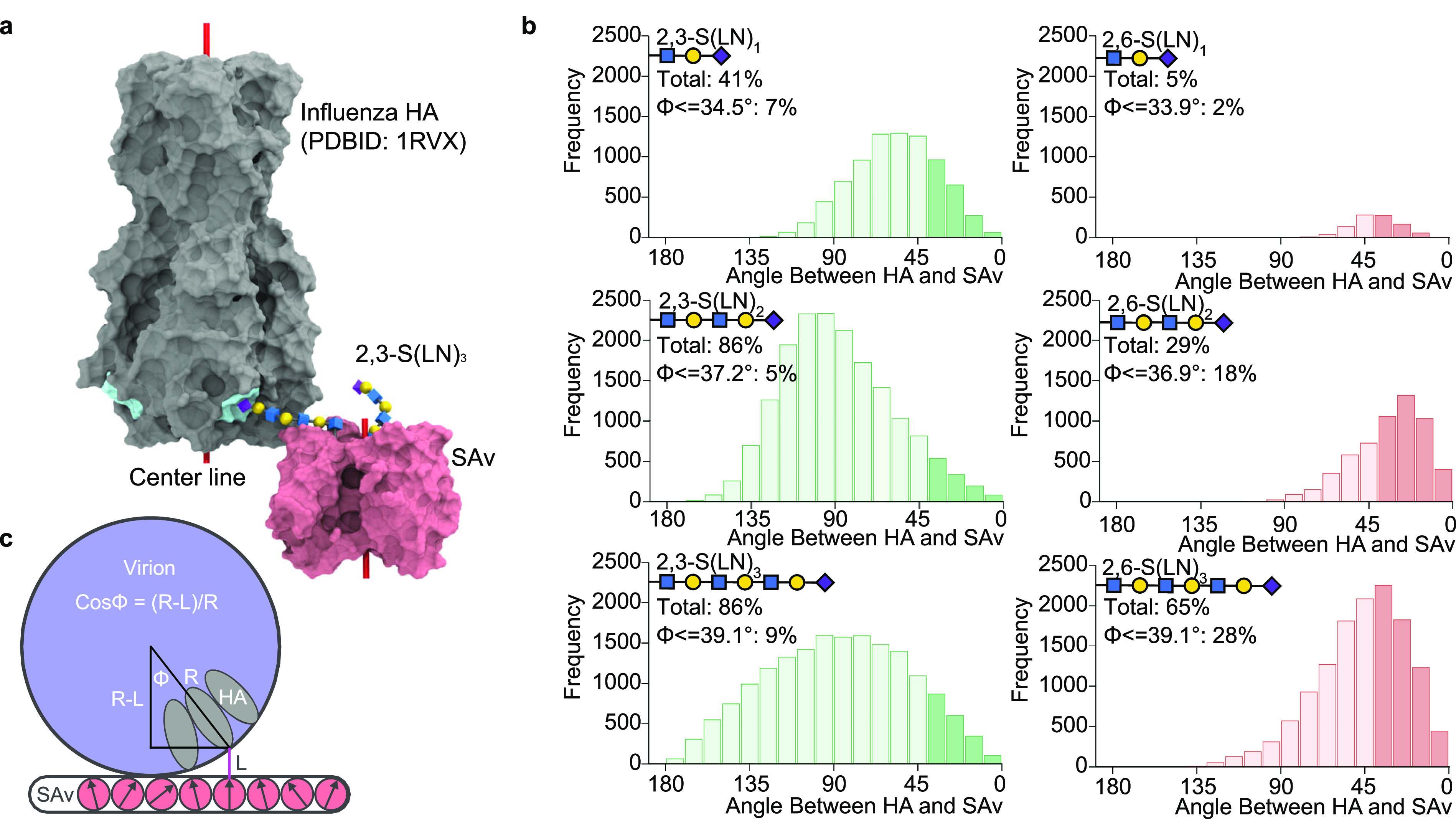
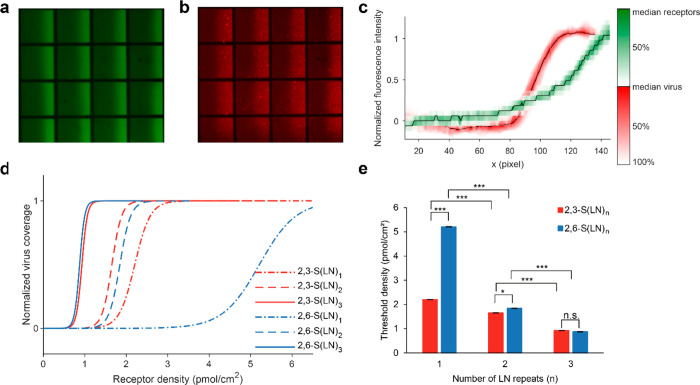
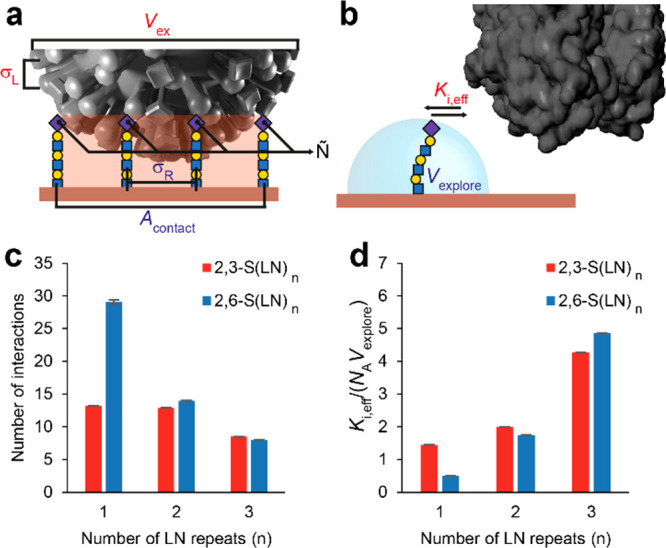
Understanding how emerging influenza viruses recognize host cells is critical in evaluating their zoonotic potential, pathogenicity, and transmissibility between humans. The surface of the influenza virus is covered with hemagglutinin (HA) proteins that can form multiple interactions with sialic acid-terminated glycans on the host cell surface. This multivalent binding affects the selectivity of the virus in ways that cannot be predicted from the individual receptor-ligand interactions alone. Here, we show that the intrinsic structural and energetic differences between the interactions of avian- or human-type receptors with influenza HA translate from individual site affinity and orientation through receptor length and density on the surface into virus avidity and specificity. We introduce a method to measure virus avidity using receptor density gradients. We found that influenza viruses attached stably to a surface at receptor densities that correspond to a minimum number of approximately 8 HA-glycan interactions, but more interactions were required if the receptors were short and human-type. Thus, the avidity and specificity of influenza viruses for a host cell depend not on the sialic acid linkage alone but on a combination of linkage and the length and density of receptors on the cell surface. Our findings suggest that threshold receptor densities play a key role in virus tropism, which is a predicting factor for both their virulence and zoonotic potential.
了解新兴流感病毒如何识别宿主细胞对于评估其人畜共患病潜力、致病性以及在人类之间的传播能力至关重要。流感病毒表面覆盖着血凝素(HA)蛋白,这些蛋白可与宿主细胞表面的唾液酸末端聚糖形成多种相互作用。这种多价结合对病毒选择性的影响方式无法仅从单个受体 - 配体相互作用中预测出来。在这里,我们表明,禽流感或人流感病毒受体与流感HA相互作用之间的内在结构和能量差异,从单个位点的亲和力和方向,通过表面受体的长度和密度,转化为病毒的亲合力和特异性。我们介绍了一种使用受体密度梯度来测量病毒亲合力的方法。我们发现,流感病毒在受体密度对应于约8个HA - 聚糖相互作用的最小数量时稳定附着于表面,但如果受体短且为人源型,则需要更多的相互作用。因此,流感病毒对宿主细胞的亲合力和特异性不仅取决于唾液酸连接,还取决于连接方式以及细胞表面受体的长度和密度。我们的研究结果表明,阈值受体密度在病毒嗜性中起关键作用,而病毒嗜性是其毒力和人畜共患病潜力的预测因素。