Selvatici Rita, Rossi Rachele, Fortunato Fernanda, Trabanelli Cecilia, Sifi Yamina, Margutti Alice, Neri Marcella, Gualandi Francesca, Szabò Lena, Fekete Balint, Angelova Lyudmilla, Litvinenko Ivan, Ivanov Ivan, Vildan Yurtsever, Iuhas Oana Alexandra, Vintan Mihaela, Burloiu Carmen, Lacramioara Butnariu, Visa Gabriela, Epure Diana, Rusu Cristina, Vasile Daniela, Sandu Magdalena, Vlodavets Dmitry, Mager Monica, Kyriakides Theodore, Delin Sanja, Lehman Ivan, Fureš Jadranka Sekelj, Bojinova Veneta, Militaru Mariela, Guergueltcheva Velina, Burnyte Birute, Molnar Maria Judith, Butoianu Niculina, Bensemmane Selma Dounia, Makri-Mokrane Samira, Herczegfalvi Agnes, Panzaru Monica, Emandi Adela Chirita, Lusakowska Anna, Potulska-Chromik Anna, Kostera-Pruszczyk Anna, Shatillo Andriy, Khelladi Djawed Bouchenak, Dendane Oussama, Fang Mingyan, Lu Zhiyuan, Ferlini Alessandra
Medical Genetics Unit (R.S., R.R., F.F., C.T., A.M., M.N., F.G., A.F.), Department of Medical Sciences, University of Ferrara, Italy; Neurologie (Y.S.), CHU de Benbadis, Constantine, Algérie; 2nd Department of Paediatrics Clinic (L.S., A.H.), Semmelweis University; Institute of Genomic Medicine and Rare Disorders (B.F., M.J.M.), Semmelweis University, Budapest, Hungary; Department of Medical Genetics (L.A.), Medical University, Varna, Bulgaria; Department of Pediatrics (I. Litvinenko), Medical University Sofia; Department of Child Neurology (I. Litvinenko), University Pediatric Hospital "Prof. Ivan Mitev", Sofia; Department Pediatrics (I.I.), St. George University Hospital, Medical University Plovdiv, Bulgaria; Pediatric Neurology Department (Y.V.), Pediatric Neurologist County Clinical Emergency Hospital of Constanta; G. Curteanu Municipal Clinical Hospital Oradea (O.A.I.); Department of Neuroscience (M.V., M. Militaru), Iuliu Hatieganu University of Medicine and Pharmacy, Cluj Napoca; Pediatric Neurology Department (C.B., N.B.), "Alexandru Obregia" Clinical Psychiatry Hospital, Bucharest; "Grigore T Popa" University of Medicine and Pharmacy (B.L., C.R., M.P.); "Sfanta Maria" Children's Hospital (B.L., C.R., M.P.); Pediatric Clinical Hospital Sibiu (G.V.); "Dr. Victor Gomoiu" Children's Hospital (D.E., D. Vasile, M.S.); "Carol Davila" University of Medicine and Pharmacy (M.S., N.B.), Bucharest, Romania; Russian Children Neuromuscular Center (D. Vlodavets), Veltischev Clinical Pediatric Research Institute of Pirogov Russian National Research Medical University, Moscow, Russia; Department of Neuroscience Neurology and Pediatric Neurology "Iuliu Hatieganu" University of Medicine and Pharmacy (M. Mager), Faculty of Medicine; Pediatric Neurology Department (M. Mager), Emergency Clinical Hospital for Children, Cluj-Napoca, Romania; Department of Basic and Clinical Sciences (T.K.), University of Nicosia, Cyprus; Department of Pediatrics (S.D.), General Hospital Zadar, Zadar, Croatia; Department of Paediatrics (I. Lehman, J.S.F.); University Hospital Centre Zagreb, ; Faculty of Medicine University of Osijek (J.S.F.), Croatia; University Hospital of Neurology and Psychiatry Sveti Naum (V.B.); Clinic of Neurology (V.G.), University Hospital Sofiamed; Sofia University "St. Kliment Ohridski" (V.G.)Bulgaria; Institute of Biomedical Sciences (B.B.), Faculty of Medicine, Vilnius University, Lithuania; Ali Ait Idir Hospital (S.D.B., S.M.-M.), Algiers, Algeria; University of Algiers I. Algeria (S.D.B., S.M.-M.); Center of Genomic Medicine (A.C.E.), University of Medicine and Pharmacy Victor Babes Timisoara; Regional Center of Medical Genetics Timis (A.C.E.), Clinical Emergency Hospital for Children Louis Turcanu Timisoara, Romania; Department of Neurology (A.L., A.P., A.K.-P.), Medical University of Warsaw, Poland; Institute of Neurology (A.S.), Psychiatry and Narkology National Academy of Medical Science of Ukraine; Neurologie (D.B.K., O.D.), CHU Tidjani Damerdji, Tlemcen, Algerie; and BGI-Shenzhen (M.F., Z.L.), Shenzhen, China.
Neurol Genet. 2020 Dec 24;7(1):e536. doi: 10.1212/NXG.0000000000000536. eCollection 2021 Feb.
Genetic diagnosis and mutation identification are now compulsory for Duchenne (DMD) and Becker muscular dystrophies (BMD), which are due to dystrophin () gene mutations, either for disease prevention or personalized therapies. To evaluate the ethnic-related genetic assortments of mutations, which may impact on DMD genetic diagnosis pipelines, we studied 328 patients with DMD and BMD from non-European countries.
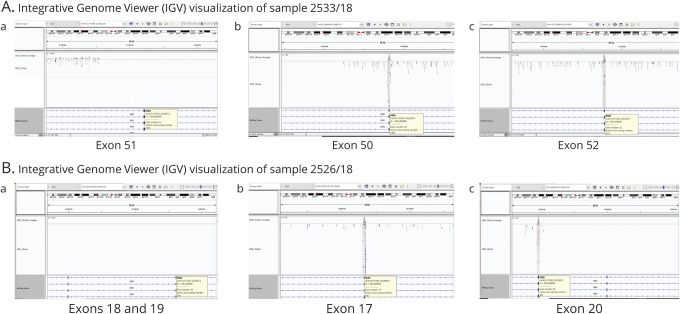
We performed a full DMD mutation detection in 328 patients from 10 Eastern European countries (Poland, Hungary, Lithuania, Romania, Serbia, Croatia, Bosnia, Bulgaria, Ukraine, and Russia) and 2 non-European countries (Cyprus and Algeria). We used both conventional methods (multiplex ligation-dependent probe amplification [MLPA] followed by gene-specific sequencing) and whole-exome sequencing (WES) as a pivotal study ran in 28 patients where mutations were already identified by standard techniques. WES output was also interrogated for gene modifiers.
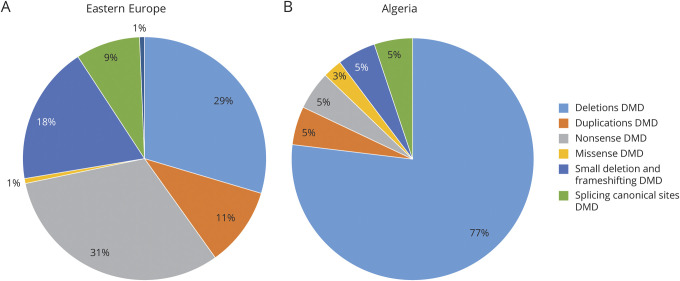
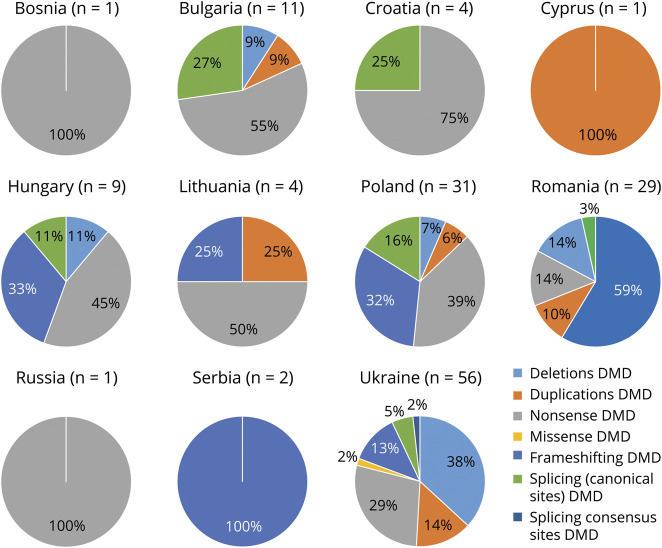
We identified gene mutations in 222 male patients. We identified a remarkable allele heterogeneity among different populations with a mutation landscape often country specific. We also showed that WES is effective for picking up all deletions and small mutations and its adoption could allow a detection rate close to 90% of all occurring mutations. Gene modifiers haplotypes were identified with some ethnic-specific configurations.
Our data provide unreported mutation landscapes in different countries, suggesting that ethnicity may orient genetic diagnosis flowchart, which can be adjusted depending on the mutation type frequency, with impact in drug eligibility.
杜氏肌营养不良症(DMD)和贝克型肌营养不良症(BMD)是由抗肌萎缩蛋白()基因突变引起的,目前对于这两种疾病进行基因诊断和突变鉴定是疾病预防或个性化治疗所必需的。为了评估可能影响DMD基因诊断流程的与种族相关的突变基因组合,我们研究了328名来自非欧洲国家的DMD和BMD患者。
我们对来自10个东欧国家(波兰、匈牙利、立陶宛、罗马尼亚、塞尔维亚、克罗地亚、波斯尼亚、保加利亚、乌克兰和俄罗斯)以及2个非欧洲国家(塞浦路斯和阿尔及利亚)的328名患者进行了全面的DMD突变检测。我们使用了传统方法(多重连接依赖性探针扩增[MLPA],随后进行基因特异性测序)和全外显子组测序(WES),其中在28名患者中进行了关键研究,这些患者的突变已通过标准技术鉴定。还对WES输出结果进行了抗肌萎缩蛋白基因修饰因子的检测。
我们在222名男性患者中鉴定出抗肌萎缩蛋白基因突变。我们发现不同人群之间存在显著的等位基因异质性,突变情况往往因国家而异。我们还表明,WES对于检测所有抗肌萎缩蛋白缺失和小突变是有效的,采用WES可以使检测率接近所有发生突变的90%。鉴定出了一些具有种族特异性配置的基因修饰因子单倍型。
我们的数据提供了不同国家未报告的突变情况,表明种族可能为基因诊断流程提供导向,该流程可根据突变类型频率进行调整,这对药物适用性有影响。