Developmental Paediatrics Unit, Christian Medical College, Vellore, India.
Wellcome research Unit, Christian Medical College, Vellore, India.
Child Care Health Dev. 2021 May;47(3):336-348. doi: 10.1111/cch.12846. Epub 2021 Jan 20.
Early childhood home environment is intricately linked to child development and later cognitive and academic skills. There is limited literature evaluating home environmental trends and predictors in the low- and middle-income country settings.
Determine the trends of early childhood home environment changes between 6 and 36 months of age, and the factors associated with these changes.
Longitudinal community-based birth cohort follow-up study in a semi-urban slum in Vellore, South India.
Consecutive sampling of a birth cohort between March 2010 and February 2012.
Home environment was objectively assessed using the 'Home Observation for the Measurement of the Environment' (HOME) scale. Predictors of change in the home environment over time also were analyzed. Multivariable linear regression models and linear mixed effect models were used to identify the factors associated with HOME score at individual time points and over-a-time period, respectively.
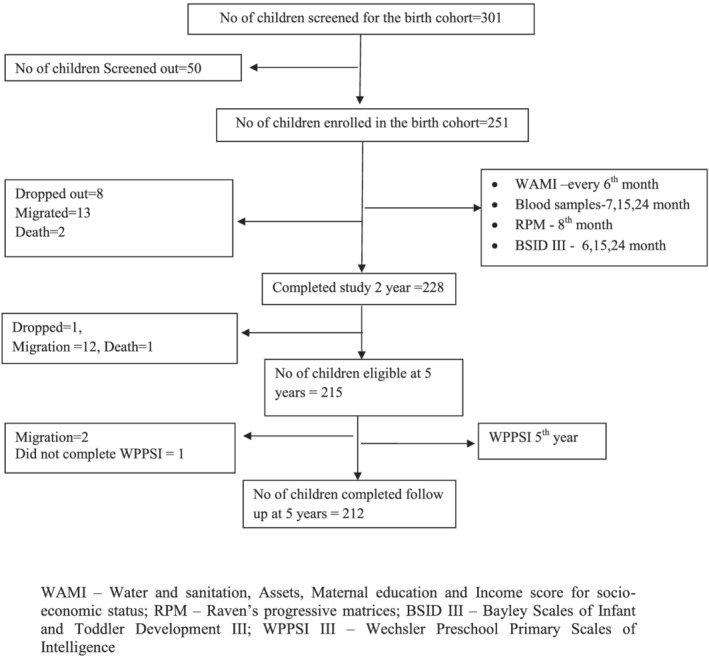
The birth cohort enrolled 251 children with a follow-up of 235, 228 and 218 children at 6, 24 and 36 months, respectively. The socio-economic status (SES) was the single biggest predictor for the HOME score at each time point, with increasing strength over time. Maternal education predicted home environment at 24 months, while maternal depression was negatively associated at 6 and 24 months of age. SES and maternal factors contributed to the overall change in the HOME score. Maternal factors predicted relational home environmental change over time.
SES and maternal factors consistently predicted early childhood home environment at 6, 24 and 36 months of age and its change over time. It is important to support maternal education and wellbeing along with socio-economic measures to optimize early childhood environment.
儿童早期的家庭环境与儿童发育以及日后的认知和学术技能密切相关。在中低收入国家,有关家庭环境趋势和预测因素的文献有限。
确定 6 至 36 个月龄儿童家庭环境变化的趋势,以及与这些变化相关的因素。
在印度南部维洛尔的一个半城市贫民窟进行的基于社区的纵向出生队列随访研究。
2010 年 3 月至 2012 年 2 月连续抽样的出生队列。
使用“家庭观察评估环境”(HOME)量表客观评估家庭环境。还分析了家庭环境随时间变化的预测因素。多变量线性回归模型和线性混合效应模型分别用于确定个体时间点和一段时间内与 HOME 评分相关的因素。
该出生队列共纳入 251 名儿童,其中 235 名、228 名和 218 名儿童分别在 6、24 和 36 个月时进行了随访。社会经济地位(SES)是每个时间点 HOME 评分的唯一最大预测因素,且随着时间的推移而逐渐增强。母亲的教育程度预测了 24 个月时的家庭环境,而母亲的抑郁程度在 6 个月和 24 个月时与之呈负相关。SES 和母亲因素共同导致了 HOME 评分的总体变化。母亲因素预测了家庭环境的关系变化。
SES 和母亲因素始终预测了儿童在 6、24 和 36 个月时的早期家庭环境及其随时间的变化。支持母亲的教育和幸福感以及社会经济措施对于优化儿童早期环境非常重要。