Zhang Cheng, Chen Zuhua, Chong Xiaoyi, Chen Yang, Wang Zhenghang, Yu Ruoying, Sun Tingting, Chen Xiaoxi, Shao Yang, Zhang Xiaotian, Gao Jing, Shen Lin
Department of Gastrointestinal Oncology, Key laboratory of Carcinogenesis and Translational Research (Ministry of Education/Beijing), Peking University Cancer Hospital & Institute, Beijing, China.
Department of Oncology, Tongji Hospital, Tongji Medical College, Huazhong University of Science and Technology, Wuhan, China.
Clin Transl Med. 2020 Dec;10(8):e254. doi: 10.1002/ctm2.254.
Gastric cancer (GC) is confronted with limited options for precision medicine. Human epidermal growth factor receptor 2 (HER2) is the principal druggable target of GC, yet proper biomarkers for response/resistance prediction remain unveiled.
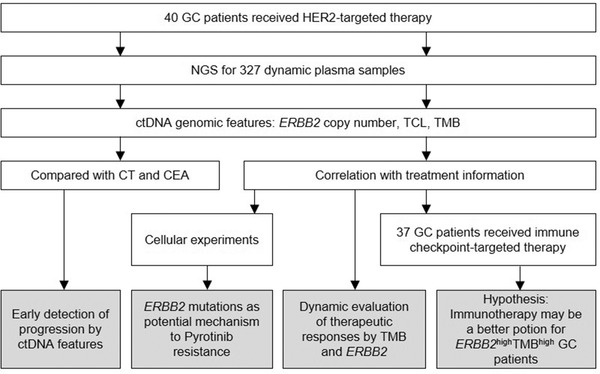
From 40 GC patients received HER2-targeted therapy, a total of 327 peripheral blood plasma specimens was collected including baseline and treatment time points. Circulating tumor DNA (ctDNA) was extracted and sequenced with a target panel of 425 genes. Experimental validation of resistant mutations was carried out in NIH-3T3 cell line.
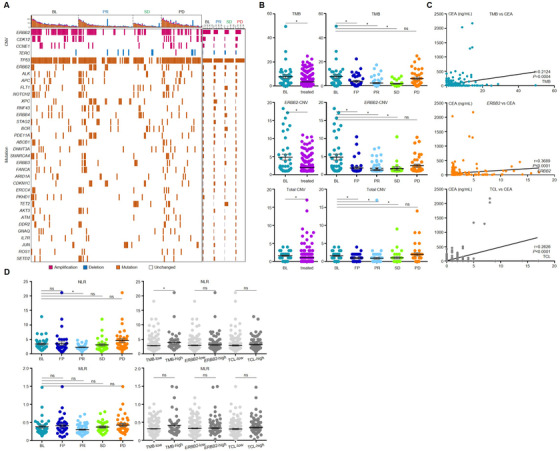
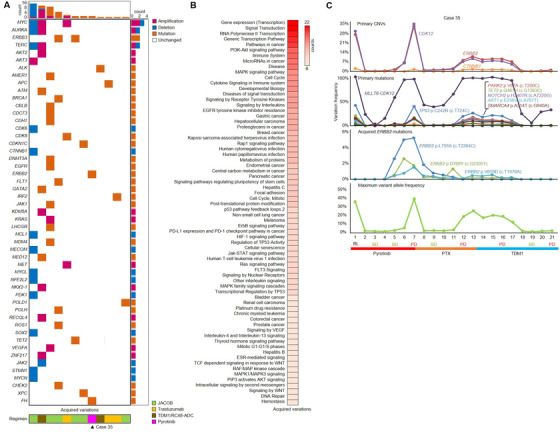
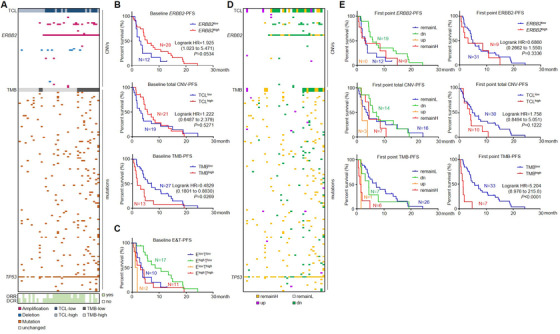
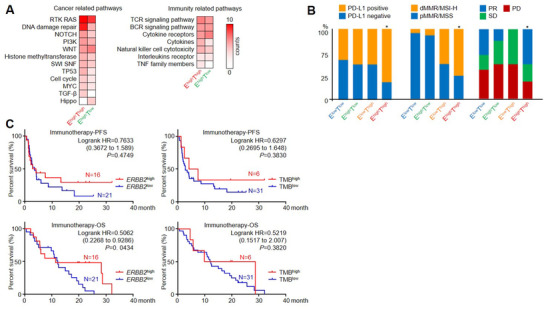
Genomic features, including ERBB2 copy number variation (CNV), total copy number load, and tumor mutation burdens (TMBs), dynamically changed along with the treatment process and correlated with disease progression. Plasma ctDNA-based diagnosis was more sensitive than conventional computed tomography scanning in 40% of investigated patients, gaining additional time for clinical management. Compared to baseline, new gene alterations were emerged in 12 patients who developed drug resistance during treatment. ERBB2 mutations potentially related to Pyrotinib resistance were identified in plasma ctDNA of one patient and functional analysis of their downstream signaling pathways was carried out in NIH-3T3 cell line. TMB exhibited more power than ERBB2 CNV in predicting treatment responses and prognosis for HER2-targeted therapy in GC patients. Interestingly, survival analysis indicated that patients harboring both HER2 (ERBB2) positivity and high TMB might gain more therapeutic benefits from immune checkpoint inhibitors instead of HER2-targeted regimens that required further studies and validations CONCLUSIONS: Our work showed that the dynamic surveillance of plasma ctDNA genomic features provided instructive information for the precision medication of GC patients.
胃癌(GC)在精准医学方面面临的选择有限。人表皮生长因子受体2(HER2)是GC主要的可靶向治疗靶点,但用于预测反应/耐药性的合适生物标志物仍未明确。
从40例接受HER2靶向治疗的GC患者中,共收集了327份外周血血浆样本,包括基线和治疗时间点的样本。提取循环肿瘤DNA(ctDNA),并使用包含425个基因的靶向panel进行测序。在NIH-3T3细胞系中对耐药突变进行实验验证。
基因组特征,包括ERBB2拷贝数变异(CNV)、总拷贝数负荷和肿瘤突变负担(TMB),随治疗过程动态变化,并与疾病进展相关。在40%的研究患者中,基于血浆ctDNA的诊断比传统计算机断层扫描更敏感,为临床管理争取了额外时间。与基线相比,12例在治疗期间出现耐药的患者出现了新的基因改变。在1例患者的血浆ctDNA中鉴定出可能与吡咯替尼耐药相关的ERBB2突变,并在NIH-3T3细胞系中对其下游信号通路进行了功能分析。在预测GC患者HER2靶向治疗的反应和预后方面,TMB比ERBB2 CNV表现出更强的预测能力。有趣的是,生存分析表明,同时具有HER2(ERBB2)阳性和高TMB的患者可能从免疫检查点抑制剂中获得更多治疗益处,而不是从HER2靶向治疗方案中获得更多益处,这需要进一步研究和验证。结论:我们的研究表明,对血浆ctDNA基因组特征的动态监测为GC患者的精准用药提供了指导性信息。