Lue Kun-Han, Wu Yi-Feng, Lin Hsin-Hon, Hsieh Tsung-Cheng, Liu Shu-Hsin, Chan Sheng-Chieh, Chen Yu-Hung
Department of Medical Imaging and Radiological Sciences, Tzu Chi University of Science and Technology, Hualien 97005, Taiwan.
Department of Hematology and Oncology, Hualien Tzu Chi Hospital, Buddhist Tzu Chi Medical Foundation, Hualien 97004, Taiwan.
Diagnostics (Basel). 2020 Dec 28;11(1):36. doi: 10.3390/diagnostics11010036.
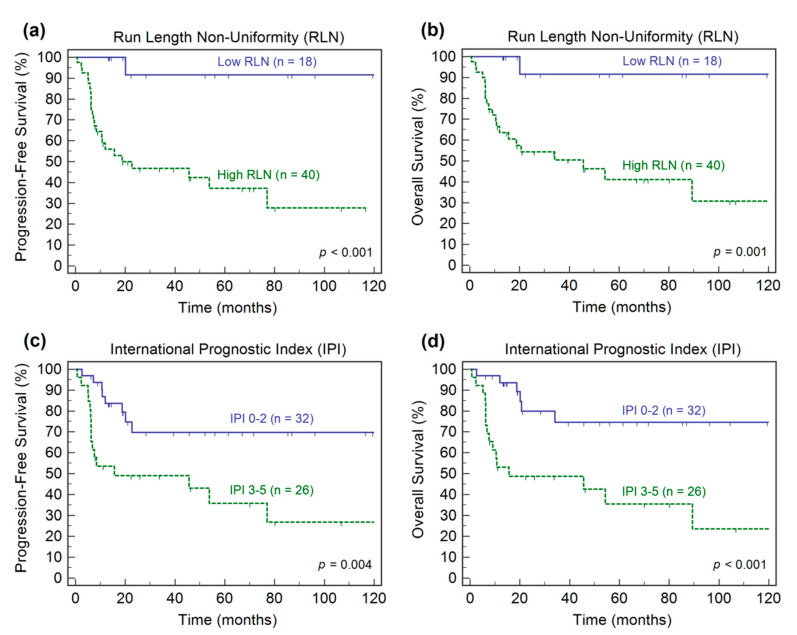
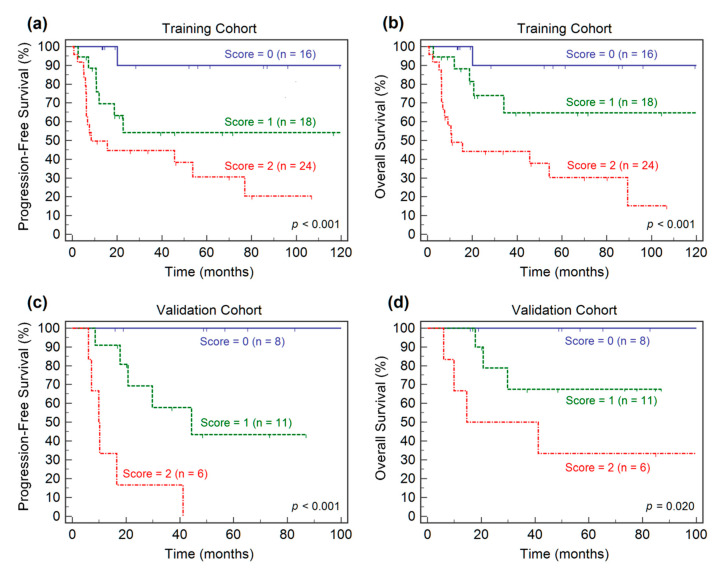
This study investigates whether baseline F-FDG PET radiomic features can predict survival outcomes in patients with diffuse large B-cell lymphoma (DLBCL). We retrospectively enrolled 83 patients diagnosed with DLBCL who underwent F-FDG PET scans before treatment. The patients were divided into the training cohort ( = 58) and the validation cohort ( = 25). Eighty radiomic features were extracted from the PET images for each patient. Least absolute shrinkage and selection operator regression were used to reduce the dimensionality within radiomic features. Cox proportional hazards model was used to determine the prognostic factors for progression-free survival (PFS) and overall survival (OS). A prognostic stratification model was built in the training cohort and validated in the validation cohort using Kaplan-Meier survival analysis. In the training cohort, run length non-uniformity (RLN), extracted from a gray level run length matrix (GLRLM), was independently associated with PFS (hazard ratio (HR) = 15.7, = 0.007) and OS (HR = 8.64, = 0.040). The International Prognostic Index was an independent prognostic factor for OS (HR = 2.63, = 0.049). A prognostic stratification model was devised based on both risk factors, which allowed identification of three risk groups for PFS and OS in the training ( < 0.001 and < 0.001) and validation ( < 0.001 and = 0.020) cohorts. Our results indicate that the baseline F-FDG PET radiomic feature, RLN, is an independent prognostic factor for survival outcomes. Furthermore, we propose a prognostic stratification model that may enable tailored therapeutic strategies for patients with DLBCL.
本研究调查了基线F-FDG PET影像组学特征是否能够预测弥漫性大B细胞淋巴瘤(DLBCL)患者的生存结局。我们回顾性纳入了83例经诊断为DLBCL且在治疗前接受了F-FDG PET扫描的患者。将患者分为训练队列(n = 58)和验证队列(n = 25)。从每位患者的PET图像中提取了80个影像组学特征。使用最小绝对收缩和选择算子回归来降低影像组学特征的维度。采用Cox比例风险模型确定无进展生存期(PFS)和总生存期(OS)的预后因素。在训练队列中构建了一个预后分层模型,并使用Kaplan-Meier生存分析在验证队列中进行验证。在训练队列中,从灰度游程长度矩阵(GLRLM)中提取的游程长度非均匀性(RLN)与PFS(风险比(HR)= 15.7,P = 0.007)和OS(HR = 8.64,P = 0.040)独立相关。国际预后指数是OS的独立预后因素(HR = 2.63,P = 0.049)。基于这两个危险因素设计了一个预后分层模型,该模型能够在训练队列(P < 0.001和P < 0.001)和验证队列(P < 0.001和P = 0.020)中识别出PFS和OS的三个风险组。我们的结果表明,基线F-FDG PET影像组学特征RLN是生存结局的独立预后因素。此外,我们提出了一个预后分层模型,该模型可能能够为DLBCL患者制定个性化的治疗策略。