• 文献检索
  • 文档翻译
  • 深度研究
  • 学术资讯
  • Suppr Zotero 插件Zotero 插件
  • 邀请有礼
  • 套餐&价格
  • 历史记录
应用&插件
Suppr Zotero 插件Zotero 插件浏览器插件Mac 客户端Windows 客户端微信小程序
定价
高级版会员购买积分包购买API积分包
服务
文献检索文档翻译深度研究API 文档MCP 服务
关于我们
关于 Suppr公司介绍联系我们用户协议隐私条款
关注我们

Suppr 超能文献

核心技术专利:CN118964589B侵权必究
粤ICP备2023148730 号-1Suppr @ 2026

文献检索

告别复杂PubMed语法,用中文像聊天一样搜索,搜遍4000万医学文献。AI智能推荐,让科研检索更轻松。

立即免费搜索

文件翻译

保留排版,准确专业,支持PDF/Word/PPT等文件格式,支持 12+语言互译。

免费翻译文档

深度研究

AI帮你快速写综述,25分钟生成高质量综述,智能提取关键信息,辅助科研写作。

立即免费体验

一种机器学习方法,用于识别老年骨关节炎患者中潜在不合理使用非甾体抗炎药(NSAIDs)的预测因子。

A Machine Learning Approach to Identify Predictors of Potentially Inappropriate Non-Steroidal Anti-Inflammatory Drugs (NSAIDs) Use in Older Adults with Osteoarthritis.

机构信息

Department of Pharmaceutical Systems and Policy, West Virginia University, Morgantown, WV 26506, USA.

Rheumatology, West Virginia University Medicine, Morgantown, WV 26506, USA.

出版信息

Int J Environ Res Public Health. 2020 Dec 28;18(1):155. doi: 10.3390/ijerph18010155.

DOI:10.3390/ijerph18010155
PMID:33379288
原文链接:https://pmc.ncbi.nlm.nih.gov/articles/PMC7794853/
Abstract

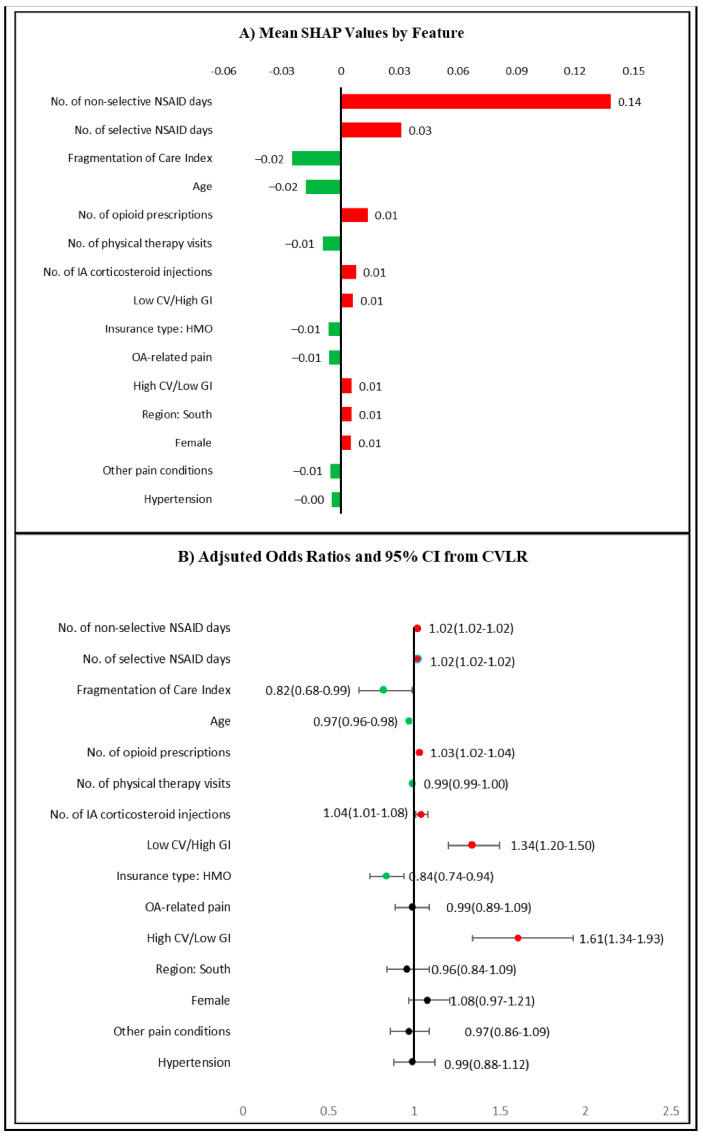
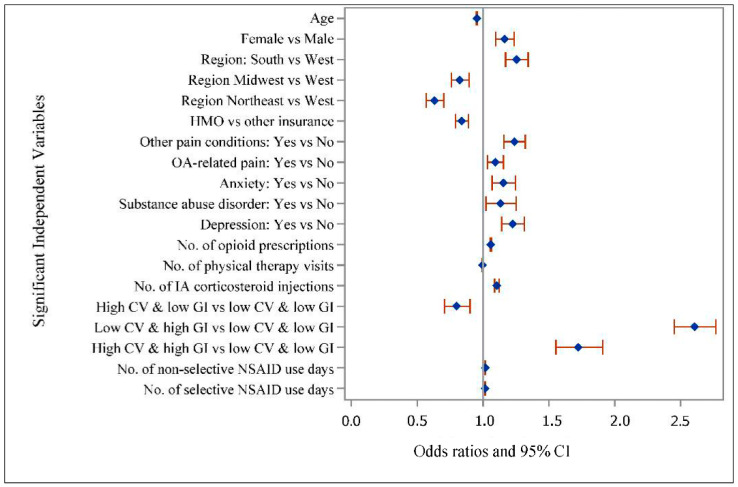
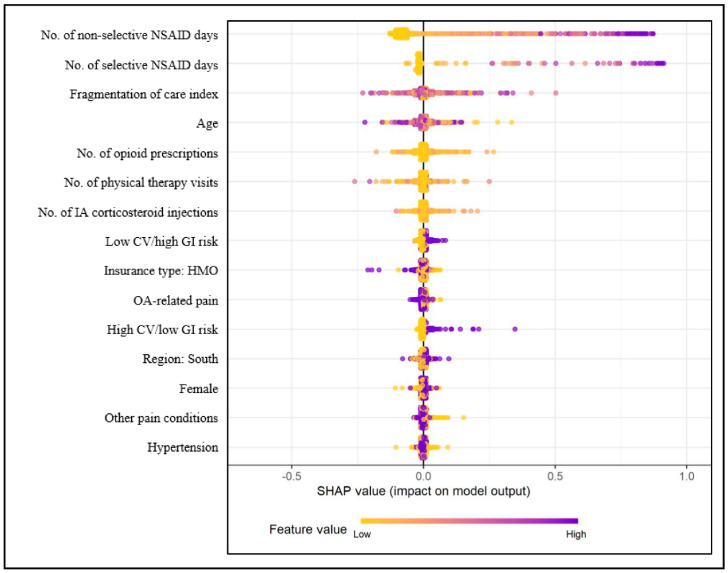
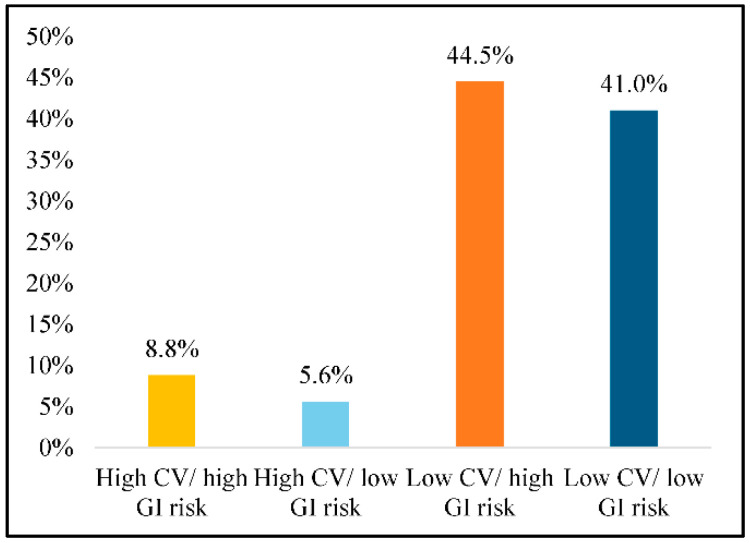
Evidence from some studies suggest that osteoarthritis (OA) patients are often prescribed non-steroidal anti-inflammatory drugs (NSAIDs) that are not in accordance with their cardiovascular (CV) or gastrointestinal (GI) risk profiles. However, no such study has been carried out in the United States. Therefore, we sought to examine the prevalence and predictors of potentially inappropriate NSAIDs use in older adults (age > 65) with OA using machine learning with real-world data from Optum De-identified Clinformatics Data Mart. We identified a retrospective cohort of eligible individuals using data from 2015 (baseline) and 2016 (follow-up). Potentially inappropriate NSAIDs use was identified using the type (COX-2 selective vs. non-selective) and length of NSAIDs use and an individual's CV and GI risk. Predictors of potentially inappropriate NSAIDs use were identified using eXtreme Gradient Boosting. Our study cohort comprised of 44,990 individuals (mean age 75.9 years). We found that 12.8% individuals had potentially inappropriate NSAIDs use, but the rate was disproportionately higher (44.5%) in individuals at low CV/high GI risk. Longer duration of NSAIDs use during baseline (AOR 1.02; 95% CI:1.02-1.02 for both non-selective and selective NSAIDs) was associated with a higher risk of potentially inappropriate NSAIDs use. Additionally, individuals with low CV/high GI (AOR 1.34; 95% CI:1.20-1.50) and high CV/low GI risk (AOR 1.61; 95% CI:1.34-1.93) were also more likely to have potentially inappropriate NSAIDs use. Heightened surveillance of older adults with OA requiring NSAIDs is warranted.

摘要

一些研究表明,骨关节炎 (OA) 患者经常开处方的非甾体抗炎药 (NSAIDs) 与其心血管 (CV) 或胃肠道 (GI) 风险状况不符。然而,在美国还没有开展过此类研究。因此,我们利用来自 Optum 去识别 Clinformatics Data Mart 的真实世界数据,采用机器学习技术,检查美国年龄大于 65 岁的 OA 患者中潜在不适当 NSAIDs 使用的流行率和预测因素。我们使用 2015 年(基线)和 2016 年(随访)的数据,确定了合格个体的回顾性队列。通过 NSAIDs 的类型(COX-2 选择性与非选择性)和使用时长以及个体的 CV 和 GI 风险来确定潜在不适当 NSAIDs 使用。使用极端梯度提升来确定潜在不适当 NSAIDs 使用的预测因素。我们的研究队列包含 44990 名个体(平均年龄 75.9 岁)。我们发现,有 12.8%的个体存在潜在不适当 NSAIDs 使用,但在 CV 风险低/ GI 风险高的个体中,这一比例不成比例地更高(44.5%)。基线期间 NSAIDs 使用时间更长(非选择性和选择性 NSAIDs 的 AOR 均为 1.02;95%CI:1.02-1.02)与潜在不适当 NSAIDs 使用风险增加相关。此外,CV 风险低/ GI 风险高(AOR 1.34;95%CI:1.20-1.50)和 CV 风险高/ GI 风险低(AOR 1.61;95%CI:1.34-1.93)的个体也更有可能存在潜在不适当 NSAIDs 使用。需要加强对需要 NSAIDs 的 OA 老年患者的监测。
https://cdn.ncbi.nlm.nih.gov/pmc/blobs/c8b7/7794853/3241397dfe19/ijerph-18-00155-g004.jpg
https://cdn.ncbi.nlm.nih.gov/pmc/blobs/c8b7/7794853/daf4e1c6a367/ijerph-18-00155-g001.jpg
https://cdn.ncbi.nlm.nih.gov/pmc/blobs/c8b7/7794853/0ae7b83a1484/ijerph-18-00155-g002.jpg
https://cdn.ncbi.nlm.nih.gov/pmc/blobs/c8b7/7794853/1ddbb2923bab/ijerph-18-00155-g003.jpg
https://cdn.ncbi.nlm.nih.gov/pmc/blobs/c8b7/7794853/3241397dfe19/ijerph-18-00155-g004.jpg
https://cdn.ncbi.nlm.nih.gov/pmc/blobs/c8b7/7794853/daf4e1c6a367/ijerph-18-00155-g001.jpg
https://cdn.ncbi.nlm.nih.gov/pmc/blobs/c8b7/7794853/0ae7b83a1484/ijerph-18-00155-g002.jpg
https://cdn.ncbi.nlm.nih.gov/pmc/blobs/c8b7/7794853/1ddbb2923bab/ijerph-18-00155-g003.jpg
https://cdn.ncbi.nlm.nih.gov/pmc/blobs/c8b7/7794853/3241397dfe19/ijerph-18-00155-g004.jpg

相似文献

1
A Machine Learning Approach to Identify Predictors of Potentially Inappropriate Non-Steroidal Anti-Inflammatory Drugs (NSAIDs) Use in Older Adults with Osteoarthritis.一种机器学习方法,用于识别老年骨关节炎患者中潜在不合理使用非甾体抗炎药(NSAIDs)的预测因子。
Int J Environ Res Public Health. 2020 Dec 28;18(1):155. doi: 10.3390/ijerph18010155.
2
Gastrointestinal and cardiovascular risk of non-selective NSAIDs and COX-2 inhibitors in elderly patients with knee osteoarthritis.老年膝骨关节炎患者使用非选择性非甾体抗炎药和COX-2抑制剂的胃肠道及心血管风险
J Med Assoc Thai. 2009 Dec;92 Suppl 6:S19-26.
3
Patterns of Comorbidities and Prescribing and Dispensing of Non-steroidal Anti-inflammatory Drugs (NSAIDs) Among Patients with Osteoarthritis in the USA: Real-World Study.美国骨关节炎患者共病模式及非甾体抗炎药(NSAIDs)的处方与配药情况:真实世界研究。
Drugs Aging. 2024 Apr;41(4):357-366. doi: 10.1007/s40266-024-01108-x. Epub 2024 Mar 23.
4
Prescription patterns and appropriateness of NSAID therapy according to gastrointestinal risk and cardiovascular history in patients with diagnoses of osteoarthritis.根据胃肠道风险和心血管病史,对诊断为骨关节炎的患者进行 NSAID 治疗的处方模式和适宜性。
BMC Med. 2011 Apr 14;9:38. doi: 10.1186/1741-7015-9-38.
5
Efficacy and safety of oral NSAIDs and analgesics in the management of osteoarthritis: Evidence from real-life setting trials and surveys.口服非甾体抗炎药和镇痛药治疗骨关节炎的疗效与安全性:来自真实场景试验和调查的证据
Semin Arthritis Rheum. 2016 Feb;45(4 Suppl):S22-7. doi: 10.1016/j.semarthrit.2015.11.009. Epub 2015 Dec 2.
6
Gastrointestinal risk of non-steroidal anti-inflammatory drugs and gastroprotective agents used in the treatment of osteoarthritis in elderly patients: A nationwide retrospective cohort study
.老年骨关节炎患者使用非甾体抗炎药和胃保护剂的胃肠道风险:一项全国性回顾性队列研究
Int J Clin Pharmacol Ther. 2019 Nov;57(11):531-541. doi: 10.5414/CP203377.
7
Assessment of gastrointestinal and cardiovascular risk in patients with osteoarthritis who require NSAIDs: the LOGICA study.评估需要 NSAIDs 的骨关节炎患者的胃肠道和心血管风险:LOGICA 研究。
Ann Rheum Dis. 2010 Aug;69(8):1453-8. doi: 10.1136/ard.2009.123166. Epub 2010 May 24.
8
Cyclooxygenase-2 selective non-steroidal anti-inflammatory drugs (etodolac, meloxicam, celecoxib, rofecoxib, etoricoxib, valdecoxib and lumiracoxib) for osteoarthritis and rheumatoid arthritis: a systematic review and economic evaluation.环氧化酶-2选择性非甾体抗炎药(依托度酸、美洛昔康、塞来昔布、罗非昔布、艾瑞昔布、伐地昔布和鲁米昔布)用于骨关节炎和类风湿性关节炎:系统评价与经济学评估
Health Technol Assess. 2008 Apr;12(11):1-278, iii. doi: 10.3310/hta12110.
9
A regional audit of the use of COX-2 selective non-steroidal anti-inflammatory drugs (NSAIDs) in rheumatology clinics in the West Midlands, in relation to NICE guidelines.针对西米德兰兹郡风湿病诊所使用COX - 2选择性非甾体抗炎药(NSAIDs)情况与英国国家卫生与临床优化研究所(NICE)指南相关的一项区域性审计。
Rheumatology (Oxford). 2005 Jul;44(7):921-4. doi: 10.1093/rheumatology/keh642. Epub 2005 Apr 12.
10
A comparison of the cost-effectiveness of five strategies for the prevention of non-steroidal anti-inflammatory drug-induced gastrointestinal toxicity: a systematic review with economic modelling.五种预防非甾体抗炎药所致胃肠道毒性策略的成本效益比较:一项基于经济模型的系统评价
Health Technol Assess. 2006 Oct;10(38):iii-iv, xi-xiii, 1-183. doi: 10.3310/hta10380.

引用本文的文献

1
Patterns of analgesic utilisation among people with knee osteoarthritis: a cohort study using UK primary care data.膝骨关节炎患者的镇痛药物使用模式:一项使用英国初级保健数据的队列研究。
J Pharm Policy Pract. 2025 Feb 27;18(1):2455067. doi: 10.1080/20523211.2025.2455067. eCollection 2025.
2
Scoping review of interventions to de-implement potentially harmful non-steroidal anti-inflammatory drugs (NSAIDs) in healthcare settings.在医疗环境中消除潜在有害的非甾体抗炎药(NSAIDs)的干预措施的范围综述。
BMJ Open. 2024 Apr 17;14(4):e078808. doi: 10.1136/bmjopen-2023-078808.
3
Artificial intelligence in the field of pharmacy practice: A literature review.

本文引用的文献

1
2019 American College of Rheumatology/Arthritis Foundation Guideline for the Management of Osteoarthritis of the Hand, Hip, and Knee.2019 年美国风湿病学会/关节炎基金会手部、髋关节和膝关节骨关节炎管理指南。
Arthritis Care Res (Hoboken). 2020 Feb;72(2):149-162. doi: 10.1002/acr.24131. Epub 2020 Jan 6.
2
Machine Learning Principles for Radiology Investigators.机器学习原理在放射学研究中的应用
Acad Radiol. 2020 Jan;27(1):13-25. doi: 10.1016/j.acra.2019.07.030.
3
Patient's Knowledge and Use of Oral Non-Steroidal Anti-Inflammatory Drugs in a Rheumatology Clinic.
药学实践领域中的人工智能:一篇文献综述。
Explor Res Clin Soc Pharm. 2023 Oct 21;12:100346. doi: 10.1016/j.rcsop.2023.100346. eCollection 2023 Dec.
4
[Knowledge Graph-Based Prediction of Potentially Inappropriate Medication].基于知识图谱的潜在不适当用药预测
Sichuan Da Xue Xue Bao Yi Xue Ban. 2023 Sep;54(5):884-891. doi: 10.12182/20230960108.
5
A comparison of jade moxibustion and traditional moxibustion in the treatment of knee osteoarthritis: A randomized clinical trial.玉石灸与传统灸治疗膝骨关节炎的比较:一项随机临床试验。
Medicine (Baltimore). 2023 Aug 4;102(31):e34537. doi: 10.1097/MD.0000000000034537.
6
Apigenin Inhibits the Progression of Osteoarthritis by Mediating Macrophage Polarization.芹菜素通过调节巨噬细胞极化抑制骨关节炎的进展。
Molecules. 2023 Mar 24;28(7):2915. doi: 10.3390/molecules28072915.
7
Analgesic Effectiveness of Physical Therapy Combining the Use of Electromagnetic Fields with Light Radiation Emitted by LEDs along with the Use of Topical Herbal Ointment in Patients with Gonarthrosis.物理疗法联合电磁场与 LED 光辐射及局部草药软膏治疗膝骨关节炎的镇痛效果。
Int J Environ Res Public Health. 2023 Feb 19;20(4):3696. doi: 10.3390/ijerph20043696.
8
A machine learning-based risk warning platform for potentially inappropriate prescriptions for elderly patients with cardiovascular disease.一个基于机器学习的针对老年心血管疾病患者潜在不适当处方的风险预警平台。
Front Pharmacol. 2022 Aug 11;13:804566. doi: 10.3389/fphar.2022.804566. eCollection 2022.
9
Antiosteoarthritic Effect of Morroniside in Chondrocyte Inflammation and Destabilization of Medial Meniscus-Induced Mouse Model.莫诺苷对软骨细胞炎症及内侧半月板失稳诱导的小鼠模型的抗骨关节炎作用
Int J Mol Sci. 2021 Mar 15;22(6):2987. doi: 10.3390/ijms22062987.
风湿病诊所中患者对口服非甾体抗炎药的认知与使用情况
Kans J Med. 2019 Nov 25;12(4):132-135. eCollection 2019 Nov.
4
Update on novel pharmacological therapies for osteoarthritis.骨关节炎新型药物治疗进展
Ther Adv Musculoskelet Dis. 2019 Jul 23;11:1759720X19864492. doi: 10.1177/1759720X19864492. eCollection 2019.
5
Clinical, humanistic, and economic burden of osteoarthritis among noninstitutionalized adults in the United States.美国非住院成年人群体中骨关节炎的临床、人文和经济负担。
Osteoarthritis Cartilage. 2019 Nov;27(11):1618-1626. doi: 10.1016/j.joca.2019.07.002. Epub 2019 Jul 9.
6
Safety of Oral Non-Selective Non-Steroidal Anti-Inflammatory Drugs in Osteoarthritis: What Does the Literature Say?口服非选择性非甾体抗炎药治疗骨关节炎的安全性:文献有何说法?
Drugs Aging. 2019 Apr;36(Suppl 1):15-24. doi: 10.1007/s40266-019-00660-1.
7
Machine learning for the prediction of volume responsiveness in patients with oliguric acute kidney injury in critical care.机器学习在危重症少尿型急性肾损伤患者容量反应性预测中的应用。
Crit Care. 2019 Apr 8;23(1):112. doi: 10.1186/s13054-019-2411-z.
8
Duration of Symptom Relief and Early Trajectory of Adverse Events for Oral Nonsteroidal Antiinflammatory Drugs in Knee Osteoarthritis: A Systematic Review and Meta-Analysis.口服非甾体抗炎药治疗膝骨关节炎的症状缓解持续时间和早期不良事件轨迹:系统评价和荟萃分析。
Arthritis Care Res (Hoboken). 2020 May;72(5):641-651. doi: 10.1002/acr.23884. Epub 2020 Apr 14.
9
American Geriatrics Society 2019 Updated AGS Beers Criteria® for Potentially Inappropriate Medication Use in Older Adults.美国老年医学学会 2019 年更新的老年人潜在不适当药物使用 AGS Beers 标准®。
J Am Geriatr Soc. 2019 Apr;67(4):674-694. doi: 10.1111/jgs.15767. Epub 2019 Jan 29.
10
Frequency and Associations of Prescription Nonsteroidal Anti-inflammatory Drug Use Among Patients With a Musculoskeletal Disorder and Hypertension, Heart Failure, or Chronic Kidney Disease.患有肌肉骨骼疾病且合并高血压、心力衰竭或慢性肾脏病的患者中处方非甾体抗炎药使用的频率及关联。
JAMA Intern Med. 2018 Nov 1;178(11):1516-1525. doi: 10.1001/jamainternmed.2018.4273.