Institute for Clinical Diabetology, German Diabetes Center, Leibniz Center for Diabetes Research at Heinrich Heine University, Düsseldorf, Germany.
German Center for Diabetes Research (DZD), München-Neuherberg, Germany.
J Clin Endocrinol Metab. 2021 Mar 25;106(4):1062-1073. doi: 10.1210/clinem/dgaa912.
Type 2 diabetes is associated with a greater risk for musculoskeletal disorders, yet its impact on joint function remains unclear.
We hypothesized that patients with type 2 diabetes and osteoarthritis would exhibit musculoskeletal impairment, which would associate with insulin resistance and distinct microRNA profiles.
Participants of the German Diabetes Study with type 2 diabetes (T2D, n = 39) or normal glucose tolerance (CON, n = 27), both with (+OA) or without osteoarthritis (-OA) underwent intravenous glucose tolerance and hyperinsulinemic-euglycemic clamp tests. Musculoskeletal function was assessed by isometric knee extension strength (KES), grip strength, range of motion (ROM), and balance skills, while neural function was measured by nerve conductance velocity (NCV). Arthritis-related symptoms were quantified using the Western Ontario and McMaster Universities Osteoarthritis Index (WOMAC) questionnaire, serum arthritis-related microRNA using quantitative polymerase chain reaction.
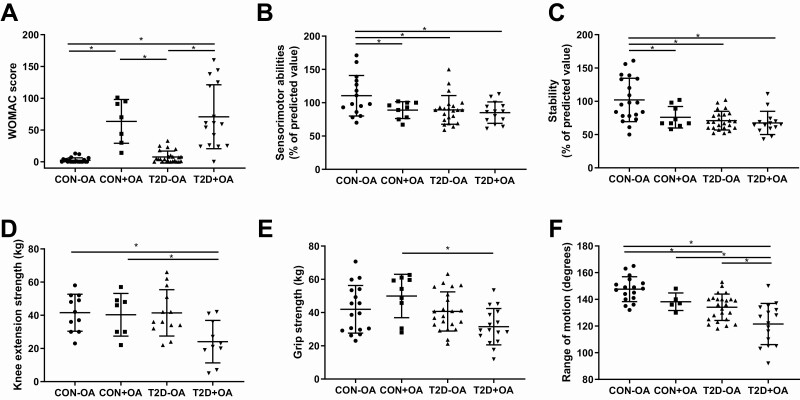
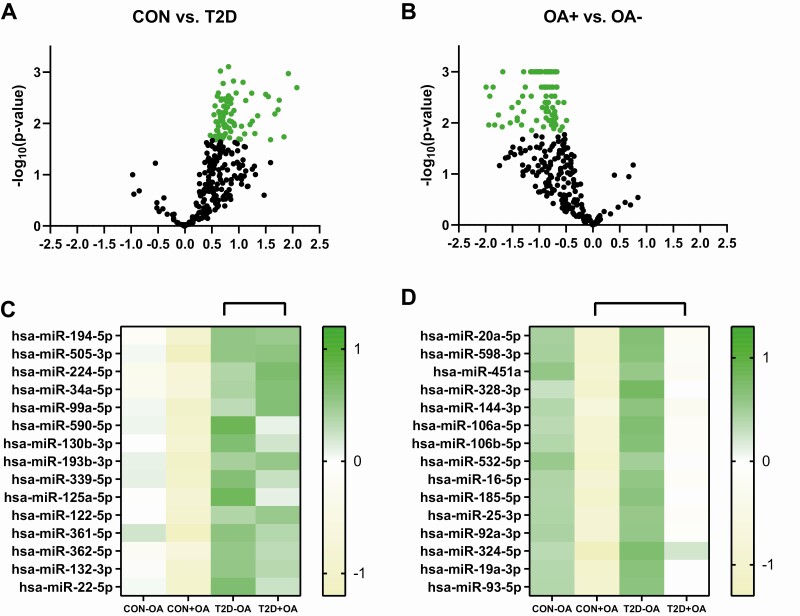
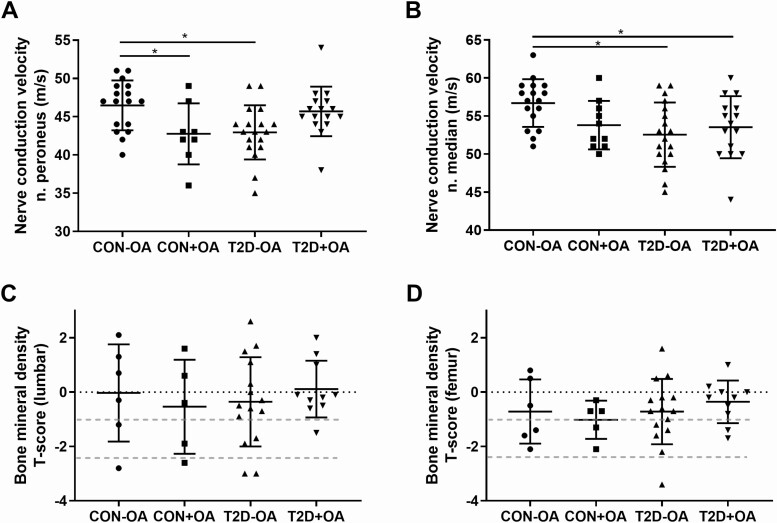
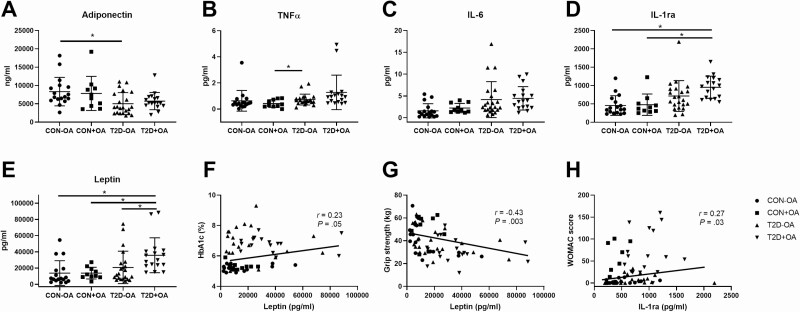
Insulin sensitivity was lower in T2D+OA vs T2D-OA (4.4 ± 2.0 vs 5.7 ± 3.0 mg* kg-1min-1) and in CON+OA vs CON-OA (8.1 ± 2.0 vs 12.0 ± 2.6 mgkg-1,*min-1, both P < .05). In T2D+OA, KES and ROM were 60% and 22% lower than in CON+OA, respectively (both P < .05). Insulin sensitivity correlated positively with KES (r = 0.41, P < .05) among T2D, and negatively with symptom severity in CON and T2D (r = -0.60 and r = -0.46, respectively, P < .05). CON+OA and T2D+OA had inferior balance skills than CON-OA, whereas NCV was comparable in T2D+OA and T2D-OA. Expression of arthritis-related microRNAs was upregulated in T2D compared to CON, but downregulated in CON+OA compared to CON-OA (P < .05), and did not differ between T2D+OA and T2D-OA.
Musculoskeletal impairment and osteoarthritis-related symptoms are associated with insulin resistance. Type 2 diabetes can mask changes in arthritis-related microRNA profiles.
2 型糖尿病与肌肉骨骼疾病的风险增加有关,但它对关节功能的影响尚不清楚。
我们假设 2 型糖尿病伴骨关节炎患者会出现肌肉骨骼损伤,这种损伤与胰岛素抵抗和独特的 microRNA 谱有关。
德国糖尿病研究的参与者包括 2 型糖尿病(T2D,n=39)或正常葡萄糖耐量(CON,n=27),均伴有(+OA)或不伴有骨关节炎(-OA),进行静脉葡萄糖耐量和高胰岛素正葡萄糖钳夹试验。肌肉骨骼功能通过等长膝关节伸展力量(KES)、握力、运动范围(ROM)和平衡技能来评估,而神经功能通过神经传导速度(NCV)来测量。关节炎相关症状采用 Western Ontario 和 McMaster 大学骨关节炎指数(WOMAC)问卷进行量化,血清关节炎相关 microRNA 采用定量聚合酶链反应进行检测。
T2D+OA 与 T2D-OA(4.4±2.0 比 5.7±3.0 mgkg-1min-1)和 CON+OA 与 CON-OA(8.1±2.0 比 12.0±2.6 mg*kg-1,*min-1)相比,胰岛素敏感性均较低(均 P<.05)。与 CON+OA 相比,T2D+OA 的 KES 和 ROM 分别低 60%和 22%(均 P<.05)。在 T2D 中,胰岛素敏感性与 KES 呈正相关(r=0.41,P<.05),而在 CON 和 T2D 中,与症状严重程度呈负相关(r=-0.60 和 r=-0.46,均 P<.05)。CON+OA 和 T2D+OA 的平衡技能比 CON-OA 差,而 T2D+OA 和 T2D-OA 的 NCV 无差异。与 CON 相比,T2D 中与关节炎相关的 microRNAs 表达上调,但与 CON-OA 相比,CON+OA 中表达下调(均 P<.05),且 T2D+OA 与 T2D-OA 之间无差异。
肌肉骨骼损伤和与骨关节炎相关的症状与胰岛素抵抗有关。2 型糖尿病可能掩盖与关节炎相关的 microRNA 谱变化。