Bonello Francesca, Grasso Mariella, D'Agostino Mattia, Celeghini Ivana, Castellino Alessia, Boccadoro Mario, Bringhen Sara
Myeloma Unit, Division of Hematology, University of Torino, Azienda Ospedaliero-Universitaria Città della Salute e della Scienza di Torino, 10126 Torino, Italy.
S.C. Ematologia, Azienda Ospedaliera Santa Croce-Carle, 88900 Cuneo, Italy.
Pharmaceuticals (Basel). 2020 Dec 29;14(1):20. doi: 10.3390/ph14010020.
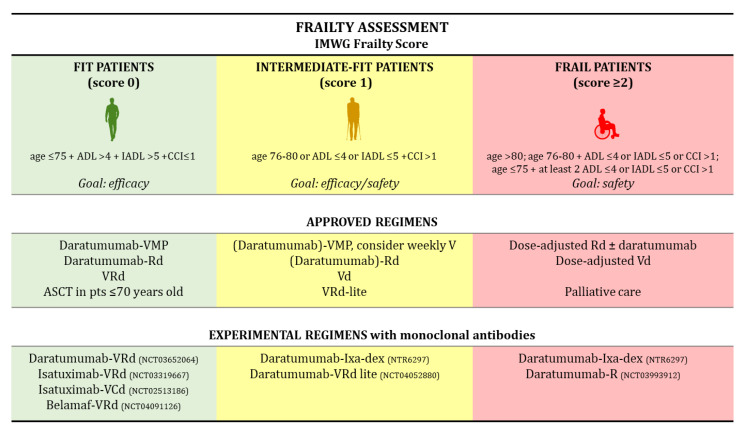
Elderly transplant-ineligible (NTE) patients represent the majority of patients affected by multiple myeloma (MM). Elderly patients are a highly heterogeneous population, with large variability in health and functional status. Thus, choosing their optimal treatment is challenging. A wide range of first-line treatments is available, and novel-agent combinations, including monoclonal antibodies (mAbs), have recently entered clinical practice. The combination of the anti-CD38 mAb daratumumab with bortezomib, melphalan and prednisone (Dara-VMP) or lenalidomide and dexamethasone (Dara-Rd) demonstrated impressive advantages in terms of progression-free survival and minimal residual disease negativity, as compared to VMP and Rd, without safety concerns. Another anti-CD38 mAb, isatuximab, is showing encouraging results, and new isatuximab-based combinations might enter clinical practice in the future. Nevertheless, available data come from clinical trials with selected patient populations and, to date, the manageability of these regimens in real-life patients or in frail patients remains unknown. Frailty-tailored treatments, including mAbs, are under evaluation in preliminary studies. In this review, we analyze recently approved mAb-based treatments for NTE newly diagnosed MM patients and new combinations under evaluation, focusing on the efficacy and safety of these regimens and on open issues regarding the choice of therapy for elderly patients.
老年移植不适合(NTE)患者占受多发性骨髓瘤(MM)影响患者的大多数。老年患者是一个高度异质性的群体,健康和功能状态差异很大。因此,选择他们的最佳治疗方法具有挑战性。有多种一线治疗方法可供选择,包括单克隆抗体(mAb)在内的新型药物组合最近已进入临床实践。与VMP和Rd相比,抗CD38单克隆抗体达雷妥尤单抗与硼替佐米、美法仑和泼尼松(Dara-VMP)或来那度胺和地塞米松(Dara-Rd)联合使用在无进展生存期和最小残留病阴性方面显示出令人印象深刻的优势,且无安全性问题。另一种抗CD38单克隆抗体isatuximab也显示出令人鼓舞的结果,基于isatuximab的新组合可能在未来进入临床实践。然而,现有数据来自对特定患者群体的临床试验,迄今为止,这些方案在现实生活患者或体弱患者中的可管理性仍然未知。包括单克隆抗体在内的针对体弱患者的治疗方法正在初步研究中进行评估。在本综述中,我们分析了最近批准的用于新诊断的NTE MM患者的基于单克隆抗体的治疗方法以及正在评估的新组合,重点关注这些方案的疗效和安全性以及老年患者治疗选择方面的未解决问题。