Division of Advanced Internal Medicine, University Medicine Cluster, National University Hospital, Singapore.
Department of Cardiology, National University Heart Centre, Singapore.
BMJ Open. 2020 Dec 31;10(12):e042647. doi: 10.1136/bmjopen-2020-042647.
The COVID-19 outbreak in Singapore has largely centred around migrant worker dormitories, comprising over 90% of all cases in the country. Dormitories are home to a culturally and linguistically distinct, low-income population, without on-site healthcare after-hours. The primary objective of this study was to assess the engagement and utilisation of a simple, low-cost, accessible, mobile health solution for remote self-reporting of vital parameters in dormitory residents with COVID-19.
Retrospective review of medical care.
Two large migrant worker dormitories with a combined population of 31 546.
All COVID-19-affected residents housed in dormitories during the study period.
All residents were taught to use a chat assistant to self-report their temperature, heart rate and oxygen saturations. Results flowed into a dashboard, which alerted clinicians of abnormal results.
The primary outcome measure was engagement rate. This was derived from the total number of residents who registered on the platform over the total number of COVID-19-affected residents in the dormitories during the study period. Secondary outcome measures included outcomes of the alerts and subsequent escalations of care.
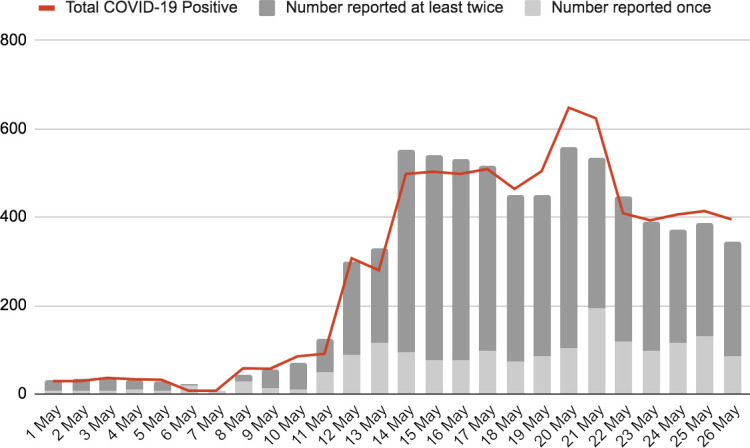
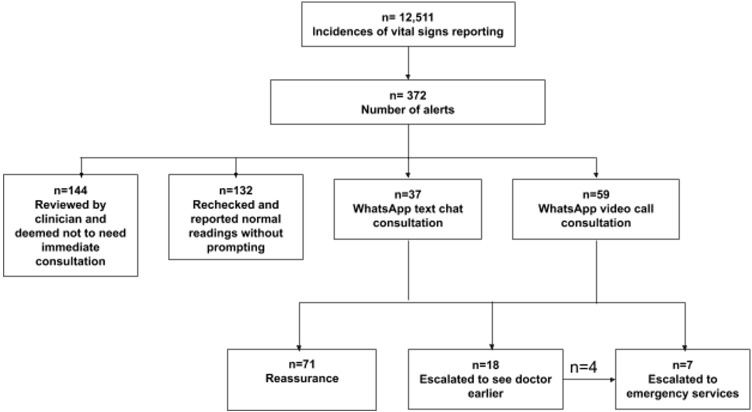
800 of the 931 COVID-19-affected residents (85.9%) engaged with the platform to log a total of 12 511 discrete episodes of vital signs. Among 372 abnormal readings, 96 teleconsultations were initiated, of which 7 (1.8%) were escalated to emergency services and 18 (4.9%) were triaged to earlier physical medical review on-site.
A chat-assistant-based self-reporting platform is an effective and safe community-based intervention to monitor marginalised populations with distinct cultural and linguistic backgrounds, living communally and affected by COVID-19. Lessons learnt from this approach may be applied to develop safe and cost-effective telemedicine solutions across similar settings.
新加坡的 COVID-19 疫情主要集中在农民工宿舍,占该国所有病例的 90%以上。宿舍里住着文化和语言背景不同、收入较低的人群,下班后没有现场医疗保健。这项研究的主要目的是评估一种简单、低成本、易于获得、移动健康解决方案在 COVID-19 宿舍居民远程自我报告生命参数方面的参与度和利用率。
医疗保健的回顾性审查。
两个拥有 31546 名居民的大型农民工宿舍。
在研究期间居住在宿舍的所有 COVID-19 感染者。
所有居民都被教导使用聊天助手自我报告体温、心率和血氧饱和度。结果流入一个仪表板,该仪表板提醒临床医生异常结果。
主要结局指标是参与率。这是通过在研究期间宿舍中 COVID-19 感染者总数中注册平台的居民总数得出的。次要结局指标包括警报的结果和随后的护理升级。
在 931 名 COVID-19 感染者中,有 800 名(85.9%)与该平台互动,共记录了 12511 次生命体征离散事件。在 372 次异常读数中,发起了 96 次远程咨询,其中 7 次(1.8%)被升级到紧急服务,18 次(4.9%)被分诊到现场更早的体格医疗检查。
基于聊天助手的自我报告平台是一种有效且安全的社区干预措施,可以监测具有不同文化和语言背景、群居且受 COVID-19 影响的边缘化人群。从这种方法中吸取的经验教训可应用于在类似环境中开发安全且具有成本效益的远程医疗解决方案。