Institute of Health Sciences, Universiti Brunei Darussalam, Gadong, Brunei Darussalam
Saw Swee Hock School of Public Health, National University of Singapore, Singapore.
Occup Environ Med. 2020 Sep;77(9):634-636. doi: 10.1136/oemed-2020-106626. Epub 2020 Jun 8.
Daily numbers of COVID-19 in Singapore from March to May 2020, the cause of a surge in cases in April and the national response were examined, and regulations on migrant worker accommodation studied.
Information was gathered from daily reports provided by the Ministry of Health, Singapore Statues online and a Ministerial statement given at a Parliament sitting on 4 May 2020.
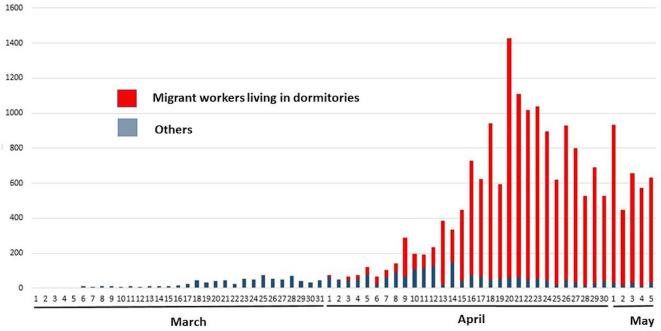
A marked escalation in the daily number of new COVID-19 cases was seen in early April 2020. The majority of cases occurred among an estimated 295 000 low-skilled migrant workers living in foreign worker dormitories. As of 6 May 2020, there were 17 758 confirmed COVID-19 cases among dormitory workers (88% of 20 198 nationally confirmed cases). One dormitory housing approximately 13 000 workers had 19.4% of residents infected. The national response included mobilising several government agencies and public volunteers. There was extensive testing of workers in dormitories, segregation of healthy and infected workers, and daily observation for fever and symptoms. Twenty-four dormitories were declared as 'isolation areas', with residents quarantined for 14 days. New housing, for example, vacant public housing flats, military camps, exhibition centres, floating hotels have been provided that will allow for appropriate social distancing.
The COVID-19 pandemic has highlighted migrant workers as a vulnerable occupational group. Ideally, matters related to inadequate housing of vulnerable migrant workers need to be addressed before a pandemic.
研究 2020 年 3 月至 5 月新加坡 COVID-19 的日病例数、4 月病例激增的原因以及国家应对措施,并研究移民工人住宿规定。
从卫生部每日报告、新加坡法规在线和 2020 年 5 月 4 日议会会议上的一份部长声明中收集信息。
2020 年 4 月初,每日新增 COVID-19 病例数明显上升。大多数病例发生在估计有 295000 名低技能移民工人中,他们居住在外国工人宿舍。截至 2020 年 5 月 6 日,宿舍工人中确诊 COVID-19 病例 17758 例(占全国确诊病例 20198 例的 88%)。一个容纳约 13000 名工人的宿舍有 19.4%的居民感染。国家应对措施包括动员多个政府机构和公共志愿者。对宿舍工人进行了广泛的检测,将健康和感染工人隔离,并每天观察发烧和症状。24 个宿舍被宣布为“隔离区”,居民被隔离 14 天。已经提供了新的住房,例如空置的公共住房公寓、军营、展览中心、浮动酒店,以实现适当的社交距离。
COVID-19 大流行突出了移民工人这一脆弱职业群体。理想情况下,在大流行之前,需要解决弱势移民工人住房不足等问题。