Shi Yan, Lin Gan-Lin, Fu Xiu-Lian, Keller Mike, Smagghe Guy, Liu Tong-Xian
Key Lab of Integrated Crop Pest Management of Shandong Province, College of Plant Health and Medicine, Qingdao Agricultural University, Qingdao, China.
School of Agriculture, Food and Wine, University of Adelaide, Glen Osmond, SA, Australia.
Front Physiol. 2020 Dec 15;11:574800. doi: 10.3389/fphys.2020.574800. eCollection 2020.
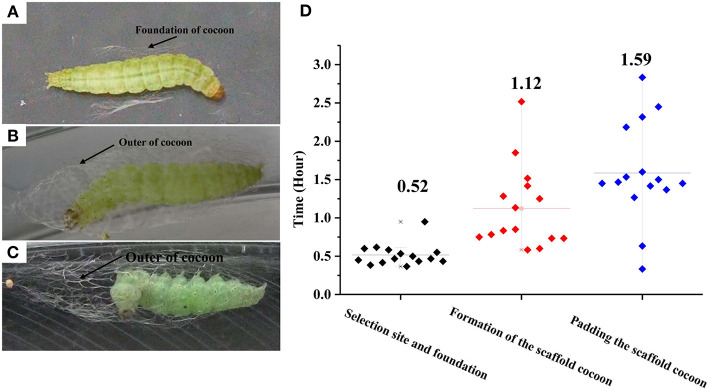
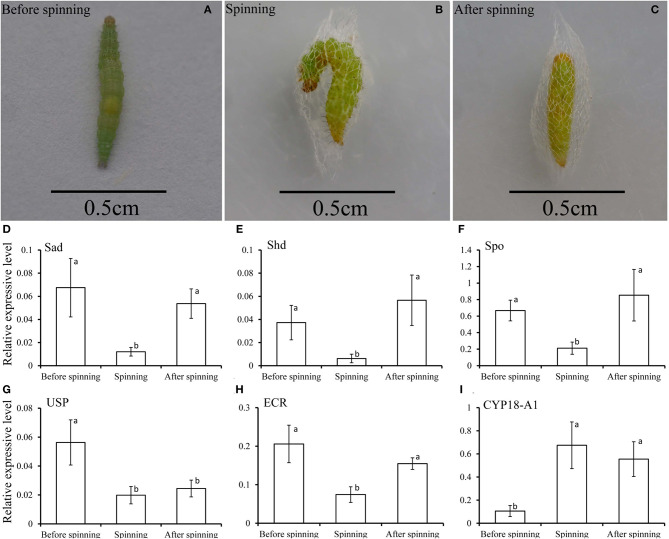
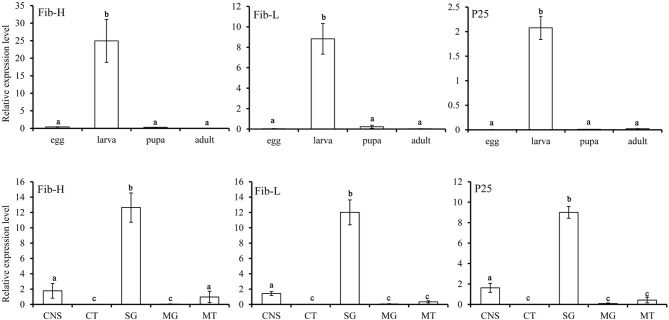
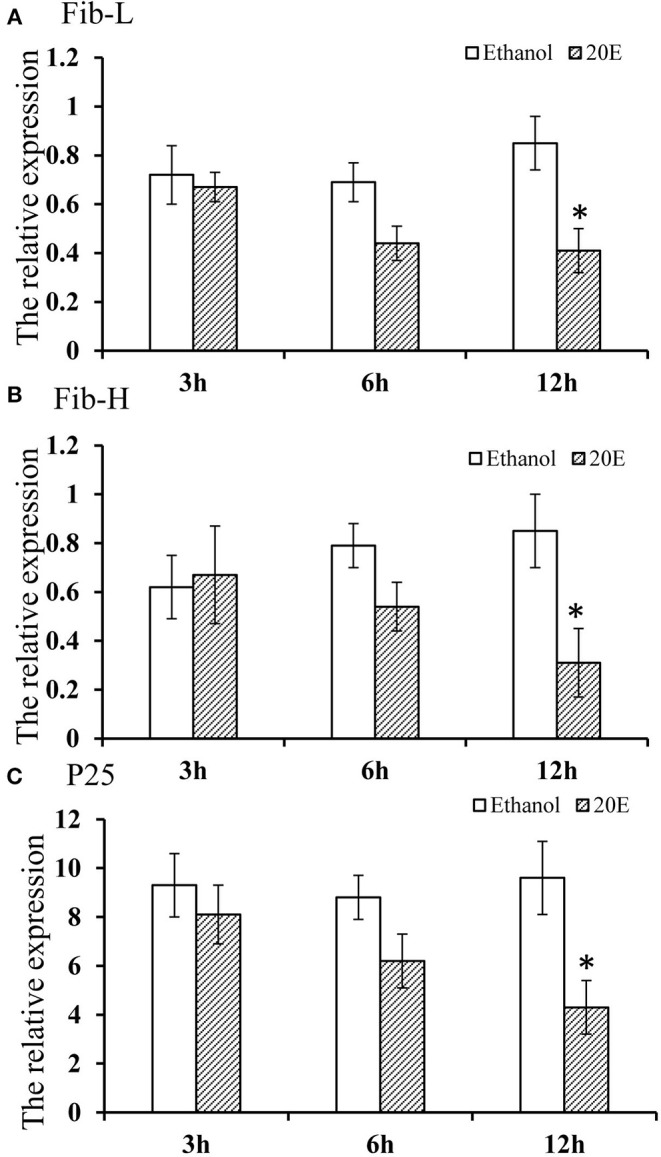
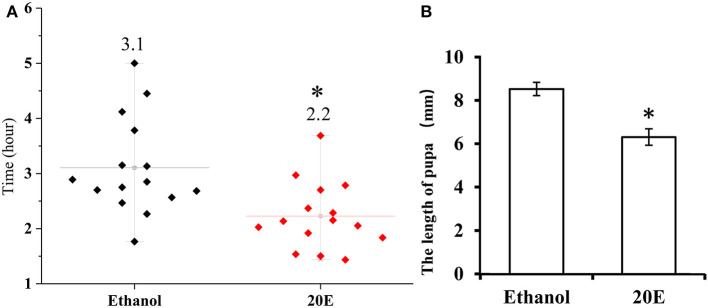
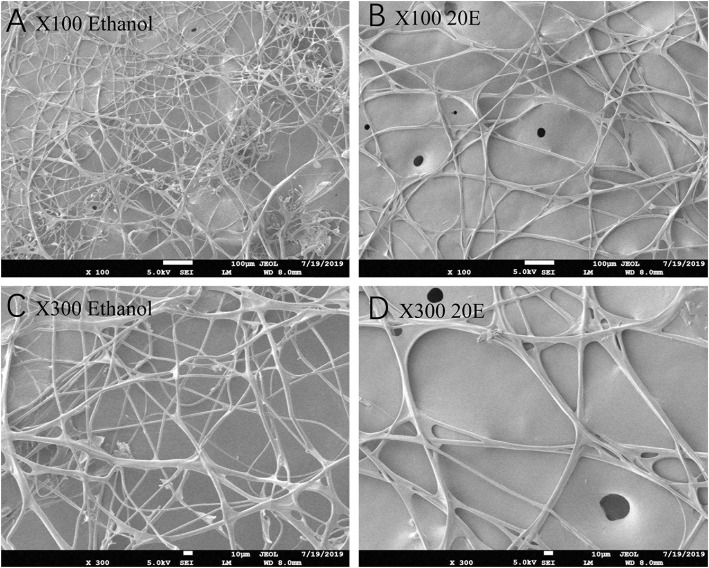
The diamondback moth is a serious pest of crucifers. It has high reproductive potential and is resistant to many insecticides. Typically, the last-instar larvae of , before pupation, move to the lower or outer plant leaves to make a loose silk cocoon and pupate inside for adult formation. To better understand this pivotal stage we studied the cocoon-spinning behavior of and measured three successive phases by video-recording, namely the selection of a pupation site, spinning a loose cocoon and padding the scaffold cocoon. Subsequently, we cloned three fibroin genes related to cocoon production, i.e., fibroin light chain (Fib-L), fibroin heavy chain (Fib-H), and glycoprotein P25. A spatio-temporal study of these three fibroin genes confirmed a high expression in the silk glands during the final larval instar silk-producing stage. In parallel, we did an exogenous treatment of the insect molting hormone 20-hydroxyecdysone (20E), and this suppressed fibroin gene expression, reduced the normal time needed for cocoon spinning, and we also observed a looser cocoon structure under the scanning electron microscope. Hence, we demonstrated that the expression levels of key genes related to the synthesis of 20E [the three Halloween genes (, and ()] decreased significantly during spinning, the expression of the 20E receptor ( and ) was significantly lower during spinning than before spinning, and that the expression levels of related to 20E degradation were significantly up-regulated during spinning. The significance of the cocoon and the effects of 20E on the cocoon-spinning behavior of are discussed.
小菜蛾是十字花科植物的一种严重害虫。它具有很高的繁殖潜力,并且对许多杀虫剂具有抗性。通常,小菜蛾末龄幼虫在化蛹前会移动到植物下部或外部叶片,制作一个松散的丝茧,并在茧内化蛹以发育成成虫。为了更好地了解这个关键阶段,我们研究了小菜蛾的结茧行为,并通过视频记录测量了三个连续阶段,即化蛹部位的选择、纺出松散的茧以及填充支架茧。随后,我们克隆了三个与结茧相关的丝素基因,即丝素轻链(Fib-L)、丝素重链(Fib-H)和糖蛋白P25。对这三个丝素基因的时空研究证实,它们在末龄幼虫产丝阶段的丝腺中高表达。同时,我们对昆虫蜕皮激素20-羟基蜕皮酮(20E)进行了外源处理,这抑制了丝素基因的表达,缩短了正常结茧所需的时间,并且在扫描电子显微镜下我们还观察到茧的结构更松散。因此,我们证明了与20E合成相关的关键基因[三个“万圣节”基因(幻影、阴影和薄纱)]在结茧过程中的表达水平显著下降,20E受体(EcR和USP)在结茧过程中的表达明显低于结茧前,并且与20E降解相关的Cyp18a1的表达水平在结茧过程中显著上调。本文讨论了茧的重要性以及20E对小菜蛾结茧行为的影响。