Tan Hongxin, Zhang Xin, Li Zhan, Liang Qing, Wu Jinsheng, Yuan Yanli, Cao Shiwei, Chen Jia, Liu Juewen, Qiu Hongdeng
CAS Key Laboratory of Chemistry of Northwestern Plant Resources and Key Laboratory for Natural Medicine of Gansu Province, Lanzhou Institute of Chemical Physics, Chinese Academy of Sciences, Lanzhou 730000, China.
University of Chinese Academy of Sciences, Chinese Academy of Sciences, Beijing 100049, China.
iScience. 2020 Dec 10;24(1):101920. doi: 10.1016/j.isci.2020.101920. eCollection 2021 Jan 22.
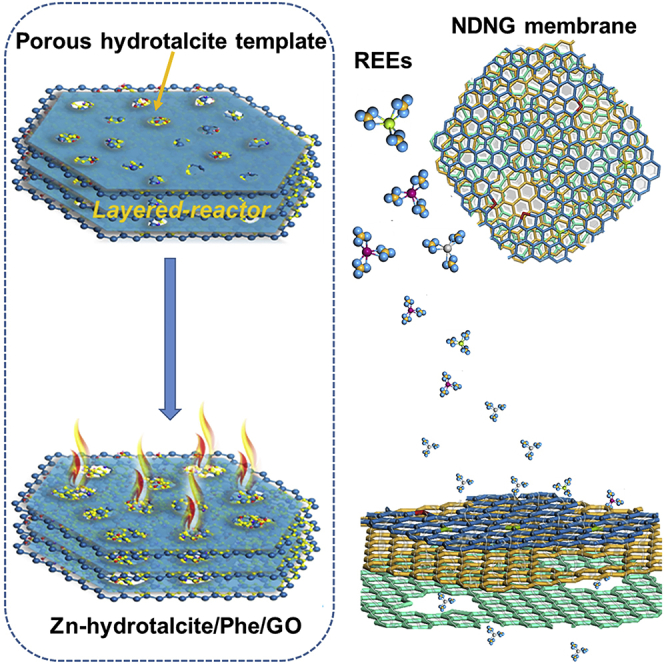
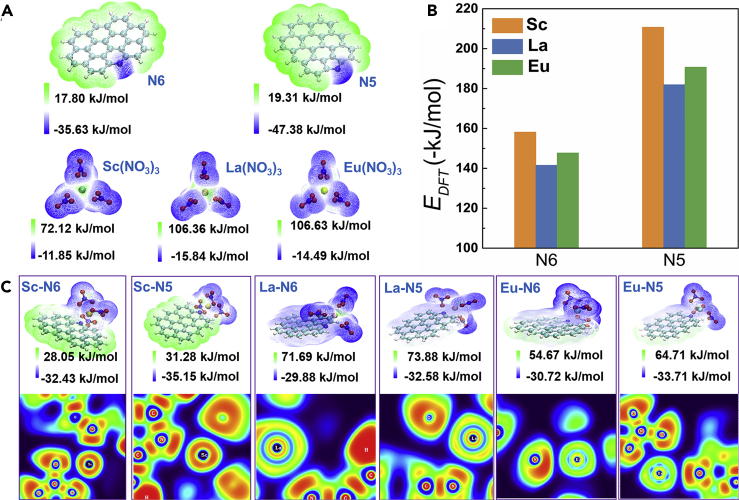
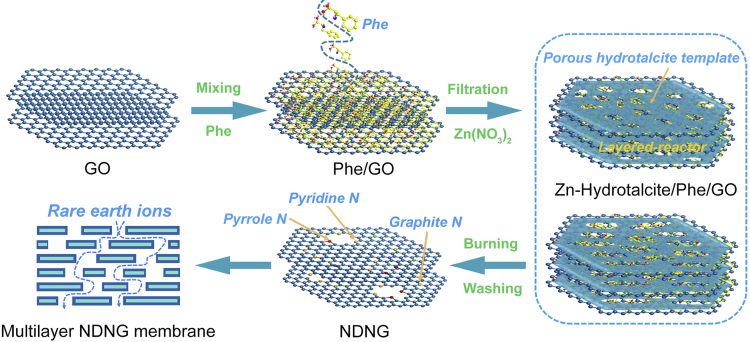
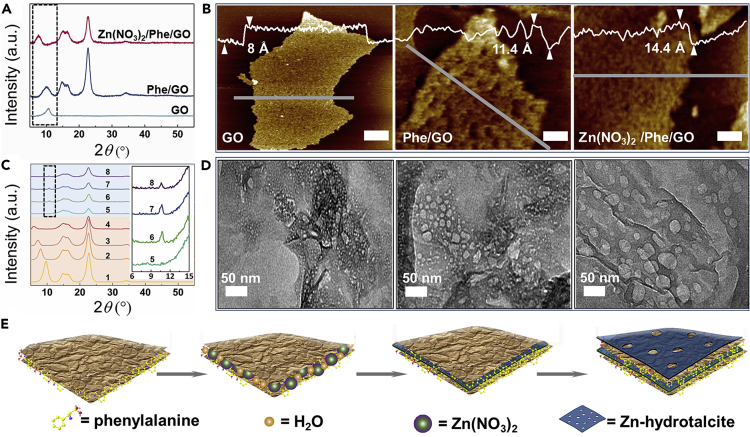
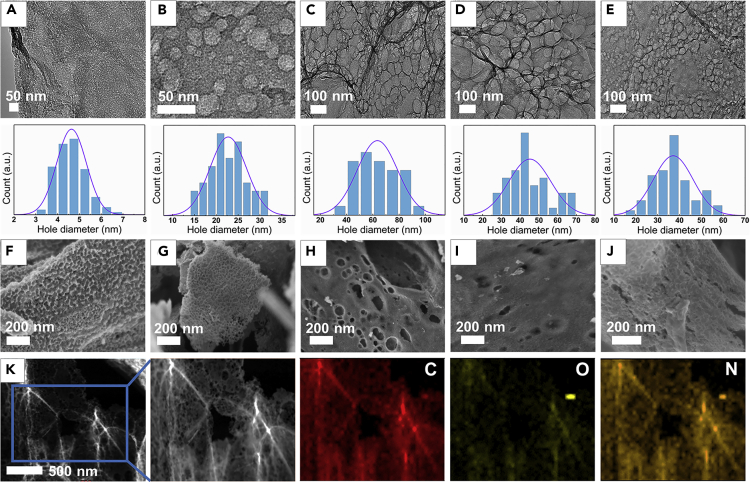
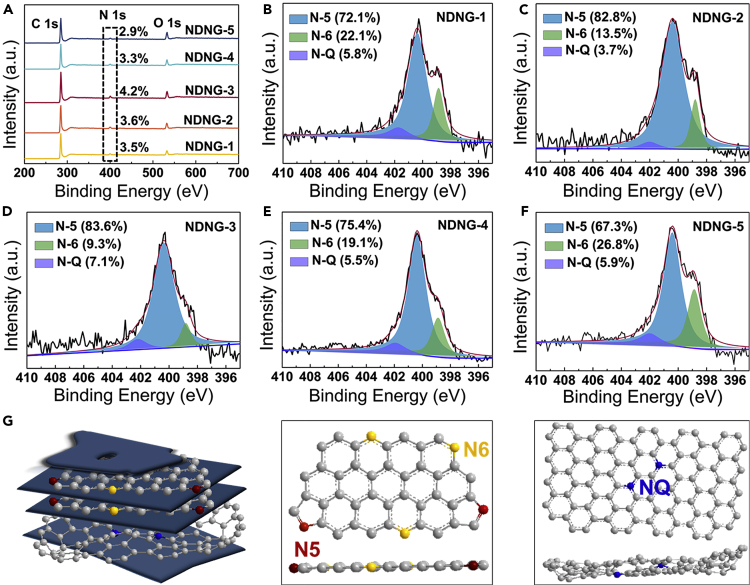
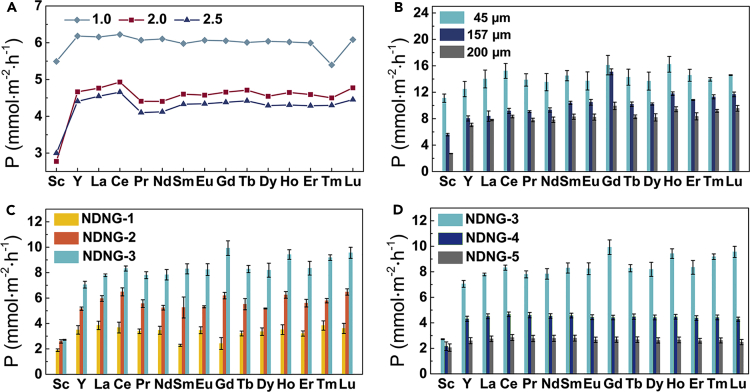
Rare earth separation is still a major challenge in membrane science. Nitrogen-doped nanoporous graphene (NDNG) is a promising material for membrane separation, but it has not yet been tested for rare earth separation, and it is limited by multi-complex synthesis. Herein, we developed a one-step, facile, and scalable approach to synthesize NDNG with tunable pore size and controlled nitrogen content using confinement combustion. Nanoporous hydrotalcite from Zn(NO) is formed between layers of graphene oxide (GO) absorbed with phenylalanine via confinement growth, thus preparing the sandwich hydrotalcite/phenylalanine/GO composites. Subsequently, area-confinement combustion of hydrotalcite nanopores is used to etch graphene nanopores, and the hydrotalcite interlayer as a closed flat nanoreactor induces two-dimensional space confinement doping of planar nitrogen into graphene. The membrane prepared by NDNG achieves separation of Sc from the other rare earth ions with excellent selectivity (∼3.7) through selective electrostatic interactions of pyrrolic-N, and separation selectivity of ∼1.7 for Tm/Sm.
稀土分离仍是膜科学领域的一项重大挑战。氮掺杂纳米多孔石墨烯(NDNG)是一种很有前景的膜分离材料,但尚未用于稀土分离测试,且受限于多步复杂合成方法。在此,我们开发了一种一步法、简便且可扩展的方法,通过限域燃烧合成孔径可调且氮含量可控的NDNG。在通过限域生长吸附了苯丙氨酸的氧化石墨烯(GO)层间形成由Zn(NO)生成的纳米多孔水滑石,从而制备夹心结构的水滑石/苯丙氨酸/GO复合材料。随后,利用水滑石纳米孔的面积限域燃烧蚀刻石墨烯纳米孔,并且作为封闭扁平纳米反应器的水滑石层间诱导平面氮对石墨烯进行二维空间限域掺杂。由NDNG制备的膜通过吡咯氮的选择性静电相互作用实现了钪与其他稀土离子的分离,具有优异的选择性(约3.7),对铥/钐的分离选择性约为1.7。