Wu Dan, Moghekar Abhay, Shi Wen, Blitz Ari M, Mori Susumu
Key Laboratory for Biomedical Engineering of Ministry of Education, Department of Biomedical Engineering, College of Biomedical Engineering & Instrument Science, Zhejiang University, Hangzhou, 310027, Zhejiang, China.
Department of Neurology, Johns Hopkins University School of Medicine, Baltimore, MD, 21205, USA.
Eur Radiol. 2021 Jul;31(7):4972-4980. doi: 10.1007/s00330-020-07531-z. Epub 2021 Jan 3.
Idiopathic normal pressure hydrocephalus (INPH) is a neurodegenerative disorder characterized by excess cerebrospinal fluid (CSF) in the ventricles, which can be diagnosed by invasive CSF drainage test and treated by shunt placement. Here, we aim to investigate the diagnostic and prognostic power of systematic volumetric analysis based on brain structural MRI for INPH.
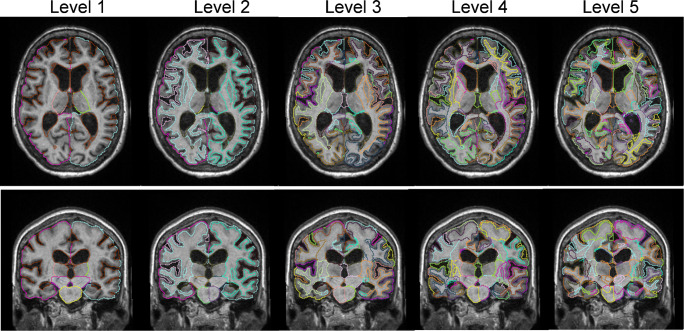
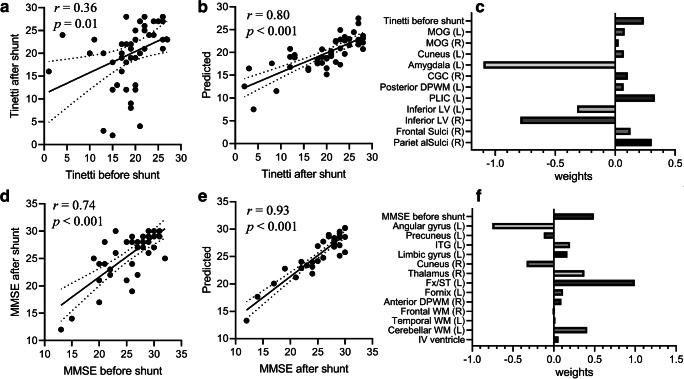
We performed a retrospective study with a cohort of 104 probable INPH patients who underwent CSF drainage tests and another cohort of 41 INPH patients who had shunt placement. High-resolution T1-weighted images of the patients were segmented using an automated pipeline into 283 structures that are grouped into different granularity levels for volumetric analysis. Volumes at multi-granularity levels were used in a recursive feature elimination model to classify CSF drainage responders and non-responders. We then used pre-surgical brain volumes to predict Tinetti and MMSE scores after shunting, based on the least absolute shrinkage and selection operator.
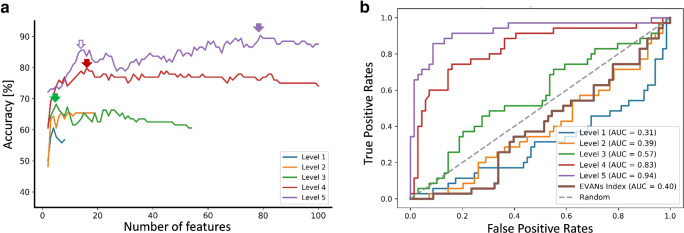
The classification accuracy of differentiating the CSF drainage responders and non-responders increased as the granularity increased. The highest diagnostic accuracy was achieved at the finest segmentation with a sensitivity/specificity/precision/accuracy of 0.89/0.91/0.84/0.90 and an area under the curve of 0.94. The predicted post-surgical neurological scores showed high correlations with the ground truth, with r = 0.80 for Tinetti and r = 0.88 for MMSE. The anatomical features that played important roles in the diagnostic and prognostic tasks were also illustrated.
We demonstrated that volumetric analysis with fine segmentation could reliably differentiate CSF drainage responders from other INPH-like patients, and it could accurately predict the neurological outcomes after shunting.
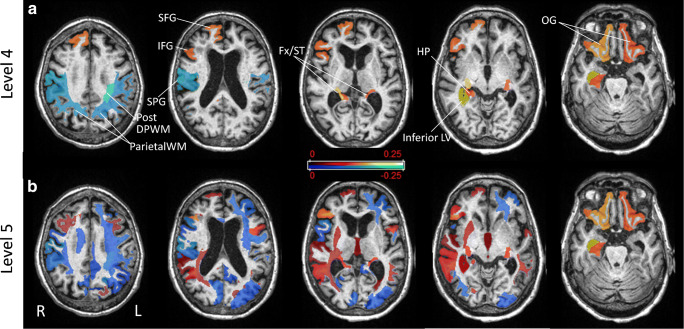
• We performed a fully automated segmentation of brain MRI at multiple granularity levels for systematic volumetric analysis of idiopathic normal pressure hydrocephalus (INPH) patients. • We were able to differentiate patients that responded to CSF drainage test with an accuracy of 0.90 and area under the curve of 0.94 in a cohort of 104 probable INPH patients, as well as to predict the post-shunt gait and cognitive scores with a coefficient of 0.80 for Tinetti and 0.88 for MMSE. • Feature analysis showed the inferior lateral ventricle, bilateral hippocampus, and orbital cortex are positive indicators of CSF drainage responders, whereas the posterior deep white matter and parietal subcortical white matter were negative predictors.
特发性正常压力脑积水(INPH)是一种神经退行性疾病,其特征为脑室中脑脊液(CSF)过多,可通过侵入性脑脊液引流试验进行诊断,并通过分流手术进行治疗。在此,我们旨在研究基于脑结构MRI的系统容积分析对INPH的诊断和预后评估能力。
我们进行了一项回顾性研究,一组为104例可能患有INPH且接受了脑脊液引流试验的患者,另一组为41例接受了分流手术的INPH患者。使用自动化流程将患者的高分辨率T1加权图像分割为283个结构,并将其分组为不同的粒度级别以进行容积分析。多粒度级别的体积用于递归特征消除模型,以区分脑脊液引流反应者和无反应者。然后,我们基于最小绝对收缩和选择算子,使用术前脑体积来预测分流术后的Tinetti和MMSE评分。
区分脑脊液引流反应者和无反应者的分类准确率随着粒度的增加而提高。在最精细分割时实现了最高诊断准确率,灵敏度/特异性/精确率/准确率为0.89/0.91/0.84/0.90,曲线下面积为0.94。预测的术后神经学评分与实际情况显示出高度相关性,Tinetti评分的r = 0.80,MMSE评分的r = 0.88。还阐明了在诊断和预后任务中起重要作用的解剖特征。
我们证明,精细分割的容积分析能够可靠地将脑脊液引流反应者与其他类似INPH的患者区分开来,并且能够准确预测分流术后的神经学结果。
• 我们对脑MRI进行了多粒度级别的全自动分割,以对特发性正常压力脑积水(INPH)患者进行系统容积分析。• 在一组104例可能患有INPH的患者中,我们能够以0.90的准确率和0.94的曲线下面积区分对脑脊液引流试验有反应的患者,并以Tinetti系数0.80和MMSE系数0.88预测分流术后的步态和认知评分。• 特征分析表明,外侧脑室下部、双侧海马体和眶皮质是脑脊液引流反应者的阳性指标,而后部深部白质和顶叶皮质下白质是阴性预测指标。