Japan Environment and Children's Study Programme Office, National Institute for Environmental Studies.
Department of Environmental and Occupational Health, School of Medicine, Toho University.
J Epidemiol. 2022 May 5;32(5):228-236. doi: 10.2188/jea.JE20200448. Epub 2021 May 25.
The Japan Environment and Children's Study (JECS) is a nationwide birth cohort study investigating environmental effects on children's health and development. A Sub-Cohort Study has begun, conducting extended exposure and outcome measurements by targeting a subgroup randomly selected from the JECS Main Study. We report the Sub-Cohort Study methodology and participants' baseline profiles.
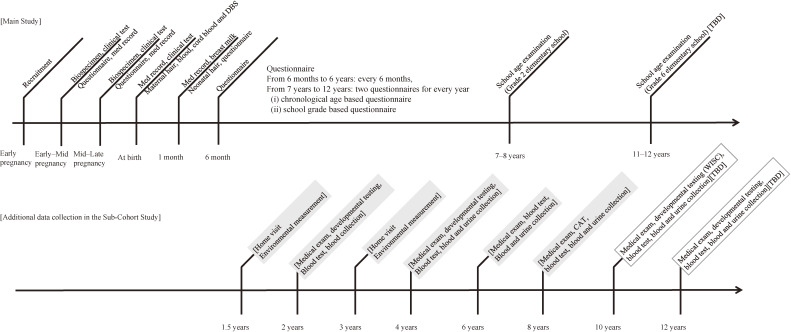
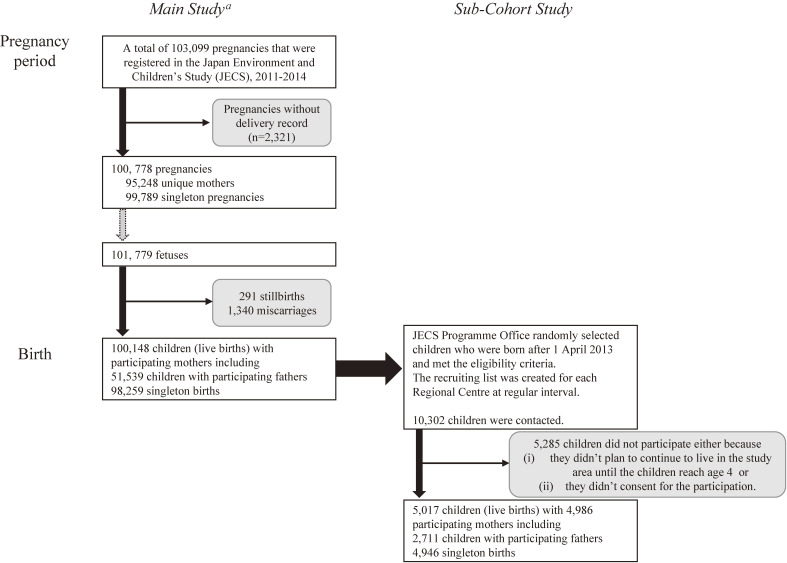
Of 100,148 children in the JECS Main Study, children born after April 1, 2013 who met eligibility criteria ([1] all questionnaire and medical record data from children and their mothers collected from the first trimester to 6 months of age, [2] biospecimens [except umbilical cord blood] from children and their mothers collected at first to second/third trimester and delivery) were randomly selected for each Regional Centre at regular intervals. Face-to-face assessment of neuropsychiatric development, body measurement, paediatrician's examination, blood/urine collection for clinical testing and chemical analysis, and home visits (ambient and indoor air measurement and dust collection) are conducted. Participants are followed up at 1.5 and 3 years old for home visits, and 2, 4, 6, and 8 years old for developmental/medical examination. The details of protocols after age 10 are under discussion.
Of 10,302 selected children, 5,017 participated. The profiles of the participating mothers, fathers and children did not substantially differ between the Main Study and Sub-Cohort Study.
The JECS Sub-Cohort Study offers a platform for investigating associations between environmental exposure and outcomes.
日本环境与儿童健康研究(JECS)是一项全国性的出生队列研究,旨在调查环境对儿童健康和发育的影响。一项子队列研究已经开始,通过针对从 JECS 主要研究中随机选择的亚组进行扩展暴露和结局测量。我们报告了子队列研究的方法学和参与者的基线特征。
在 JECS 主要研究的 100148 名儿童中,符合以下条件的儿童于 2013 年 4 月 1 日后出生,且满足入选标准([1] 从妊娠早期至 6 个月期间收集的儿童及其母亲的所有问卷调查和病历数据,[2] 儿童及其母亲的生物样本[脐带血除外]从妊娠早期至第二/三妊娠期末和分娩时收集),按照一定间隔在每个区域中心进行随机选择。对神经精神发育、身体测量、儿科医生检查、临床检测和化学分析的血液/尿液采集以及家访(环境和室内空气测量和灰尘收集)进行面对面评估。参与者在 1.5 岁和 3 岁时进行家访,在 2、4、6 和 8 岁时进行发育/医学检查。10 岁以后的方案细节正在讨论中。
在 10302 名选定的儿童中,有 5017 名儿童参加了研究。参与的母亲、父亲和儿童的特征在主要研究和子队列研究之间没有实质性差异。
JECS 子队列研究为研究环境暴露与结局之间的关系提供了一个平台。