Division of Reproductive Endocrinology and Infertility & California IVF Fertility Center, Department of Obstetrics and Gynecology, University of California Davis, Sacramento, CA, 95833, USA.
California Northstate University Medical College, Elk Grove, CA, 95757, USA.
Int J Biol Sci. 2021 Jan 1;17(1):62-72. doi: 10.7150/ijbs.51811. eCollection 2021.
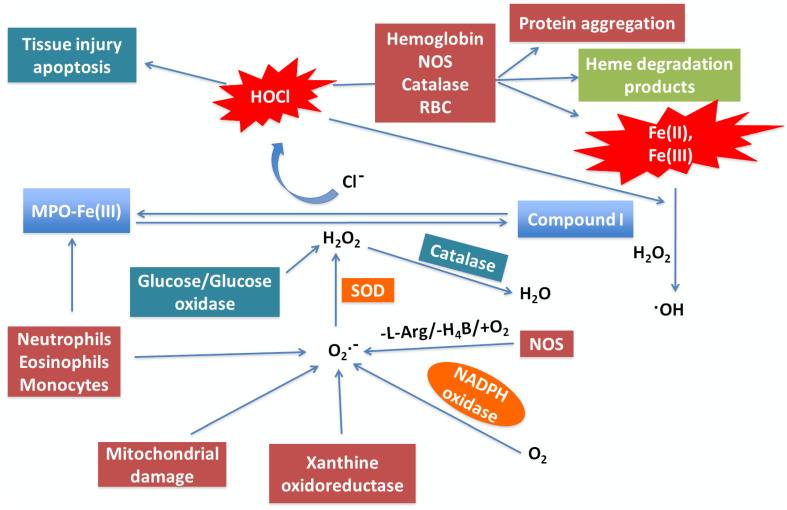
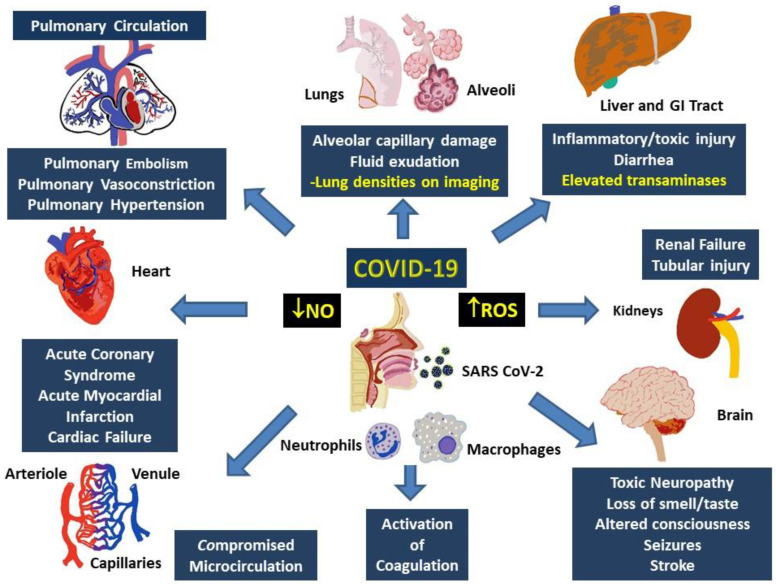
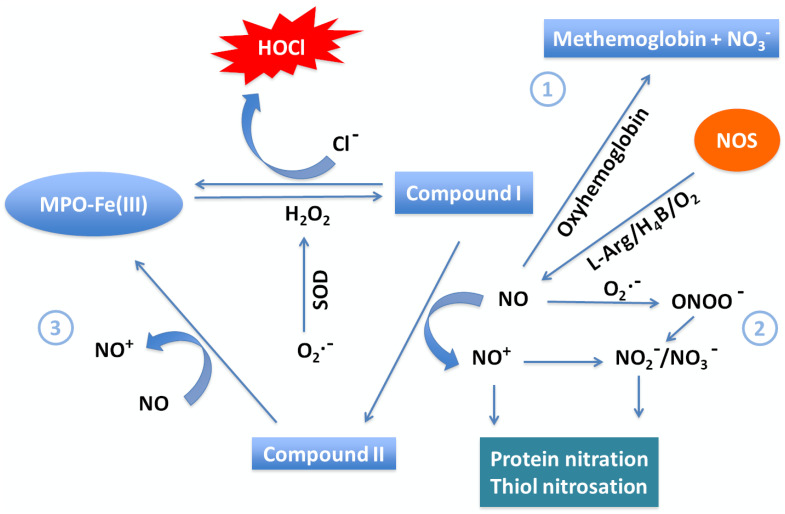
Multi-system involvement and rapid clinical deterioration are hallmarks of coronavirus disease 2019 (COVID-19) related mortality. The unique clinical phenomena in severe COVID-19 can be perplexing, and they include disproportionately severe hypoxemia relative to lung alveolar-parenchymal pathology and rapid clinical deterioration, with poor response to O supplementation, despite preserved lung mechanics. Factors such as microvascular injury, thromboembolism, pulmonary hypertension, and alteration in hemoglobin structure and function could play important roles. Overwhelming immune response associated with "cytokine storms" could activate reactive oxygen species (ROS), which may result in consumption of nitric oxide (NO), a critical vasodilation regulator. In other inflammatory infections, activated neutrophils are known to release myeloperoxidase (MPO) in a natural immune response, which contributes to production of hypochlorous acid (HOCl). However, during overwhelming inflammation, HOCl competes with O at heme binding sites, decreasing O saturation. Moreover, HOCl contributes to several oxidative reactions, including hemoglobin-heme iron oxidation, heme destruction, and subsequent release of free iron, which mediates toxic tissue injury through additional generation of ROS and NO consumption. Connecting these reactions in a multi-hit model can explain generalized tissue damage, vasoconstriction, severe hypoxia, and precipitous clinical deterioration in critically ill COVID-19 patients. Understanding these mechanisms is critical to develop therapeutic strategies to combat COVID-19.
多系统受累和快速临床恶化是 2019 年冠状病毒病(COVID-19)相关死亡的标志。严重 COVID-19 的独特临床现象可能令人费解,包括与肺肺泡-实质病理学不成比例的严重低氧血症和快速临床恶化,尽管肺力学正常,但对 O 补充的反应不佳。微血管损伤、血栓栓塞、肺动脉高压以及血红蛋白结构和功能的改变等因素可能起重要作用。与“细胞因子风暴”相关的过度免疫反应可能会激活活性氧(ROS),这可能导致一氧化氮(NO)的消耗,NO 是一种关键的血管舒张调节剂。在其他炎症性感染中,已知激活的中性粒细胞会在自然免疫反应中释放髓过氧化物酶(MPO),有助于产生次氯酸(HOCl)。然而,在过度炎症中,HOCl 在血红素结合部位与 O 竞争,降低 O 饱和度。此外,HOCl 参与几种氧化反应,包括血红蛋白-血红素铁氧化、血红素破坏以及随后释放游离铁,通过额外产生 ROS 和 NO 消耗介导毒性组织损伤。在多打击模型中连接这些反应可以解释重症 COVID-19 患者的广泛组织损伤、血管收缩、严重缺氧和急剧临床恶化。了解这些机制对于制定对抗 COVID-19 的治疗策略至关重要。