Smolen Paul, Baxter Douglas A, Byrne John H
Department of Neurobiology and Anatomy, W.M. Keck Center for the Neurobiology of Learning and Memory, McGovern Medical School at the University of Texas Health Science Center at Houston, Houston, TX, United States.
Engineering and Medicine, Texas A&M Health Science Center, Houston, TX, United States.
Front Comput Neurosci. 2020 Dec 16;14:569349. doi: 10.3389/fncom.2020.569349. eCollection 2020.
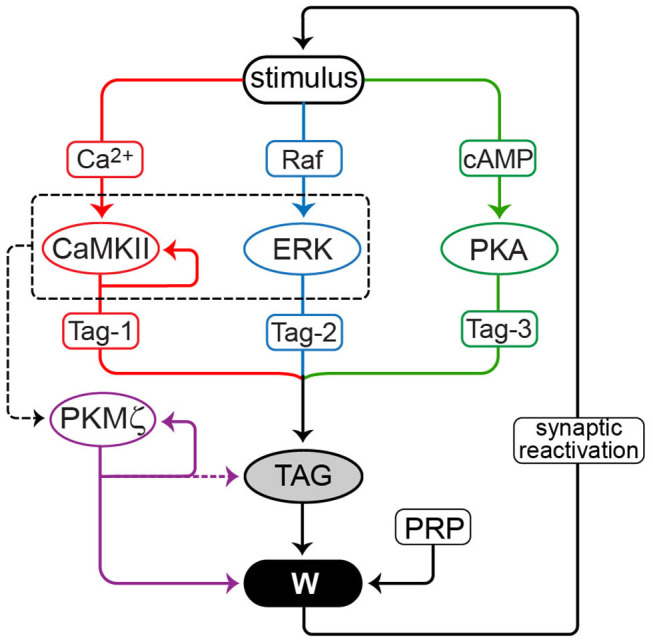
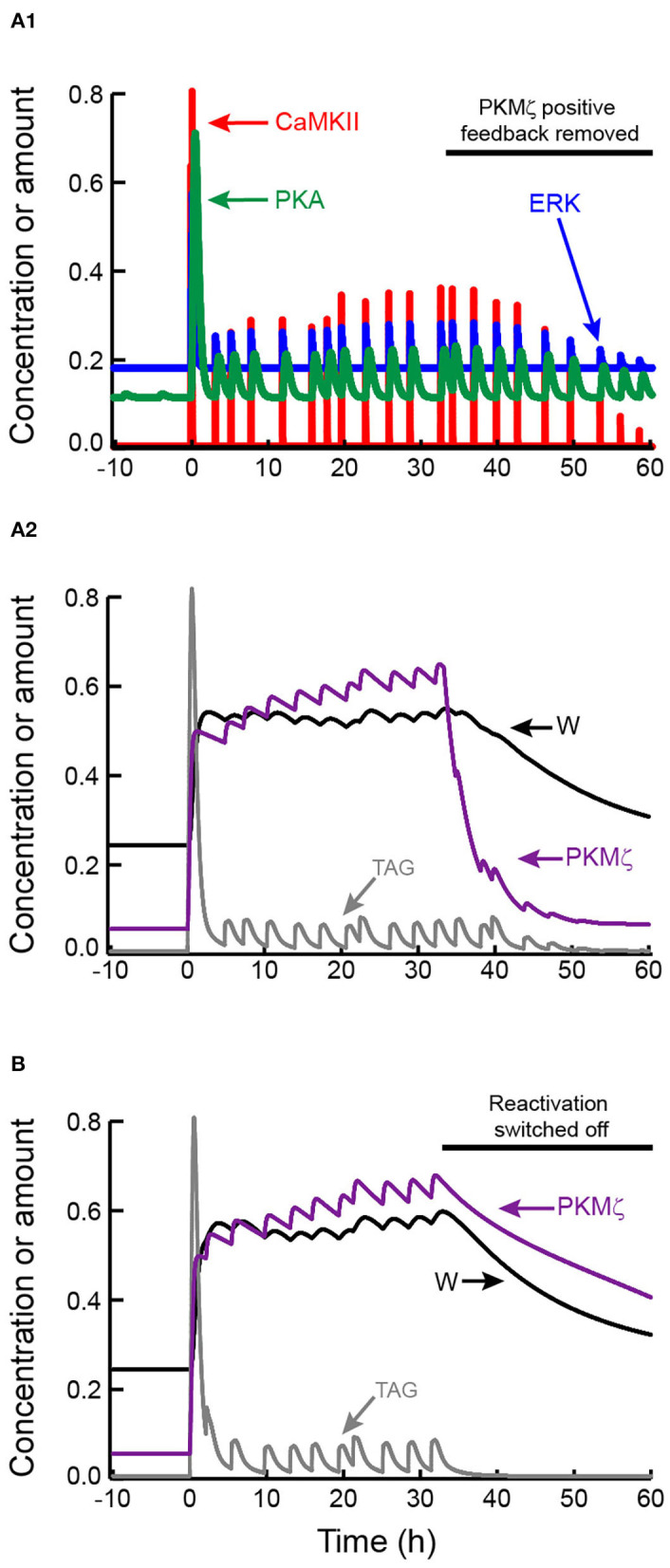
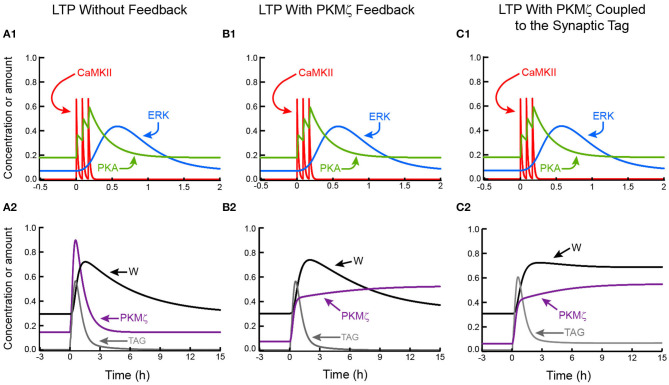
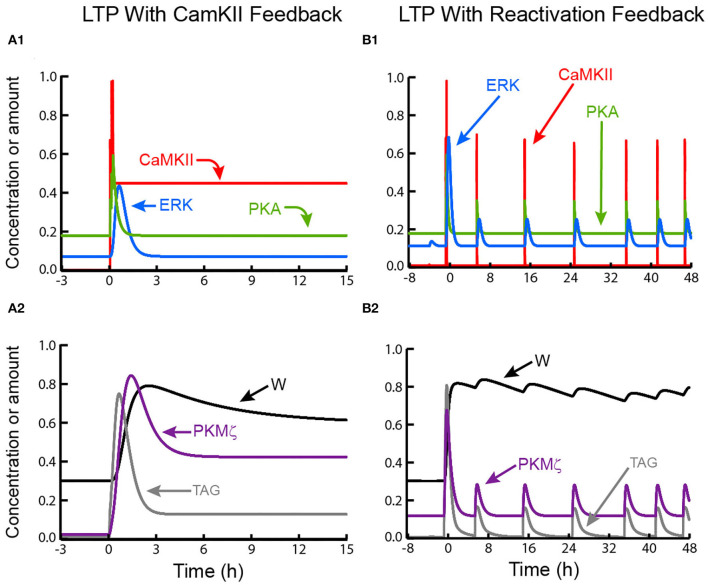
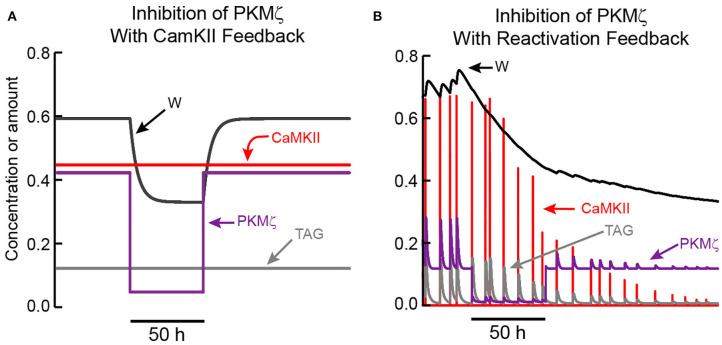
A fundamental neuroscience question is how memories are maintained from days to a lifetime, given turnover of proteins that underlie expression of long-term synaptic potentiation (LTP) or "tag" synapses as eligible for LTP. A likely solution relies on synaptic positive feedback loops, prominently including persistent activation of Ca/calmodulin kinase II (CaMKII) and self-activated synthesis of protein kinase M ζ (PKMζ). Data also suggest positive feedback based on recurrent synaptic reactivation within neuron assemblies, or engrams, is necessary to maintain memories. The relative importance of these mechanisms is controversial. To explore the likelihood that each mechanism is necessary or sufficient to maintain memory, we simulated maintenance of LTP with a simplified model incorporating persistent kinase activation, synaptic tagging, and preferential reactivation of strong synapses, and analyzed implications of recent data. We simulated three model variants, each maintaining LTP with one feedback loop: autonomous, self-activated PKMζ synthesis (model variant I); self-activated CamKII (model variant II); and recurrent reactivation of strengthened synapses (model variant III). Variant I predicts that, for successful maintenance of LTP, either 1) PKMζ contributes to synaptic tagging, or 2) a low constitutive tag level persists during maintenance independent of PKMζ, or 3) maintenance of LTP is independent of tagging. Variant II maintains LTP and suggests persistent CaMKII activation could maintain PKMζ activity, a feedforward interaction not previously considered. However, we note data challenging the CaMKII feedback loop. In Variant III synaptic reactivation drives, and thus predicts, recurrent or persistent activation of CamKII and other necessary kinases, plausibly contributing to persistent elevation of PKMζ levels. Reactivation is thus predicted to sustain recurrent rounds of synaptic tagging and incorporation of plasticity-related proteins. We also suggest (model variant IV) that synaptic reactivation and autonomous kinase activation could synergistically maintain LTP. We propose experiments that could discriminate these maintenance mechanisms.
一个基本的神经科学问题是,鉴于构成长期突触增强(LTP)表达基础的蛋白质会更新,或者“标记”突触使其有资格产生LTP,记忆是如何从数天维持到一生的。一个可能的解决方案依赖于突触正反馈回路,主要包括钙/钙调蛋白激酶II(CaMKII)的持续激活以及蛋白激酶M ζ(PKMζ)的自我激活合成。数据还表明,基于神经元集群(即记忆印迹)内反复的突触再激活的正反馈对于维持记忆是必要的。这些机制的相对重要性存在争议。为了探究每种机制对于维持记忆是必要的还是充分的可能性,我们用一个简化模型模拟了LTP的维持,该模型纳入了持续的激酶激活、突触标记以及强突触的优先再激活,并分析了近期数据的影响。我们模拟了三种模型变体,每种变体通过一个反馈回路维持LTP:自主的、自我激活的PKMζ合成(模型变体I);自我激活的CaMKII(模型变体II);以及强化突触的反复再激活(模型变体III)。变体I预测,为了成功维持LTP,要么1)PKMζ有助于突触标记,要么2)在维持过程中存在一个低水平的组成性标记,且该标记与PKMζ无关,要么3)LTP的维持与标记无关。变体II维持LTP,并表明CaMKII的持续激活可以维持PKMζ的活性,这是一种之前未被考虑的前馈相互作用。然而,我们注意到有数据对CaMKII反馈回路提出了挑战。在变体III中,突触再激活驱动并因此预测CaMKII和其他必要激酶的反复或持续激活,这可能导致PKMζ水平的持续升高。因此,再激活预计会维持一轮又一轮的突触标记以及可塑性相关蛋白的整合。我们还提出(模型变体IV)突触再激活和自主激酶激活可以协同维持LTP。我们提出了一些可以区分这些维持机制的实验。