Department of Neurobiology and Anatomy, W. M. Keck Center for the Neurobiology of Learning and Memory, McGovern Medical School of the University of Texas Health Science Center at Houston, Houston, Texas 77030, USA.
Learn Mem. 2019 Apr 16;26(5):133-150. doi: 10.1101/lm.049395.119. Print 2019 May.
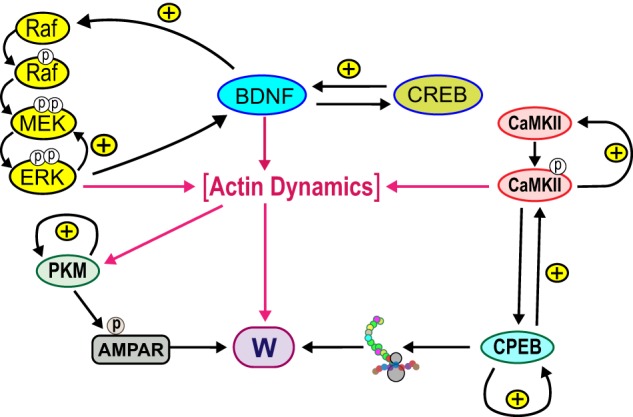
With memory encoding reliant on persistent changes in the properties of synapses, a key question is how can memories be maintained from days to months or a lifetime given molecular turnover? It is likely that positive feedback loops are necessary to persistently maintain the strength of synapses that participate in encoding. Such feedback may occur within signal-transduction cascades and/or the regulation of translation, and it may occur within specific subcellular compartments or within neuronal networks. Not surprisingly, numerous positive feedback loops have been proposed. Some posited loops operate at the level of biochemical signal-transduction cascades, such as persistent activation of Ca/calmodulin kinase II (CaMKII) or protein kinase Mζ. Another level consists of feedback loops involving transcriptional, epigenetic and translational pathways, and autocrine actions of growth factors such as BDNF. Finally, at the neuronal network level, recurrent reactivation of cell assemblies encoding memories is likely to be essential for late maintenance of memory. These levels are not isolated, but linked by shared components of feedback loops. Here, we review characteristics of some commonly discussed feedback loops proposed to underlie the maintenance of memory and long-term synaptic plasticity, assess evidence for and against their necessity, and suggest experiments that could further delineate the dynamics of these feedback loops. We also discuss crosstalk between proposed loops, and ways in which such interaction can facilitate the rapidity and robustness of memory formation and storage.
由于记忆的编码依赖于突触性质的持续变化,因此一个关键问题是,在分子周转率的情况下,如何将记忆从几天到几个月甚至一生都保持下来?很可能需要正反馈环来持续维持参与编码的突触的强度。这种反馈可能发生在信号转导级联和/或翻译调节内,也可能发生在特定的亚细胞隔室或神经元网络内。毫不奇怪,已经提出了许多正反馈环。一些假定的环在生化信号转导级联的水平上起作用,例如 Ca/calmodulin 激酶 II(CaMKII)或蛋白激酶 Mζ的持续激活。另一个层次包括涉及转录、表观遗传和翻译途径的反馈环,以及 BDNF 等生长因子的自分泌作用。最后,在神经元网络水平上,记忆编码细胞组件的反复再激活对于记忆的后期维持可能是必不可少的。这些水平不是孤立的,而是通过反馈环的共享组件连接起来的。在这里,我们回顾了一些常见的反馈环的特征,这些反馈环被认为是记忆和长时程突触可塑性维持的基础,评估了它们存在的证据以及它们存在的必要性,并提出了一些可能进一步阐明这些反馈环动态的实验。我们还讨论了提议的循环之间的串扰,以及这种相互作用如何促进记忆形成和存储的快速性和稳健性。