Naveed Zunaira Afzal, Wei Xiangying, Chen Jianjun, Mubeen Hira, Ali Gul Shad
Department of Plant Pathology, Institute of Food and Agriculture Sciences, University of Florida, Gainesville, FL, United States.
Mid-Florida Research and Education Center, Institute of Food and Agriculture Sciences, University of Florida, Apopka, FL, United States.
Front Plant Sci. 2020 Dec 17;11:593905. doi: 10.3389/fpls.2020.593905. eCollection 2020.
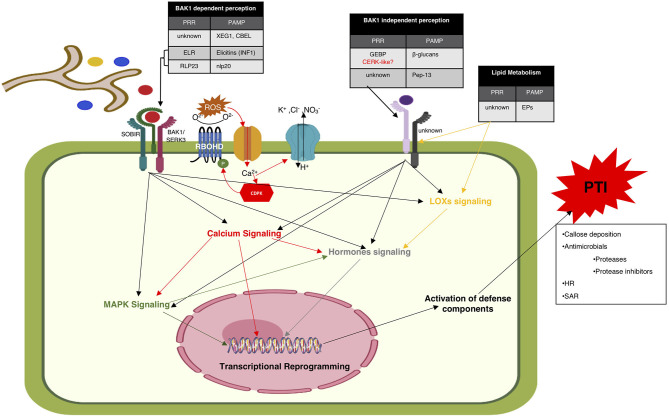
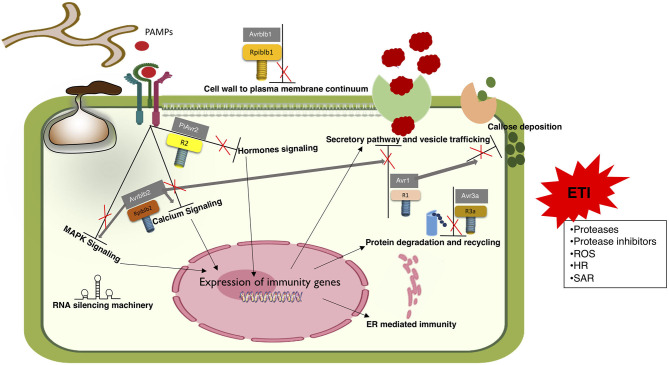
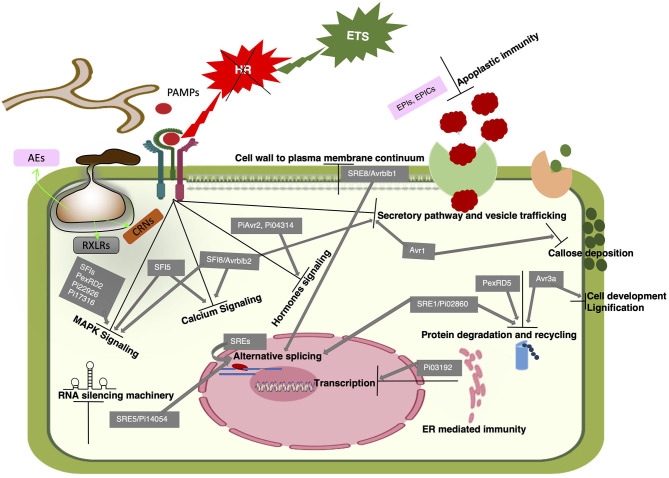
species are notorious pathogens of several economically important crop plants. Several general elicitors, commonly referred to as Pathogen-Associated Molecular Patterns (PAMPs), from spp. have been identified that are recognized by the plant receptors to trigger induced defense responses in a process termed PAMP-triggered Immunity (PTI). Adapted pathogens have evolved multiple strategies to evade PTI. They can either modify or suppress their elicitors to avoid recognition by host and modulate host defense responses by deploying hundreds of effectors, which suppress host defense and physiological processes by modulating components involved in calcium and MAPK signaling, alternative splicing, RNA interference, vesicle trafficking, cell-to-cell trafficking, proteolysis and phytohormone signaling pathways. In incompatible interactions, resistant host plants perceive effector-induced modulations through resistance proteins and activate downstream components of defense responses in a quicker and more robust manner called effector-triggered-immunity (ETI). When pathogens overcome PTI-usually through effectors in the absence of R proteins-effectors-triggered susceptibility (ETS) ensues. Qualitatively, many of the downstream defense responses overlap between PTI and ETI. In general, these multiple phases of plant interactions follow the PTI-ETS-ETI paradigm, initially proposed in the zigzag model of plant immunity. However, based on several examples, in -plant interactions, boundaries between these phases are not distinct but are rather blended pointing to a PTI-ETI continuum.
该物种是几种具有重要经济价值的农作物的臭名昭著的病原体。已从该物种中鉴定出几种通常称为病原体相关分子模式(PAMPs)的通用激发子,这些激发子可被植物受体识别,从而在称为PAMP触发免疫(PTI)的过程中触发诱导的防御反应。适应性病原体已经进化出多种策略来逃避PTI。它们可以修饰或抑制其激发子,以避免被宿主识别,并通过部署数百种效应子来调节宿主防御反应,这些效应子通过调节参与钙和MAPK信号传导、可变剪接、RNA干扰、囊泡运输、细胞间运输、蛋白水解和植物激素信号传导途径的成分来抑制宿主防御和生理过程。在不亲和的相互作用中,抗性宿主植物通过抗性蛋白感知效应子诱导的调节,并以更快、更强壮的方式激活防御反应的下游成分,称为效应子触发免疫(ETI)。当病原体克服PTI时(通常是在没有R蛋白的情况下通过效应子),就会出现效应子触发的易感性(ETS)。定性地说,PTI和ETI之间的许多下游防御反应是重叠的。一般来说,植物相互作用的这些多个阶段遵循最初在植物免疫的zigzag模型中提出的PTI-ETS-ETI范式。然而,基于几个例子,在植物相互作用中,这些阶段之间的界限并不明显,而是相互融合,指向PTI-ETI连续体。