Sievers Katie T, McClure Eva C, Abesamis Rene A, Russ Garry R
College of Science and Engineering James Cook University Townsville QLD Australia.
Australia Research Council Centre of Excellence for Coral Reef Studies James Cook University Townsville QLD Australia.
Ecol Evol. 2020 Nov 19;10(24):13673-13686. doi: 10.1002/ece3.6940. eCollection 2020 Dec.
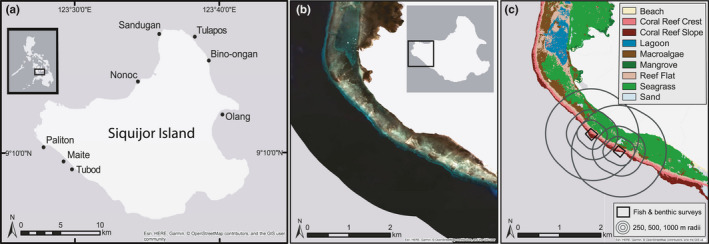
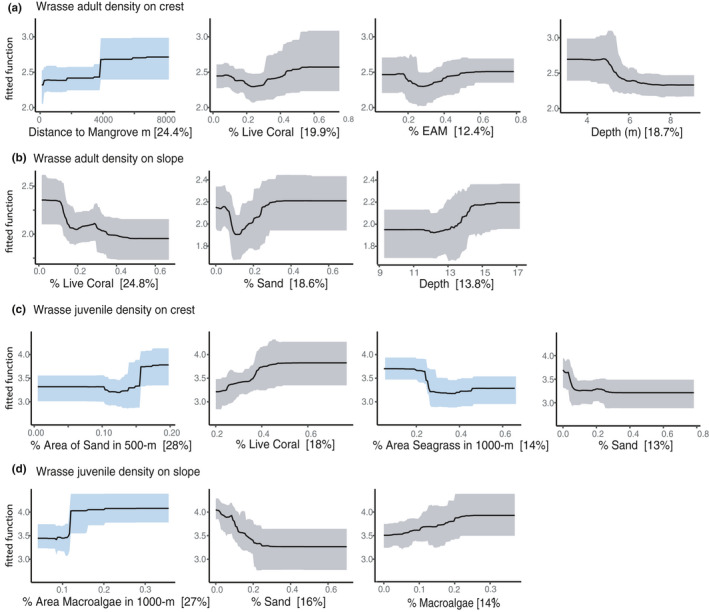
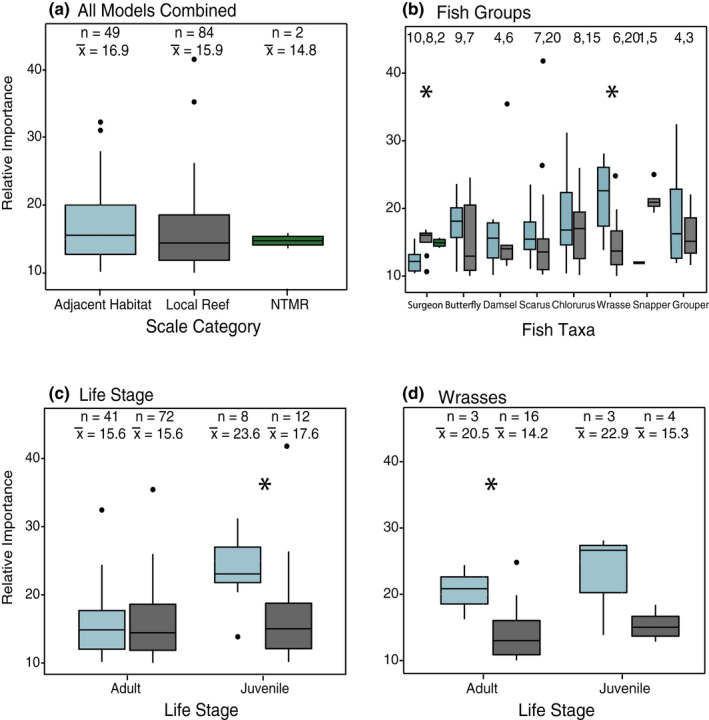
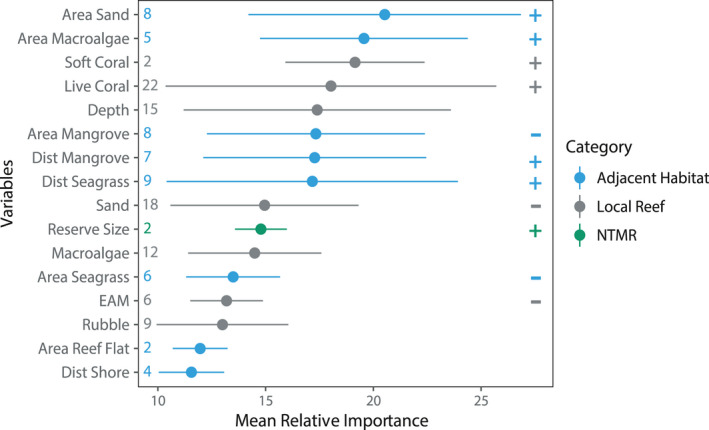
Nonreef habitats such as mangroves, seagrass, and macroalgal beds are important for foraging, spawning, and as nursery habitat for some coral reef fishes. The spatial configuration of nonreef habitats adjacent to coral reefs can therefore have a substantial influence on the distribution and composition of reef fish. We investigate how different habitats in a tropical seascape in the Philippines influence the presence, density, and biomass of coral reef fishes to understand the relative importance of different habitats across various spatial scales. A detailed seascape map generated from satellite imagery was combined with field surveys of fish and benthic habitat on coral reefs. We then compared the relative importance of local reef (within coral reef) and adjacent habitat (habitats in the surrounding seascape) variables for coral reef fishes. Overall, adjacent habitat variables were as important as local reef variables in explaining reef fish density and biomass, despite being fewer in number in final models. For adult and juvenile wrasses (Labridae), and juveniles of some parrotfish taxa (, adjacent habitat was more important in explaining fish density and biomass. Notably, wrasses were positively influenced by the amount of sand and macroalgae in the adjacent seascape. Adjacent habitat metrics with the highest relative importance were sand (positive), macroalgae (positive), and mangrove habitats (negative), and fish responses to these metrics were consistent across fish groups evaluated. The 500-m spatial scale was selected most often in models for seascape variables. Local coral reef variables with the greatest importance were percent cover of live coral (positive), sand (negative), and macroalgae (mixed). Incorporating spatial metrics that describe the surrounding seascape will capture more holistic patterns of fish-habitat relationships on reefs. This is important in regions where protection of reef fish habitat is an integral part of fisheries management but where protection of nonreef habitats is often overlooked.
红树林、海草床和大型海藻床等非珊瑚礁栖息地对于某些珊瑚礁鱼类的觅食、产卵以及作为育幼栖息地而言非常重要。因此,与珊瑚礁相邻的非珊瑚礁栖息地的空间配置会对礁鱼的分布和组成产生重大影响。我们研究了菲律宾热带海景中不同栖息地如何影响珊瑚礁鱼类的存在、密度和生物量,以了解不同栖息地在各种空间尺度上的相对重要性。利用卫星图像生成的详细海景地图与珊瑚礁鱼类和底栖栖息地的实地调查相结合。然后,我们比较了本地珊瑚礁(珊瑚礁内部)和相邻栖息地(周边海景中的栖息地)变量对珊瑚礁鱼类的相对重要性。总体而言,尽管在最终模型中相邻栖息地变量的数量较少,但在解释礁鱼密度和生物量方面,相邻栖息地变量与本地珊瑚礁变量同样重要。对于成年和幼年隆头鱼(隆头鱼科)以及一些鹦嘴鱼分类群的幼鱼来说,相邻栖息地在解释鱼类密度和生物量方面更为重要。值得注意的是,隆头鱼受到相邻海景中沙子和大型海藻数量的积极影响。相对重要性最高的相邻栖息地指标是沙子(正向)、大型海藻(正向)和红树林栖息地(负向),并且在评估的鱼类群体中,鱼类对这些指标的反应是一致的。在海景变量模型中,最常选择的空间尺度是500米。最重要的本地珊瑚礁变量是活珊瑚覆盖率(正向)、沙子(负向)和大型海藻(混合)。纳入描述周边海景的空间指标将捕捉到珊瑚礁上鱼类与栖息地关系更全面的模式。这在将保护礁鱼栖息地作为渔业管理不可或缺的一部分,但非珊瑚礁栖息地保护往往被忽视的地区非常重要。