Wibawa Hendra, Hakim Mohamad Saifudin, Daniwijaya Edwin Widyanto, Rizki Ludhang Pradipta, Supriyati Endah, Nugrahaningsih Dwi Aris Agung, Iskandar Kristy, Anggorowati Nungki, Kalim Alvin Santoso, Puspitarani Dyah Ayu, Athollah Kemala, Arguni Eggi, Nuryastuti Titik, Wibawa Tri
Pediatric Surgery Division, Department of Surgery, Faculty of Medicine, Public Health and Nursing, Universitas Gadjah Mada, Yogyakarta, Indonesia.
Disease Investigation Center Wates, Yogyakarta, Ministry of Agriculture, Indonesia.
PeerJ. 2020 Dec 21;8:e10575. doi: 10.7717/peerj.10575. eCollection 2020.
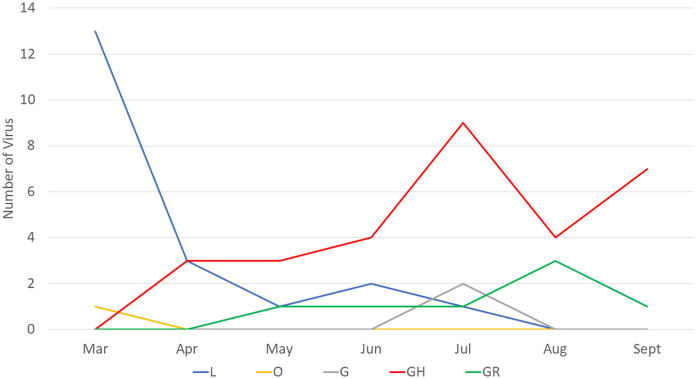
Recently, SARS-CoV-2 virus with the D614G mutation has become a public concern due to rapid dissemination of this variant across many countries. Our study aims were (1) to report full-length genome sequences of SARS-CoV-2 collected from four COVID-19 patients in the Special Region of Yogyakarta and Central Java provinces, Indonesia; (2) to compare the clade distribution of full-length genome sequences from Indonesia ( = 60) from March to September 2020 and (3) to perform phylogenetic analysis of SARS-CoV-2 complete genomes from different countries, including Indonesia.
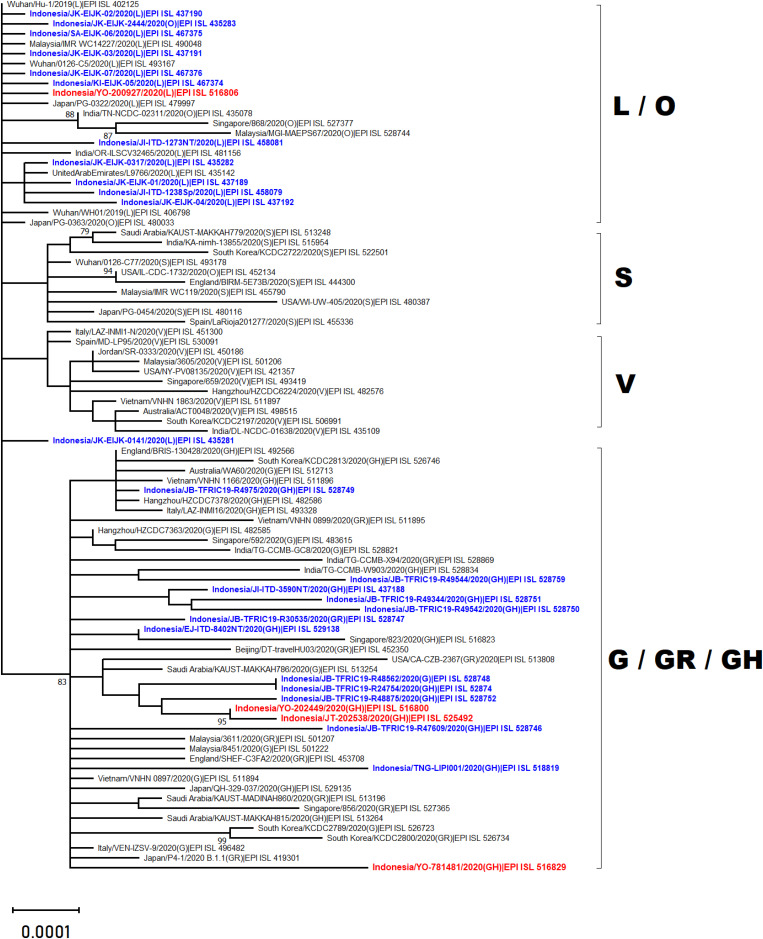
Whole genome sequencing (WGS) was performed using next-generation sequencing (NGS) applied in the Illumina MiSeq instrument. Full-length virus genomes were annotated using the reference genome of hCoV-19/Wuhan/Hu-1/2019 (NC_045512.2) and then visualized in UGENE v. 1.30. For phylogenetic analysis, a dataset of 88 available SARS-CoV-2 complete genomes from different countries, including Indonesia, was retrieved from GISAID.
All patients were hospitalized with various severities of COVID-19. Phylogenetic analysis revealed that one and three virus samples belong to clade L and GH. These three clade GH virus samples (EPI_ISL_525492, EPI_ISL_516800 and EPI_ISL_516829) were not only located in a cluster with SARS-CoV-2 genomes from Asia but also those from Europe, whereas the clade L virus sample (EPI_ISL_516806) was located amongst SARS-CoV-2 genomes from Asia. Using full-length sequences available in the GISAID EpiCoV Database, 39 of 60 SARS-CoV-2 (65%) from Indonesia harbor the D614G mutation.
These findings indicate that SARS-CoV-2 with the D614G mutation appears to become the major circulating virus in Indonesia, concurrent with the COVID-19 situation worldwide.
最近,携带D614G突变的严重急性呼吸综合征冠状病毒2(SARS-CoV-2)病毒因该变种在许多国家迅速传播而受到公众关注。我们的研究目的是:(1)报告从印度尼西亚日惹特别行政区和中爪哇省的4例2019冠状病毒病(COVID-19)患者中收集的SARS-CoV-2全长基因组序列;(2)比较2020年3月至9月来自印度尼西亚的60条全长基因组序列的进化枝分布;(3)对包括印度尼西亚在内的不同国家的SARS-CoV-2完整基因组进行系统发育分析。
使用应用于Illumina MiSeq仪器的下一代测序(NGS)进行全基因组测序(WGS)。使用hCoV-19/武汉/Hu-1/2019(NC_045512.2)的参考基因组对全长病毒基因组进行注释,然后在UGENE v. 1.30中进行可视化。为了进行系统发育分析,从全球共享流感数据倡议组织(GISAID)检索了包括印度尼西亚在内的不同国家的88条可用SARS-CoV-2完整基因组数据集。
所有患者均因不同严重程度的COVID-19住院。系统发育分析显示,1个和3个病毒样本分别属于L和GH进化枝。这3个GH进化枝病毒样本(EPI_ISL_525492、EPI_ISL_516800和EPI_ISL_516829)不仅与来自亚洲的SARS-CoV-2基因组聚集在一起,也与来自欧洲的聚集在一起,而L进化枝病毒样本(EPI_ISL_516806)位于来自亚洲的SARS-CoV-2基因组之中。利用GISAID EpiCoV数据库中可用的全长序列,印度尼西亚60条SARS-CoV-2序列中有39条(65%)携带D614G突变。
这些发现表明,携带D614G突变的SARS-CoV-2似乎已成为印度尼西亚主要的流行病毒,这与全球COVID-19疫情形势一致。