Institute for Stem Cell Research and Regenerative Medicine, Medical Faculty, Heinrich Heine University, 40225, Düsseldorf, Germany.
Sci Rep. 2021 Oct 26;11(1):21108. doi: 10.1038/s41598-021-00267-w.
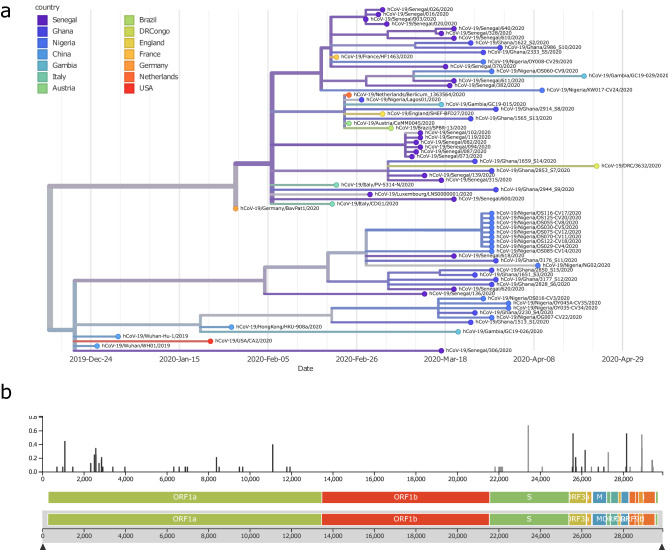
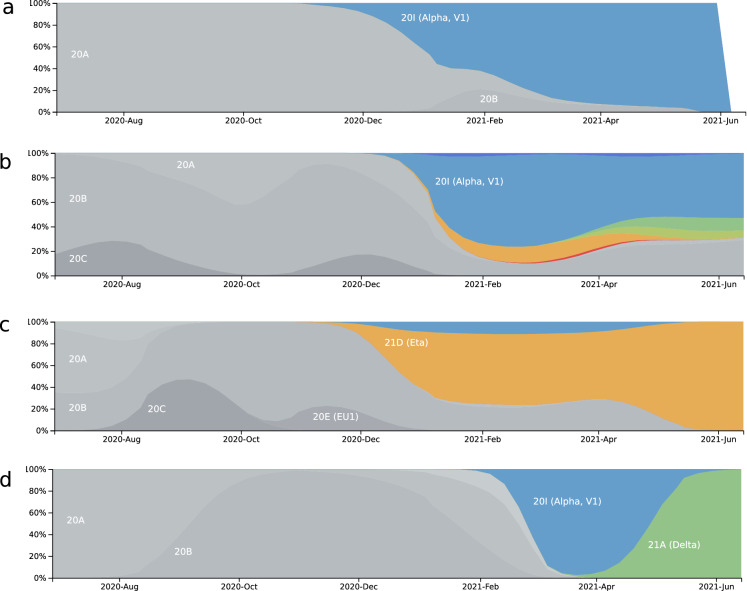
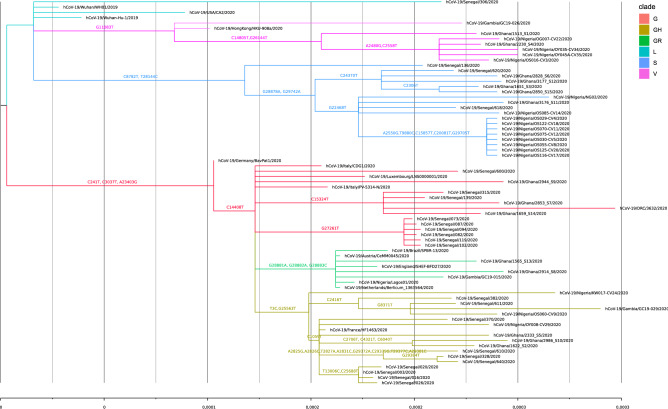
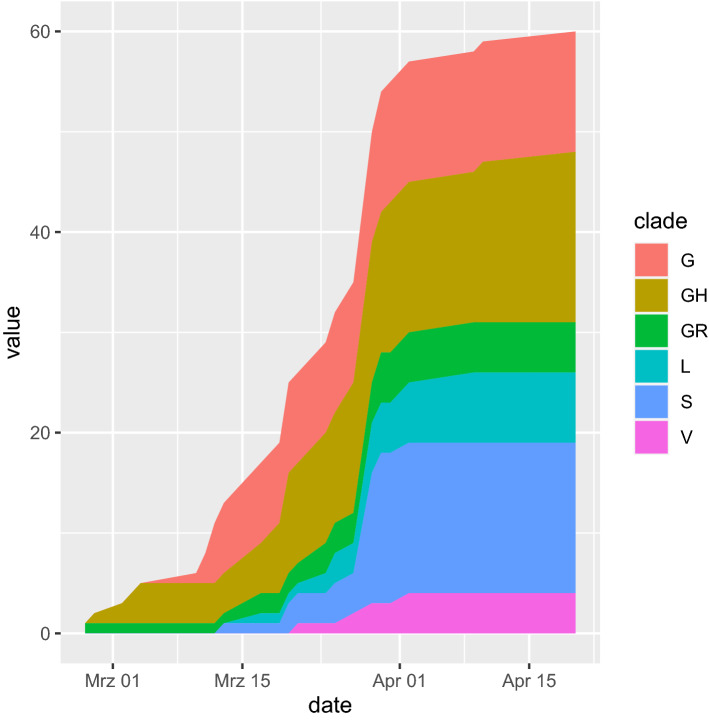
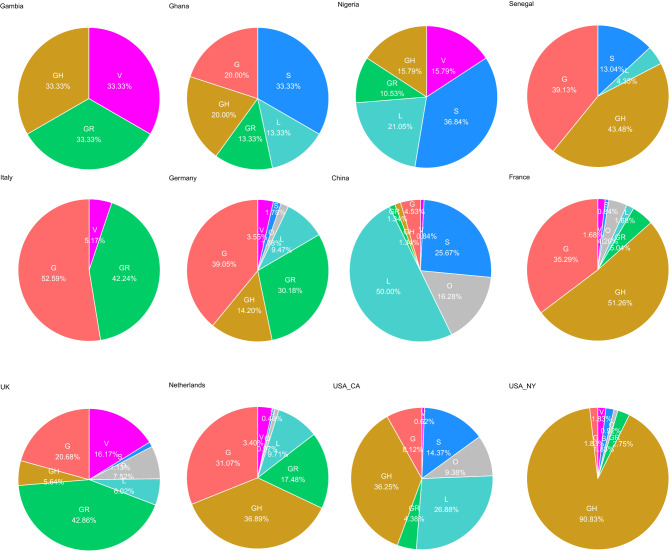
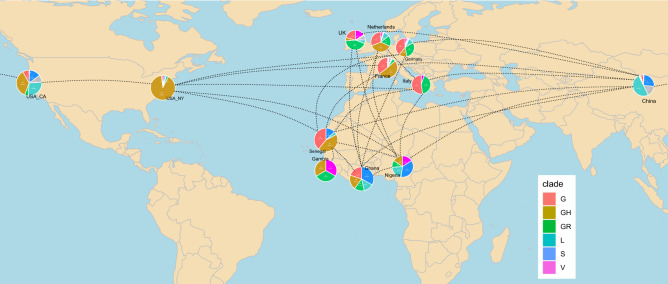
SARS-CoV-2, the virus causing the COVID-19 pandemic emerged in December 2019 in China and raised fears it could overwhelm healthcare systems worldwide. Mutations of the virus are monitored by the GISAID database from which we downloaded sequences from four West African countries Ghana, Gambia, Senegal and Nigeria from February 2020 to April 2020. We subjected the sequences to phylogenetic analysis employing the nextstrain pipeline. We found country-specific patterns of viral variants and supplemented that with data on novel variants from June 2021. Until April 2020, variants carrying the crucial Europe-associated D614G amino acid change were predominantly found in Senegal and Gambia, and combinations of late variants with and early variants without D614G in Ghana and Nigeria. In June 2021 all variants carried the D614G amino acid substitution. Senegal and Gambia exhibited again variants transmitted from Europe (alpha or delta), Ghana a combination of several variants and in Nigeria the original Eta variant. Detailed analysis of distinct samples revealed that some might have circulated latently and some reflect migration routes. The distinct patterns of variants within the West African countries point at their global transmission via air traffic predominantly from Europe and only limited transmission between the West African countries.
导致 COVID-19 大流行的 SARS-CoV-2 病毒于 2019 年 12 月在中国出现,引发了人们对其可能使全球医疗体系不堪重负的担忧。病毒的突变由 GISAID 数据库监测,我们从该数据库下载了 2020 年 2 月至 4 月来自四个西非国家加纳、冈比亚、塞内加尔和尼日利亚的序列。我们将这些序列提交给 nextstrain 管道进行系统发育分析。我们发现了特定国家的病毒变体模式,并补充了 2021 年 6 月以来新型变体的数据。直到 2020 年 4 月,在塞内加尔和冈比亚主要发现携带关键的欧洲相关 D614G 氨基酸变化的变体,而在加纳和尼日利亚则是晚期变体与早期变体无 D614G 的组合。2021 年 6 月,所有变体均携带 D614G 氨基酸取代。塞内加尔和冈比亚再次出现了来自欧洲(阿尔法或德尔塔)的变体,加纳则是几种变体的组合,而尼日利亚则是原始的 Eta 变体。对不同样本的详细分析表明,一些样本可能一直处于潜伏状态,而另一些则反映了迁移路线。西非国家内部变体的不同模式表明,它们主要通过航空交通从欧洲传播到全球,而在西非国家之间的传播则非常有限。