Department of Physiology, Tokyo Medical University, Tokyo 160-8402, Japan.
Int J Mol Sci. 2020 Dec 30;22(1):327. doi: 10.3390/ijms22010327.
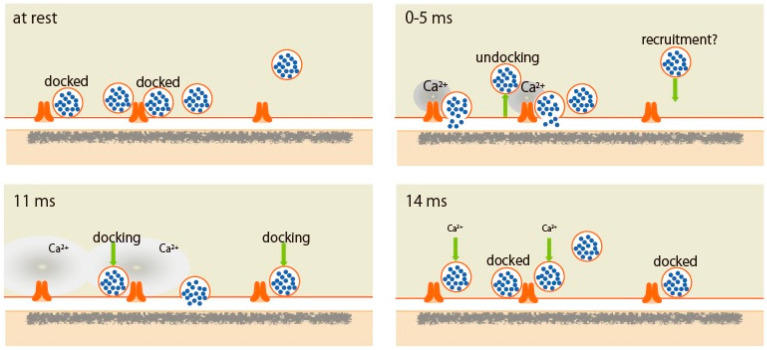
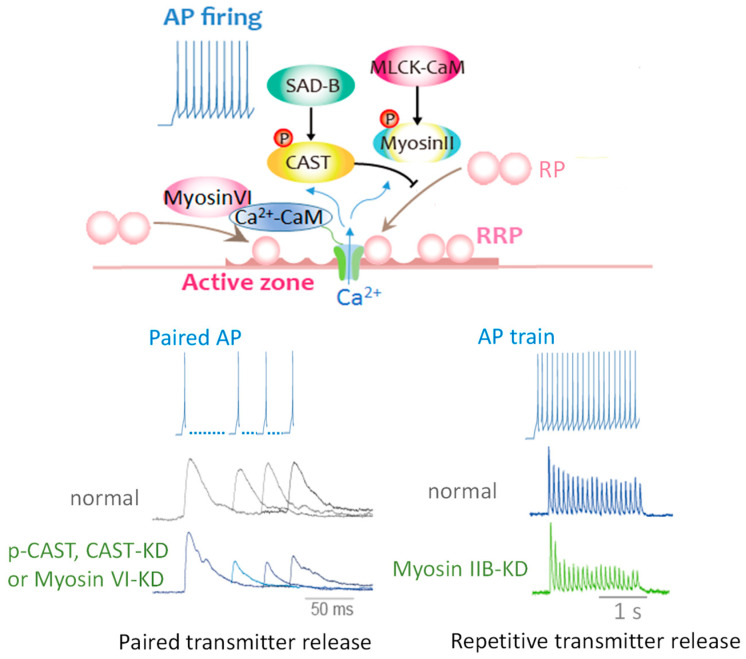
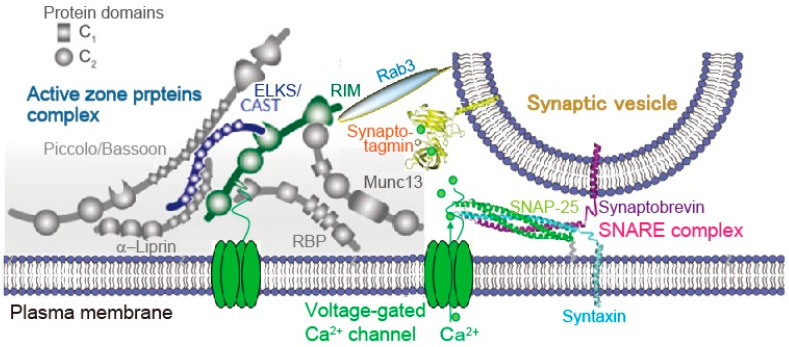
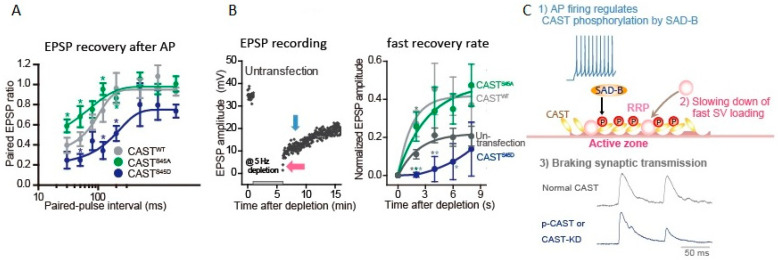
An action potential (AP) triggers neurotransmitter release from synaptic vesicles (SVs) docking to a specialized release site of presynaptic plasma membrane, the active zone (AZ). The AP simultaneously controls the release site replenishment with SV for sustainable synaptic transmission in response to incoming neuronal signals. Although many studies have suggested that the replenishment time is relatively slow, recent studies exploring high speed resolution have revealed SV dynamics with milliseconds timescale after an AP. Accurate regulation is conferred by proteins sensing Ca entering through voltage-gated Ca channels opened by an AP. This review summarizes how millisecond Ca dynamics activate multiple protein cascades for control of the release site replenishment with release-ready SVs that underlie presynaptic short-term plasticity.
动作电位 (AP) 触发突触小泡 (SV) 从突触前质膜的特化释放位点 (即活性区,AZ) 中释放神经递质。AP 同时控制释放位点的 SV 补充,以响应传入的神经元信号,实现可持续的突触传递。尽管许多研究表明补充时间相对较慢,但最近探索高速分辨率的研究揭示了 AP 后毫秒级的 SV 动力学。通过感应 Ca 的蛋白的精确调节进入通过 AP 打开的电压门控 Ca 通道。本综述总结了毫秒级 Ca 动力学如何激活多个蛋白级联反应,以控制具有释放准备 SV 的释放位点补充,这是突触前短期可塑性的基础。