Laboratory of Brain Physiology, CNRS UMR 8118, Paris Descartes University, 45 rue des Saints Pères, 75006, Paris, France.
Graduate School of Brain Science, Doshisha University, 1-3 Tatara Miyakodani, Kyotanabe-shi, Kyoto, 610-0394, Japan.
Nat Commun. 2018 Sep 26;9(1):3943. doi: 10.1038/s41467-018-06336-5.
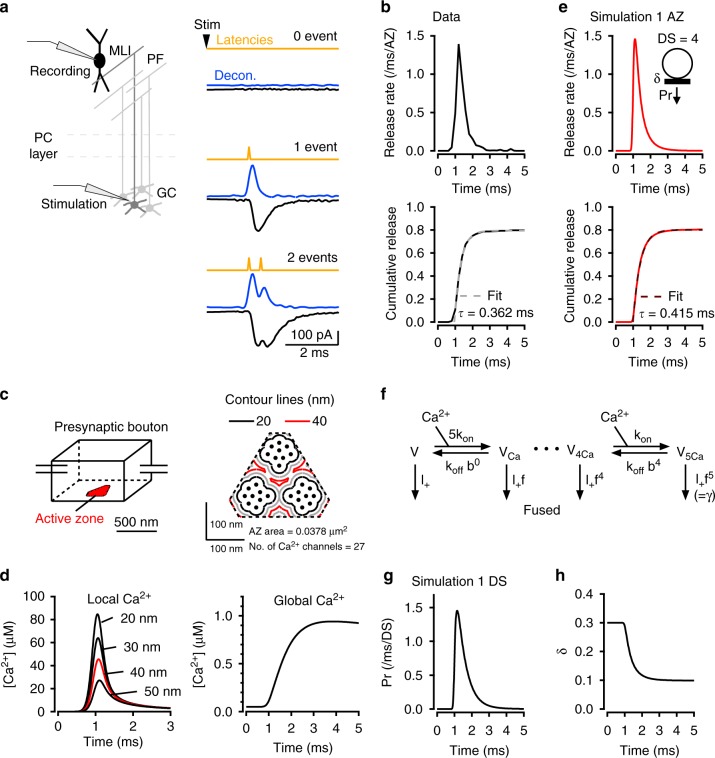
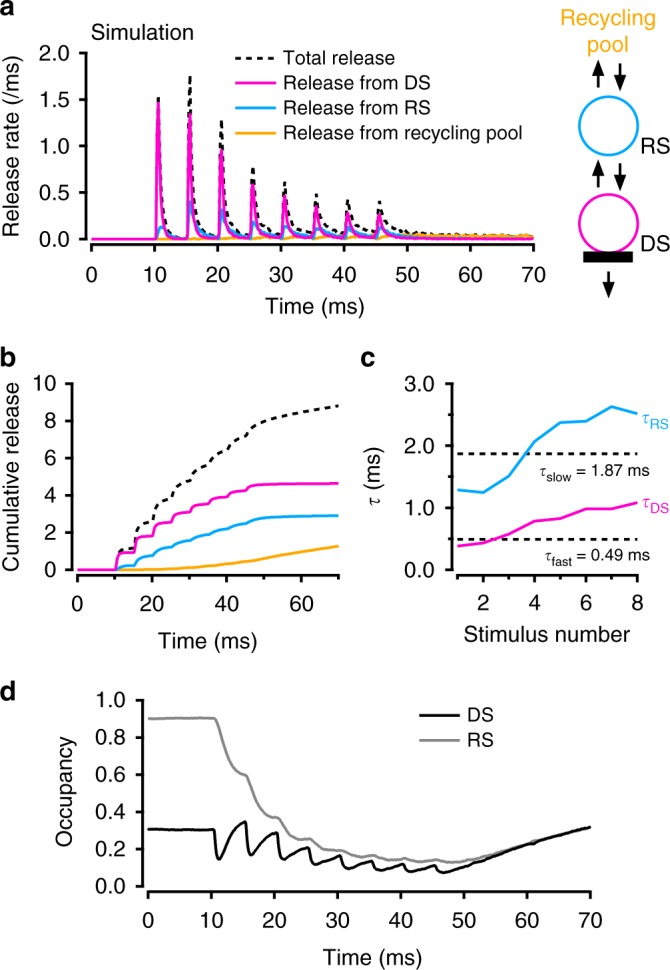
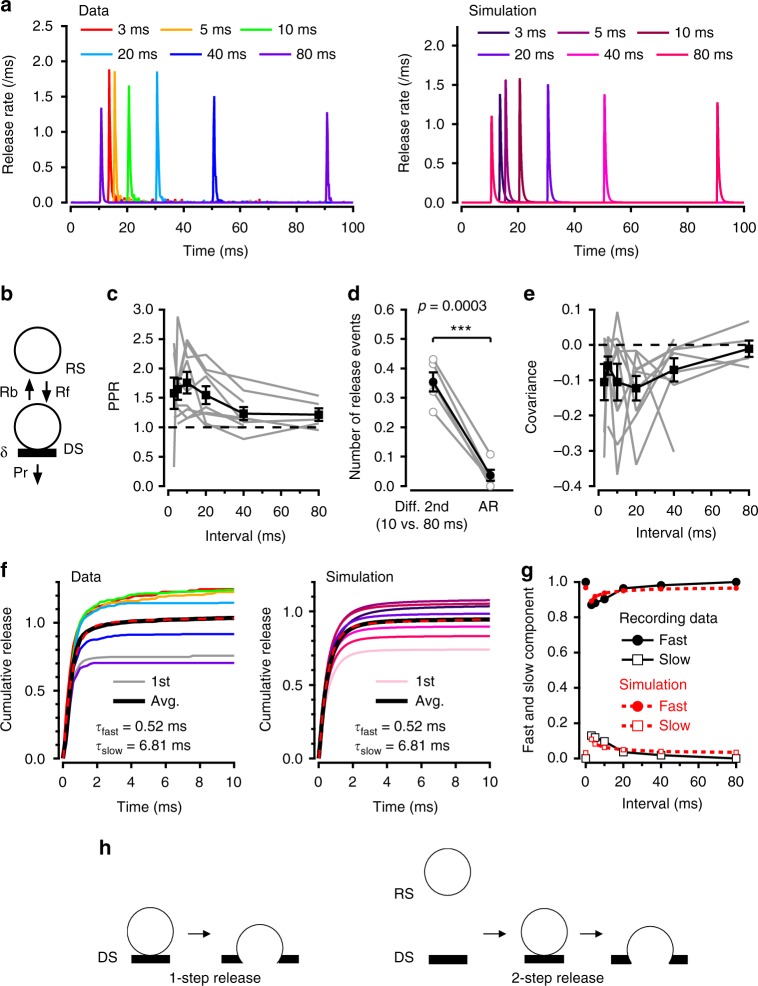
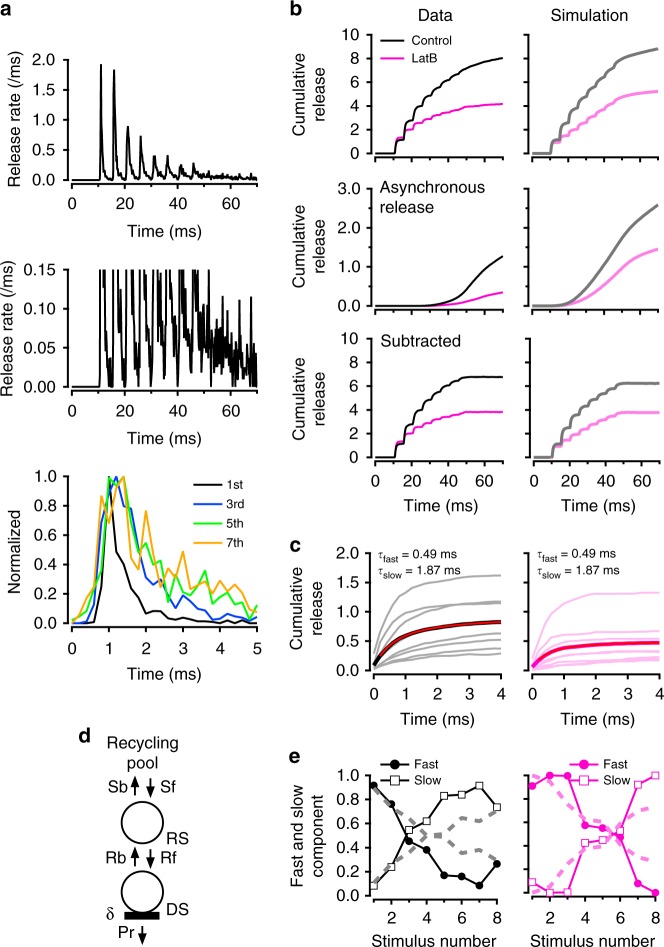
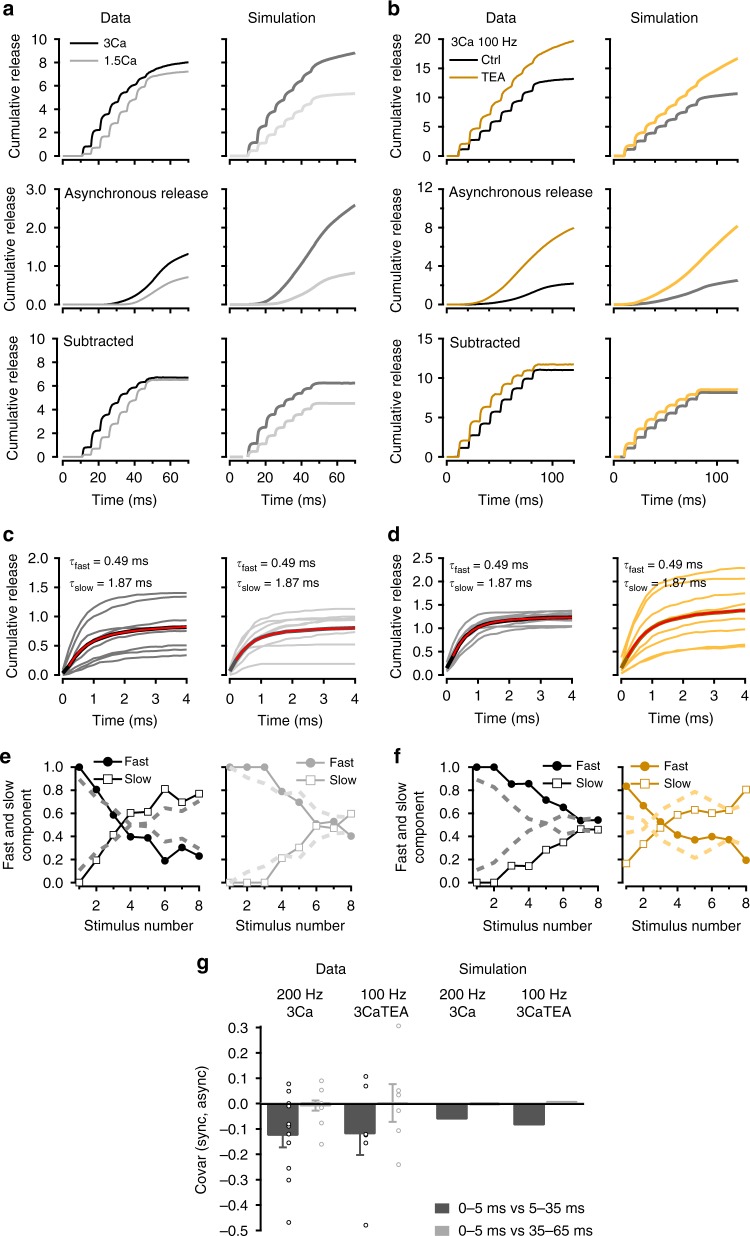
It is often assumed that only stably docked synaptic vesicles can fuse following presynaptic action potential stimulation. However, during action potential trains docking sites are increasingly depleted, raising the question of the source of synaptic vesicles during sustained release. We have recently developed methods to reliably measure release latencies during high frequency trains at single synapses between parallel fibers and molecular layer interneurons. The latency distribution exhibits a single fast component at train onset but contains both a fast and a slow component later in the train. The contribution of the slow component increases with stimulation frequency and with release probability and decreases when blocking the docking step with latrunculin. These results suggest that the slow component reflects sequential docking and release in immediate succession. The transition from fast to slow component, as well as a later transition to asynchronous release, appear as successive adaptations of the synapse to maintain fidelity at the expense of time accuracy.
人们通常认为,只有稳定停靠的突触小泡才能在突触前动作电位刺激后融合。然而,在动作电位串中,停靠位点逐渐耗尽,这就引发了一个问题,即在持续释放期间,突触小泡的来源是什么。我们最近开发了一些方法,可以在平行纤维和分子层中间神经元之间的单个突触上的高频串中可靠地测量释放潜伏期。潜伏期分布在串起始时表现出一个快速的单一成分,但在串的后期包含一个快速和一个缓慢的成分。慢成分的贡献随着刺激频率的增加和释放概率的增加而增加,而在用 latrunculin 阻断停靠步骤时则减少。这些结果表明,慢成分反映了连续的停靠和连续释放。从快速到慢速成分的转变,以及随后向异步释放的转变,似乎是突触为了在时间精度上保持保真度而做出的连续适应。