Center for Brain and Cognition, Computational Neuroscience Group, Department of Information and Communication Technologies, Universitat Pompeu Fabra, Barcelona, Spain.
Institució Catalana de la Recerca i Estudis Avançats (ICREA), Barcelona, Spain.
Nat Hum Behav. 2021 Apr;5(4):497-511. doi: 10.1038/s41562-020-01003-6. Epub 2021 Jan 4.
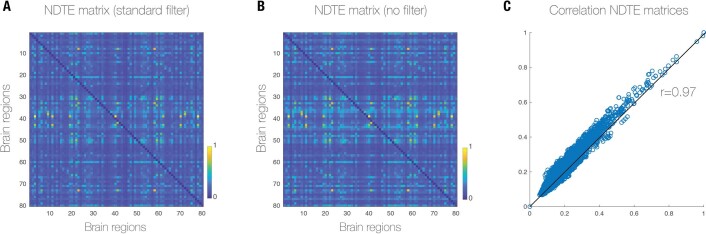
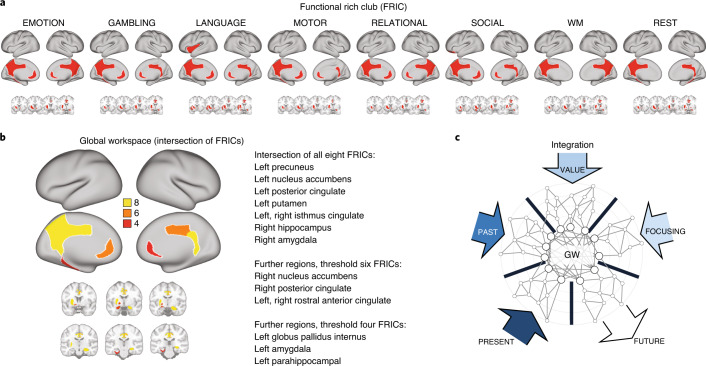
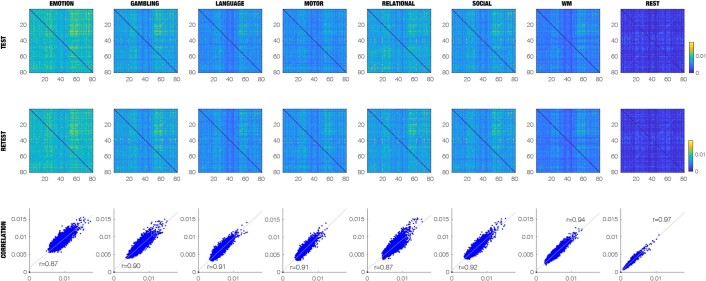
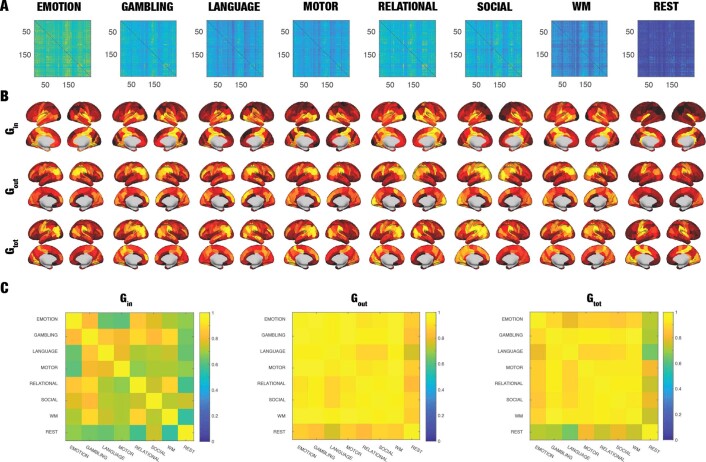
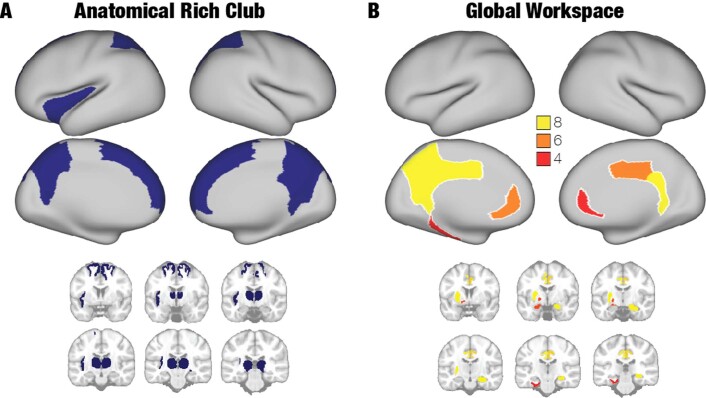
A central challenge in neuroscience is how the brain organizes the information necessary to orchestrate behaviour. Arguably, this whole-brain orchestration is carried out by a core subset of integrative brain regions, a 'global workspace', but its constitutive regions remain unclear. We quantified the global workspace as the common regions across seven tasks as well as rest, in a common 'functional rich club'. To identify this functional rich club, we determined the information flow between brain regions by means of a normalized directed transfer entropy framework applied to multimodal neuroimaging data from 1,003 healthy participants and validated in participants with retest data. This revealed a set of regions orchestrating information from perceptual, long-term memory, evaluative and attentional systems. We confirmed the causal significance and robustness of our results by systematically lesioning a generative whole-brain model. Overall, this framework describes a complex choreography of the functional hierarchical organization of the human brain.
神经科学的一个核心挑战是大脑如何组织协调行为所需的信息。可以说,这种全脑协调是由一个核心的整合脑区,即“全局工作空间”来执行的,但它的组成区域尚不清楚。我们在一个共同的“功能丰富俱乐部”中,将全局工作空间定义为七个任务以及休息时共有的共同区域。为了识别这个功能丰富的俱乐部,我们通过使用归一化有向转移熵框架来确定大脑区域之间的信息流,该框架适用于来自 1003 名健康参与者的多模态神经影像学数据,并在具有重测数据的参与者中进行了验证。这揭示了一组协调来自感知、长期记忆、评价和注意力系统的信息的区域。我们通过系统地损伤一个生成式全脑模型,确认了我们结果的因果意义和稳健性。总的来说,这个框架描述了人类大脑功能层次组织的复杂编排。