Mohebati Lisa M, Hilpert Peter, Bath Sarah, Rayman Margaret P, Raats Monique M, Martinez Homero, Caulfield Laura E
Center for Human Nutrition, Department of International Health, Johns Hopkins University Bloomberg School of Public Health, Baltimore, Maryland, USA.
Nutrition, Food and Exercise Sciences Department, School of Biosciences and Medicine, University of Surrey, Guildford, Surrey, UK.
Matern Child Nutr. 2021 Jul;17(3):e13133. doi: 10.1111/mcn.13133. Epub 2021 Jan 5.
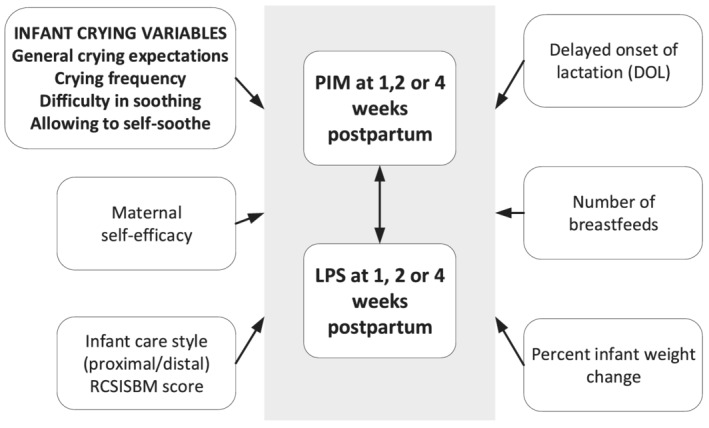
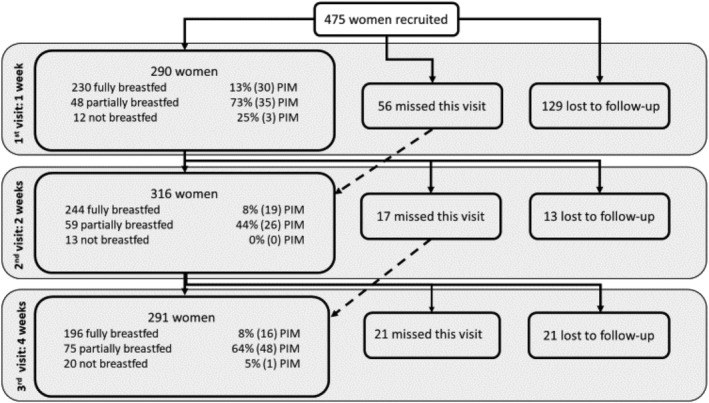
Breastfeeding mothers often report perceived insufficient milk (PIM) believing their infant is crying too much, which leads to introducing formula and the early abandonment of breastfeeding. We sought to determine if infant crying was associated with reported PIM (yes/no) and number of problems associated with lactation (lactation problem score [LPS] 6-point Likert scale) before formula introduction. Primiparous breastfeeding mothers were recruited at birth and visited at 1, 2 and 4 weeks. Among those fully breastfeeding at 1 week (N = 230), infant crying variables based on maternal reports were not associated with PIM at 1 week, but LPS was. However, a mother's expectation that her infant would cry more than other infants was associated with increased odds of reporting PIM at 2 and 4 weeks, as were delayed onset of lactation and previous LPS. At 1 week, crying variables (frequency, difficulty in soothing) were associated with LPS along with percent weight change. Delayed onset of lactation, infant care style, number of breastfeeds and previous LPS were longitudinally associated with change in LPS from 1 to 2 weeks and 2 to 4 weeks. Our data suggest that reported infant crying is associated with PIM and LPS in the first 4 weeks of life. Guidance on what to expect in crying behaviour and the impact of infant care style may be beneficial in reducing PIM and LPS in the first month.
母乳喂养的母亲常常报告感觉奶水不足(PIM),认为自己的婴儿哭得太多,这导致她们引入配方奶并过早放弃母乳喂养。我们试图确定在引入配方奶之前,婴儿哭闹是否与报告的奶水不足(是/否)以及与泌乳相关的问题数量(泌乳问题评分[LPS],6点李克特量表)有关。初产妇在分娩时被招募,并在第1、2和4周接受访视。在1周时完全母乳喂养的母亲中(N = 230),基于母亲报告的婴儿哭闹变量与1周时的奶水不足无关,但泌乳问题评分有关。然而,母亲预期自己的婴儿会比其他婴儿哭得更多,这与在第2周和第4周报告奶水不足的几率增加有关,泌乳开始延迟和之前的泌乳问题评分也是如此。在1周时,哭闹变量(频率、安抚困难程度)与泌乳问题评分以及体重变化百分比有关。泌乳开始延迟、婴儿护理方式、母乳喂养次数和之前的泌乳问题评分在纵向与第1周到第2周以及第2周到第4周泌乳问题评分的变化有关。我们的数据表明,报告的婴儿哭闹与生命最初4周内的奶水不足和泌乳问题评分有关。关于婴儿哭闹行为的预期以及婴儿护理方式影响的指导可能有助于减少第一个月内的奶水不足和泌乳问题评分。