Ghoniem Gamal, Farhan Bilal, Csuka David, Zaldivar Frank
Department of Urology, University of California, Irvine (UCI), Orange, CA, USA.
Urology Division, Medical Branch (UTMB), University of Texas, Galveston, TX, USA.
Int Neurourol J. 2020 Dec;24(4):341-348. doi: 10.5213/inj.2040366.183. Epub 2020 Dec 31.
To compare urinary levels of monocyte chemoattractant protein-1 (MCP-1), an inflammatory cytokine, in healthy controls and overactive bladder (OAB) patients, to correlate changes in urinary MCP-1 with OAB treatment response and symptom severity, and to study the diagnostic potential of MCP-1 for OAB, as well as the efficacy of MCP-1 as a potential biomarker for different phenotypes of OAB.
We used enzyme-linked immunosorbent assay to measure normalized urinary MCP-1 levels in 56 individuals (43 OAB patients and 13 controls). We assessed the OAB patients at 3 visits with 2 validated symptom severity questionnaires (OAB-V8 and Patient Perception of Bladder Condition).
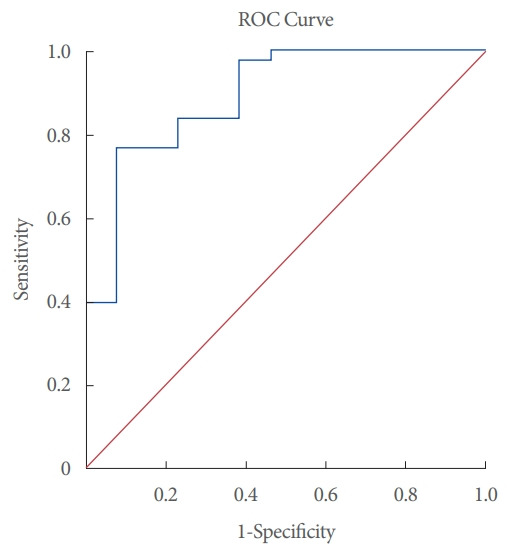
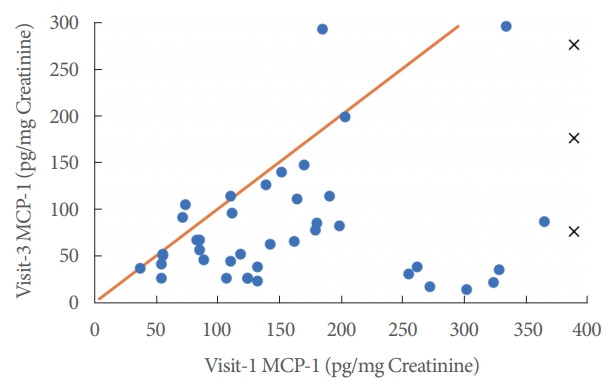
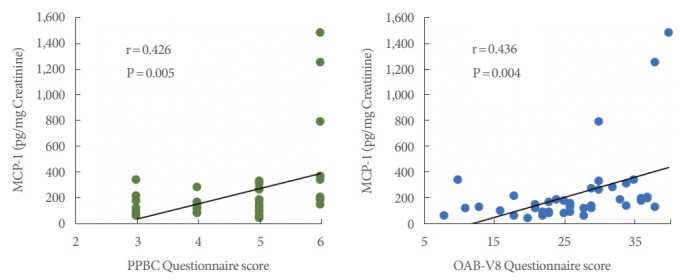
The mean pretreatment urinary MCP-1 level at visit 1 (229.2-pg/mg creatinine) was significantly greater than the MCP-1 levels at visit 3 in both the treatment (107.0-pg/mg creatinine) (P<0.001) and control (52.35-pg/mg creatinine) groups (P<0.001). Average OAB symptom severity decreased significantly from visit 1 (baseline) to visits 2 (4 weeks) and 3 (12-14 weeks) and was significantly correlated with urinary MCP-1 levels. Urinary MCP-1 levels dropped significantly (P=0.002) posttreatment in patients whose symptom severity improved by >30%, whereas nonresponders displayed no significant MCP-1 decrease (P=0.164). The receiver operating characteristic analysis of the OAB visit 1 and control groups produced an area under the curve of 0.891. We found no significant differences in sex, race, or age between the OAB and control groups.
MCP-1 levels differed significantly between the control and OAB groups and were closely correlated with symptom severity and treatment response. The good diagnostic accuracy of MCP-1 for OAB suggests the potential usage of MCP-1 for OAB diagnosis. The varying response of urinary MCP-1 levels to treatment may indicate at least 2 potential phenotypes of OAB. MCP-1, in combination with other biomarkers and symptom severity questionnaires, could potentially aid in developing a patient-centered OAB treatment approach.
比较健康对照者和膀胱过度活动症(OAB)患者尿液中炎症细胞因子单核细胞趋化蛋白-1(MCP-1)的水平,将尿液中MCP-1的变化与OAB治疗反应及症状严重程度相关联,研究MCP-1对OAB的诊断潜力,以及MCP-1作为OAB不同表型潜在生物标志物的效能。
我们采用酶联免疫吸附测定法测量了56名个体(43例OAB患者和13名对照者)尿液中标准化的MCP-1水平。我们使用2份经过验证的症状严重程度问卷(OAB-V8和患者膀胱状况感知问卷)对OAB患者进行了3次随访评估。
在治疗组(107.0 pg/mg肌酐)(P<0.001)和对照组(52.35 pg/mg肌酐)(P<0.001)中,第1次随访时(229.2 pg/mg肌酐)的平均治疗前尿液MCP-1水平均显著高于第3次随访时的水平。从第1次随访(基线)到第2次随访(4周)和第3次随访(12 - 14周),OAB症状严重程度平均显著降低,且与尿液MCP-1水平显著相关。症状严重程度改善>30%的患者治疗后尿液MCP-1水平显著下降(P = 0.002),而无反应者的MCP-1水平无显著下降(P = 0.164)。OAB第1次随访组与对照组的受试者工作特征分析得出曲线下面积为0.891。我们发现OAB组和对照组在性别、种族或年龄方面无显著差异。
对照组和OAB组之间的MCP-1水平存在显著差异,且与症状严重程度和治疗反应密切相关。MCP-1对OAB具有良好的诊断准确性,提示其在OAB诊断中的潜在应用价值。尿液MCP-1水平对治疗的不同反应可能表明OAB至少存在2种潜在表型。MCP-1与其他生物标志物及症状严重程度问卷相结合,可能有助于制定以患者为中心的OAB治疗方法。