VeriSIM Life Inc., 1 Sansome St, Suite 3500, San Francisco, CA 94104, USA.
Molecules. 2021 Jan 1;26(1):182. doi: 10.3390/molecules26010182.
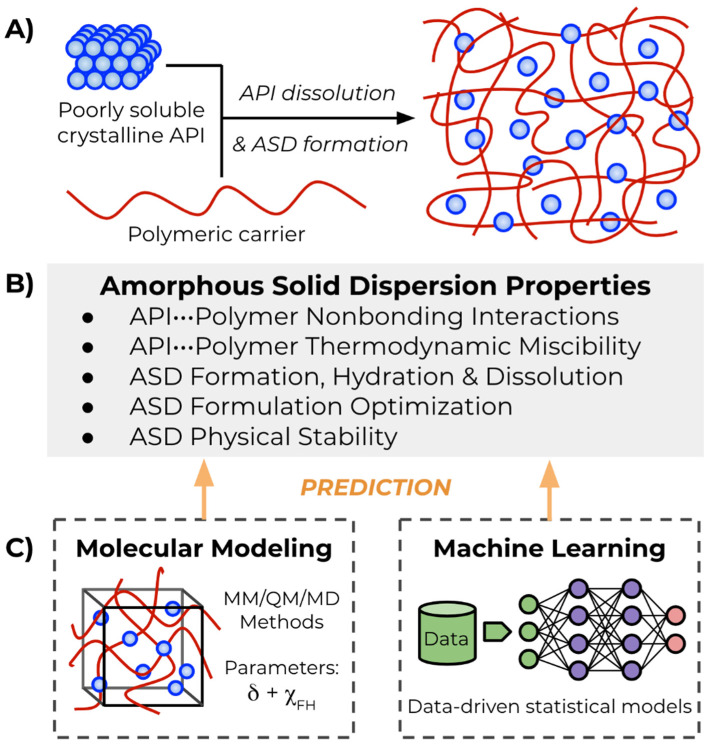
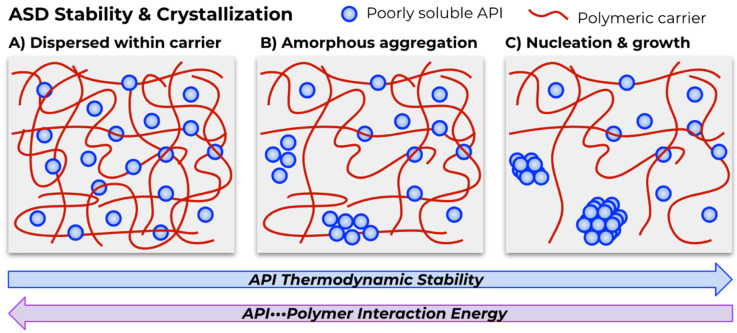
Amorphous solid dispersions (ASDs) have emerged as widespread formulations for drug delivery of poorly soluble active pharmaceutical ingredients (APIs). Predicting the API solubility with various carriers in the API-carrier mixture and the principal API-carrier non-bonding interactions are critical factors for rational drug development and formulation decisions. Experimental determination of these interactions, solubility, and dissolution mechanisms is time-consuming, costly, and reliant on trial and error. To that end, molecular modeling has been applied to simulate ASD properties and mechanisms. Quantum mechanical methods elucidate the strength of API-carrier non-bonding interactions, while molecular dynamics simulations model and predict ASD physical stability, solubility, and dissolution mechanisms. Statistical learning models have been recently applied to the prediction of a variety of drug formulation properties and show immense potential for continued application in the understanding and prediction of ASD solubility. Continued theoretical progress and computational applications will accelerate lead compound development before clinical trials. This article reviews in silico research for the rational formulation design of low-solubility drugs. Pertinent theoretical groundwork is presented, modeling applications and limitations are discussed, and the prospective clinical benefits of accelerated ASD formulation are envisioned.
无定形固体分散体(ASD)已成为用于传递难溶性活性药物成分(API)的广泛制剂。在 API-载体混合物中预测各种载体的 API 溶解度和主要 API-载体非键相互作用是合理药物开发和配方决策的关键因素。这些相互作用、溶解度和溶解机制的实验确定既耗时、昂贵,又依赖于反复试验。为此,分子建模已被应用于模拟 ASD 性质和机制。量子力学方法阐明了 API-载体非键相互作用的强度,而分子动力学模拟则用于模拟和预测 ASD 的物理稳定性、溶解度和溶解机制。统计学习模型最近已应用于各种药物配方性质的预测,并为继续应用于 ASD 溶解度的理解和预测显示出巨大的潜力。持续的理论进展和计算应用将加速临床试验前先导化合物的开发。本文综述了用于设计低溶解度药物的合理配方的计算研究。介绍了相关的理论基础,讨论了建模应用和局限性,并设想了加速 ASD 配方的潜在临床益处。