Bähler Caroline, Brüngger Beat, Ulyte Agne, Schwenkglenks Matthias, von Wyl Viktor, Dressel Holger, Gruebner Oliver, Wei Wenjia, Blozik Eva
Department of Health Sciences, Helsana Group, Zürichstrasse 130, 8600, Dübendorf, Switzerland.
Department of Epidemiology, Epidemiology, Biostatistics & Prevention Institute, University of Zurich, Hirschengraben 84, 8001, Zurich, Switzerland.
BMC Public Health. 2021 Jan 5;21(1):23. doi: 10.1186/s12889-020-10079-8.
We examined colorectal, breast, and prostate cancer screening utilization in eligible populations within three data cross-sections, and identified factors potentially modifying cancer screening utilization in Swiss adults.
The study is based on health insurance claims data of the Helsana Group. The Helsana Group is one of the largest health insurers in Switzerland, insuring approximately 15% of the entire Swiss population across all regions and age groups. We assessed proportions of the eligible populations receiving colonoscopy/fecal occult blood testing (FOBT), mammography, or prostate-specific antigen (PSA) testing in the years 2014, 2016, and 2018, and calculated average marginal effects of individual, temporal, regional, insurance-, supply-, and system-related variables on testing utilization using logistic regression.
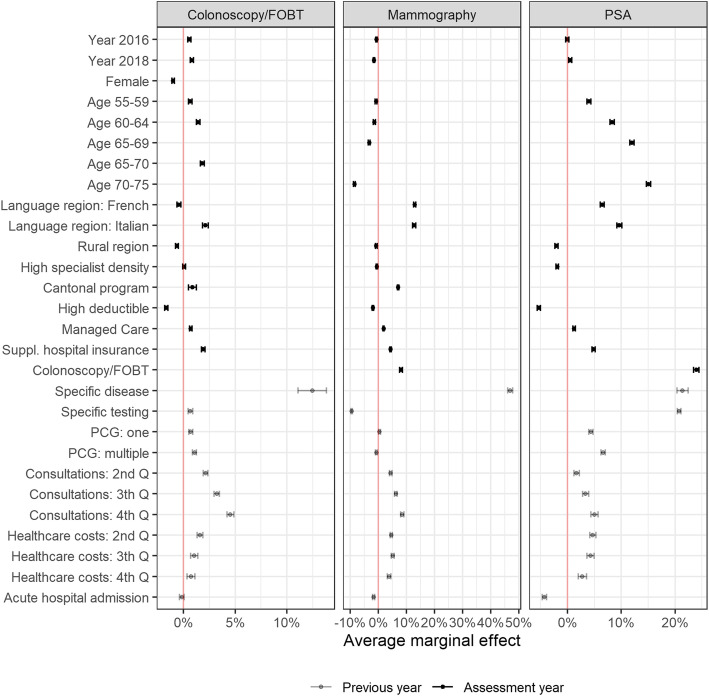
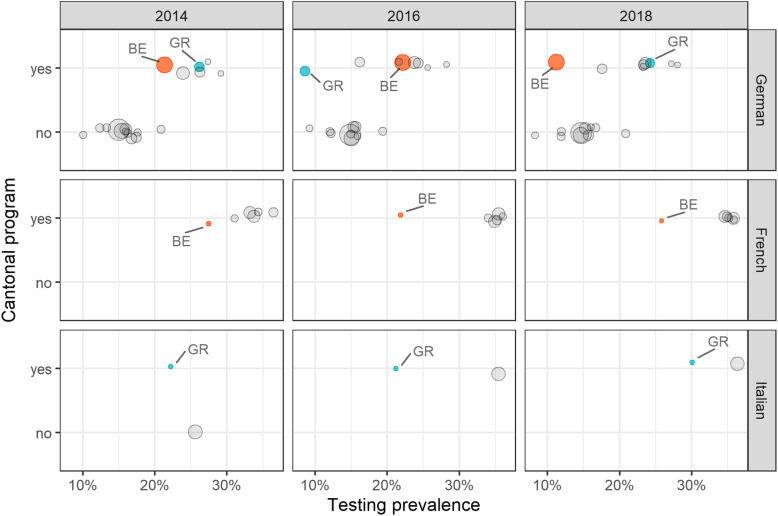
Overall, 8.3% of the eligible population received colonoscopy/FOBT in 2014, 8.9% in 2016, and 9.2% in 2018. In these years, 20.9, 21.2, and 20.4% of the eligible female population received mammography, and 30.5, 31.1, and 31.8% of the eligible male population had PSA testing. Adjusted testing utilization varied little between 2014 and 2018; there was an increasing trend of 0.8% (0.6-1.0%) for colonoscopy/FOBT and of 0.5% (0.2-0.8%) for PSA testing, while mammography use decreased by 1.5% (1.2-1.7%). Generally, testing utilization was higher in French-speaking and Italian-speaking compared to German-speaking region for all screening types. Cantonal programs for breast cancer screening were associated with an increase of 7.1% in mammography utilization. In contrast, a high density of relevant specialist physicians showed null or even negative associations with screening utilization.
Variation in cancer screening utilization was modest over time, but considerable between regions. Regional variation was highest for mammography use where recommendations are debated most controversially, and the implementation of programs differed the most.
我们在三个数据横截面中研究了符合条件人群的结直肠癌、乳腺癌和前列腺癌筛查利用率,并确定了可能影响瑞士成年人癌症筛查利用率的因素。
该研究基于赫尔萨纳集团的健康保险理赔数据。赫尔萨纳集团是瑞士最大的健康保险公司之一,为瑞士所有地区和年龄组的约15%的人口提供保险。我们评估了2014年、2016年和2018年接受结肠镜检查/粪便潜血试验(FOBT)、乳房X线摄影或前列腺特异性抗原(PSA)检测的符合条件人群的比例,并使用逻辑回归计算个体、时间、地区、保险、供应和系统相关变量对检测利用率的平均边际效应。
总体而言,2014年8.3%的符合条件人群接受了结肠镜检查/FOBT,2016年为8.9%,2018年为9.2%。在这些年份中,20.9%、21.2%和20.4%的符合条件女性人群接受了乳房X线摄影,30.5%、31.1%和31.8%的符合条件男性人群进行了PSA检测。2014年至2018年期间,调整后的检测利用率变化不大;结肠镜检查/FOBT的利用率呈上升趋势,为0.8%(0.6 - 1.0%),PSA检测的利用率为0.5%(0.2 - 0.8%),而乳房X线摄影的利用率下降了1.5%(1.2 - 1.7%)。一般来说,对于所有筛查类型,与德语区相比,法语区和意大利语区的检测利用率更高。州级乳腺癌筛查项目与乳房X线摄影利用率增加7.1%相关。相比之下,相关专科医生的高密度显示与筛查利用率呈零关联甚至负关联。
癌症筛查利用率随时间的变化不大,但地区间差异较大。乳房X线摄影的地区差异最大,其建议争议最大,项目实施差异也最大。