Institute of Family Medicine and Public Health, University of Tartu, Tartu, Estonia.
Institute of Technology, Estonian University of Life Sciences, Tartu, Estonia.
Noise Health. 2020 Oct-Dec;22(107):90-98. doi: 10.4103/nah.NAH_12_19.
Hearing loss (HL) is a major health concern among military personnel due to noise from shooting, blasts, military vehicles, and noisy training environments. Nevertheless, one's exposure can be partially reduced by using personal protective equipment (PPE). The aim of this study is to estimate the prevalence of HL among military personnel, to analyse associations between HL and self-reported occupational and leisure noise exposure, and use of PPEs.
A cross-sectional study was conducted among 150 military personnel during their routine medical examinations. First, all participants filled in a questionnaire about their exposure to noise and later the respondents went through an audiometric test. The diagnostic criteria for slight, moderate, and severe HL was HL of 25-40, 41-60, and >60 dB at 4 and 6 kHz, respectively. The associations between noise exposure and HL were studied with multinomial logistic regression analysis.
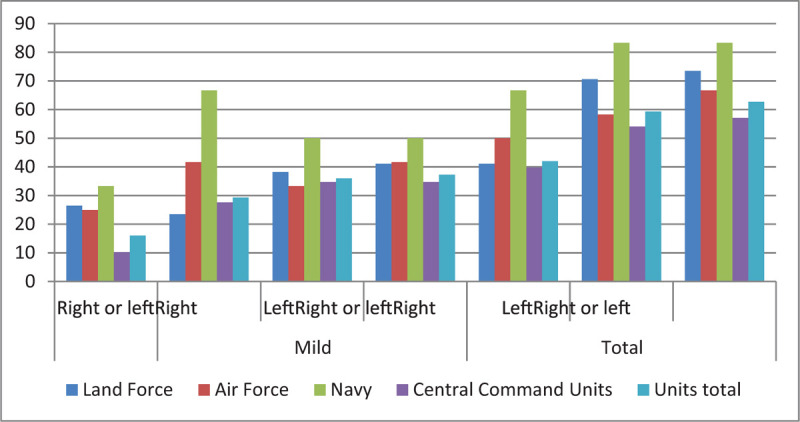
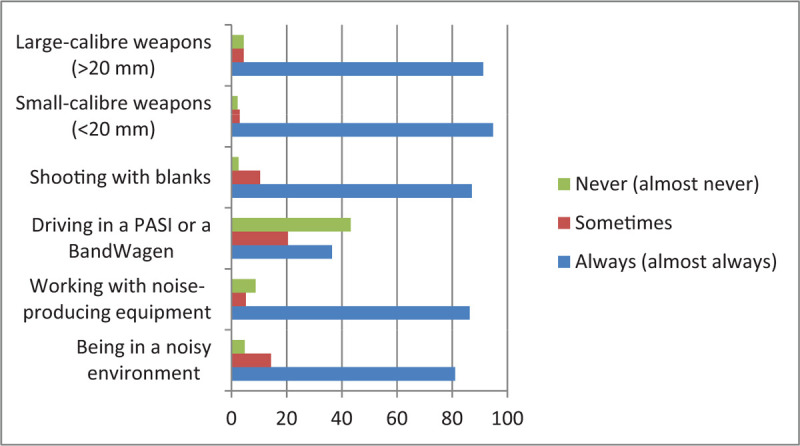
The prevalence of slight to severe HL in high frequencies (4 and 6 kHz) among study participants was 62.7%. Nevertheless, the majority of it was slight, as the prevalence of severe HL was 9.3%. The prevalence of any kind of HL was highest in the Navy and the prevalence of severe HL was highest in the Central Command Units. The relative risk ratios (RRRs) for HL were higher among those who had been working for a long time in a noisy environment, working with noise-producing equipment, driving in a PASI or a Bandvagn or had been shooting with blanks at least once per week. It also appeared that military personnel who had HL, reported tinnitus more often. Respondents' previous health problems, music-listening habits, and amount of exposure to loud noise in non-military environments were not independently associated with HL, but in several cases it increased the RRRs together with military exposure. We also found significantly more frequent HL among those never using PPEs.
HL loss was more prevalent among personnel who are more often exposed to military noise, especially among those who never use PPEs. The effect was enhanced by leisure time noise, but it was not independently associated to HL.
听力损失(HL)是军事人员的主要健康问题之一,原因是射击、爆炸、军用车辆和嘈杂的训练环境中的噪音。然而,通过使用个人防护设备(PPE)可以部分降低人的暴露量。本研究的目的是估计军事人员 HL 的患病率,分析 HL 与自我报告的职业和休闲噪声暴露以及 PPE 使用之间的关联。
在常规体检期间,对 150 名军事人员进行了横断面研究。首先,所有参与者都填写了一份关于噪声暴露的问卷,然后受访者接受了听力测试。4 和 6 kHz 时轻度、中度和重度 HL 的诊断标准分别为 25-40、41-60 和>60 dB 的 HL。使用多项逻辑回归分析研究噪声暴露与 HL 之间的关联。
研究参与者高频(4 和 6 kHz)的轻度至重度 HL 患病率为 62.7%。然而,大多数是轻度的,因为重度 HL 的患病率为 9.3%。HL 患病率在海军中最高,而在中央司令部部队中重度 HL 患病率最高。在噪声环境中工作时间较长、使用产生噪声的设备、在 PASI 或 Bandvagn 中驾驶或每周至少用空包弹射击一次的人,HL 的相对风险比(RRR)更高。似乎有 HL 的军人更常报告耳鸣。受访者以前的健康问题、听音乐习惯以及非军事环境中接触大声噪音的程度与 HL 无关,但在某些情况下,它们与军事暴露一起增加了 RRR。我们还发现,从不使用 PPE 的人 HL 发生率明显更高。
经常暴露于军事噪声的人员中 HL 损失更为普遍,尤其是从不使用 PPE 的人员。休闲时间噪声的影响增强了这种情况,但与 HL 无关。