Department of Abdominal Surgical Oncology, Zhejiang Cancer Hospital, Hangzhou, Zhejiang, China.
Department of General Surgery, Zhejiang Provincial Integrated Chinese and Western medicine Hospital, China.
Afr Health Sci. 2020 Sep;20(3):1292-1298. doi: 10.4314/ahs.v20i3.34.
Hepatocellular carcinoma is one of the most common malignant tumors found all over the globe. Despite advances in surgery and chemotherapy, the five-year survival rate of patients with hepatocellular carcinoma is still low. It is known that the proliferation of hepatocellular carcinoma cells is closely related to the occurrence, development and prognosis of hepatocellular carcinoma. The present work investigates the expression of microRNA-489 (miR-489) in human hepatocellular carcinoma cells and its effect on the biological behavior of human hepatocellular carcinoma cells.
The expression of miR-489 by fluorescence quantitative PCR detection in 30 patients with hepatoblastoma of liver cancer tissues and adjacent tissues was studied. Also, the determination of hepatoblastoma in four cell lines with different metastatic potential (HR8348, HCT116, HT29 and HEPG2) and the expression of miR-489 during miR-489 simulation process was studied. MTT assay, flow cytometry and Western blot analysis were performed to know the cell proliferation to detect the changes in cell cycle, apoptosis of cells, and SOX4 gene expression respectively.
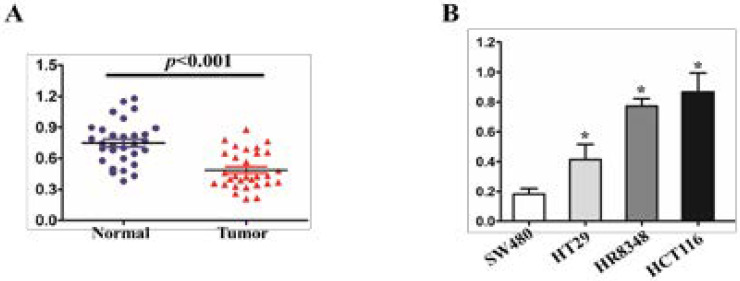
RT-PCR results showed that the cells compared with pre-cancerous tissue, the expression level of miR-489 in hepatocellular carcinoma tissues than in adjacent tissue significantly decreased (P<0.05), and with liver cancer cell metastasis increased (P<0.05); analogue transfection constructed miR-489 overexpressing HEPG2 cell line by microRNA. MTT results showed that miR-489 can inhibit the proliferation of HEPG2 cells, the differences were statistically significant (P<0.05); flow cytometry results showed that miR-489 mimics was transfected into HEPG2 cells at 48 hours had no significant effect on cell cycle distribution (P > 0.05); but miR-489 expression could induce apoptosis, compared with the control group, the apoptosis of miR-489 mimics was significantly increased and the difference was statistically significant (P < 0.05).
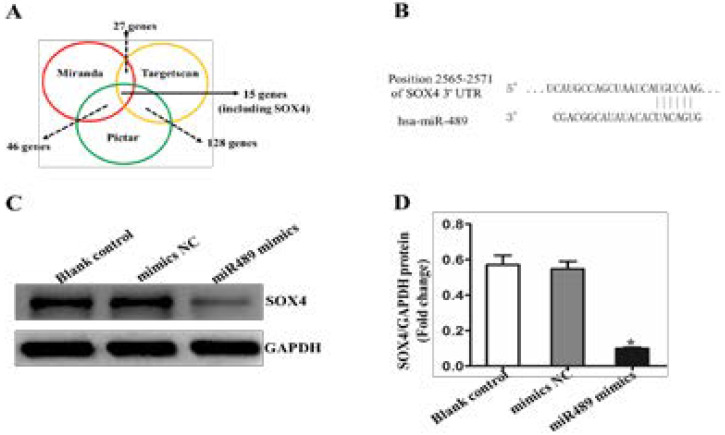
In conclusion, miR-489 can significantly inhibit the occurrence and development of hepatocellular carcinoma cells. The mechanism may be down regulated by the expression of SOX4 and inhibit cell proliferation. Further this study showed that the tumor cells SOX4 gene as a regulatory factor target the genes of miR-489 in hepatocellular carcinoma.
肝细胞癌是全球最常见的恶性肿瘤之一。尽管手术和化疗取得了进展,但肝细胞癌患者的五年生存率仍然较低。已知肝细胞癌细胞的增殖与肝细胞癌的发生、发展和预后密切相关。本研究探讨了 microRNA-489(miR-489)在人肝癌细胞中的表达及其对人肝癌细胞生物学行为的影响。
通过荧光定量 PCR 检测 30 例肝癌组织和相邻组织中 miR-489 的表达,同时检测 4 种不同转移潜能的肝癌细胞系(HR8348、HCT116、HT29 和 HEPG2)中 miR-489 的表达,并在 miR-489 模拟过程中检测细胞增殖、细胞周期变化、细胞凋亡和 SOX4 基因表达的变化。MTT 检测、流式细胞术和 Western blot 分析分别用于检测细胞增殖、细胞周期变化、细胞凋亡和 SOX4 基因表达的变化。
RT-PCR 结果显示,与癌前组织相比,肝癌组织中 miR-489 的表达水平明显低于相邻组织(P<0.05),且随肝癌细胞转移增加(P<0.05);模拟转染构建 miR-489 过表达 HEPG2 细胞系。MTT 结果显示,miR-489 可抑制 HEPG2 细胞增殖,差异有统计学意义(P<0.05);流式细胞术结果显示,miR-489 模拟物转染 HEPG2 细胞 48 小时后对细胞周期分布无明显影响(P>0.05);但 miR-489 表达可诱导细胞凋亡,与对照组相比,miR-489 模拟物组细胞凋亡明显增加,差异有统计学意义(P<0.05)。
综上所述,miR-489 可显著抑制肝癌细胞的发生发展。其机制可能是通过下调 SOX4 的表达抑制细胞增殖。进一步研究表明,肿瘤细胞 SOX4 基因作为调控因子,靶向 miR-489 基因在肝癌中的作用。