Asad Ullah Muhammad, Ahmed Muhammad Saad, Hamid Kamran, Ali Muhammad, Shazlee Muhammad Kashif, Darira Jaideep
Diagnostic Radiology, Dr. Ziauddin Hospital, Karachi, PAK.
Imaging Services, The Indus Hospital, Karachi, PAK.
Cureus. 2020 Nov 28;12(11):e11733. doi: 10.7759/cureus.11733.
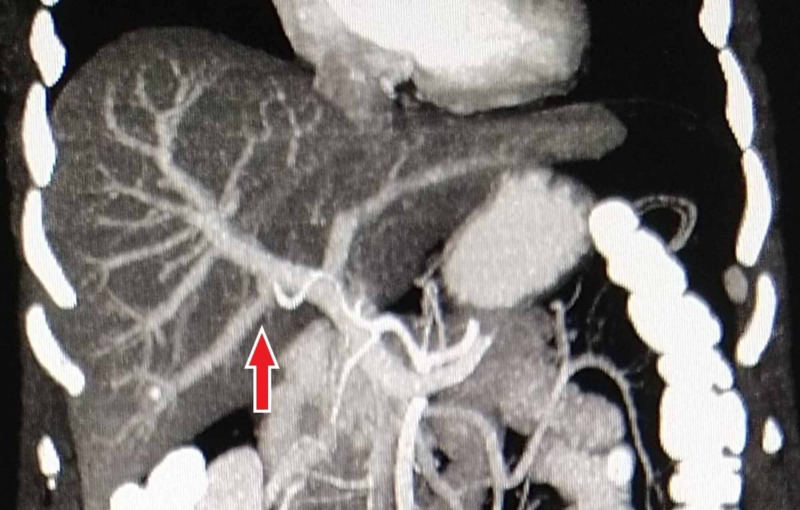
Portal vein (PV) is the principal blood vessel transporting blood from the alimentary tract and spleen to the liver. The aim of this study is to determine the prevalence of PV anatomical variations in our population using multidetector CT with maximum intensity projection (MIP) technique at a tertiary care hospital.
This cross-sectional study was prospectively conducted from November 2018 to June 2019 in the Department of Radiology at a tertiary care hospital in Karachi. After informed consent, all the patients with no known hepatic pathology undergoing routine abdomen CT were included in this study. Patients with previous hepatic resection surgeries, undiagnosed large hepatic tumors/metastasis, and those with PV thrombosis were excluded.
A total of 500 patients (256 males and 244 females) were included in the study; the mean age of female patients was relatively higher as compared to the male patients (53.80 ± 18.44 vs. 44.15 ± 19.94 years; p = 0.000). Standard PV anatomy (type 1) was found in 438 patients (87.6%). Trifurcation (type 2) occurred in 18 patients (3.6%). Right posterior portal vein as the first branch of main PV (type 3) was found in 22 patients (4.4%). A separate branch of the right portal vein (RPV) to segment VII (type 4) and separate branch of the RPV to segment VI (type 5) were found in 6 (1.2%) and 16 (3.2%) patients, respectively.
Our study displayed a relatively higher frequency of standard PV anatomy (type 1) compared to previous studies. We highlight the role of MIP in the analysis of hepatic venous anatomy with its utility demonstrating improved detection of variations.
门静脉(PV)是将来自消化道和脾脏的血液输送至肝脏的主要血管。本研究的目的是在一家三级医疗中心医院,使用多排螺旋CT的最大密度投影(MIP)技术确定我们所研究人群中PV解剖变异的发生率。
本横断面研究于2018年11月至2019年6月在卡拉奇一家三级医疗中心医院的放射科前瞻性开展。在获得知情同意后,所有无已知肝脏病变且接受常规腹部CT检查的患者均纳入本研究。既往有肝脏切除手术史、未确诊的大肝脏肿瘤/转移瘤以及PV血栓形成的患者被排除。
本研究共纳入500例患者(男性256例,女性244例);女性患者的平均年龄比男性患者相对更高(53.80±18.44岁 vs. 44.15±19.94岁;p = 0.000)。438例患者(87.6%)发现标准PV解剖(1型)。18例患者(3.6%)出现三叉分支(2型)。22例患者(4.4%)发现右后门静脉作为主PV的第一分支(3型)。分别有6例(1.2%)和16例(3.2%)患者发现右门静脉(RPV)至Ⅶ段的单独分支(4型)和RPV至Ⅵ段的单独分支(5型)。
与既往研究相比,我们的研究显示标准PV解剖(1型)的发生率相对较高。我们强调了MIP在肝静脉解剖分析中的作用,其效用表明能更好地检测变异情况。