Mickle Angela M, Garvan Cynthia, Service Chelsea, Pop Ralisa, Marks John, Wu Stanley, Edberg Jeffrey C, Staud Roland, Fillingim Roger B, Bartley Emily J, Sibille Kimberly T
Pain Research and Intervention Center of Excellence, University of Florida, Gainesville, FL, USA.
Department of Community of Dentistry and Behavioral Sciences, University of Florida, Gainesville, FL, USA.
Chronic Stress (Thousand Oaks). 2020 Dec 15;4:2470547020975758. doi: 10.1177/2470547020975758. eCollection 2020 Jan-Dec.
The relationship between psychosocial stress and chronic pain is bidirectional. An improved understanding regarding the relationships among chronic pain, life stress, and ethnicity/race will inform identification of factors contributing to health disparities in chronic pain and improve health outcomes. This study aims to assess relationships between measures of clinical pain, life stress, sociodemographics, and salivary cortisol levels.
A cross-sectional analysis involving data from 105 non-Hispanic White (NHW) and non-Hispanic Black (NHB) participants aged 45-85 years old with or at risk for knee osteoarthritis. Data included sociodemographics, clinical pain, psychosocial stress, and salivary cortisol across five time points over an approximate 12-hour period. Non-parametric correlation analysis, sociodemographic group comparisons, and regression analyses were performed.
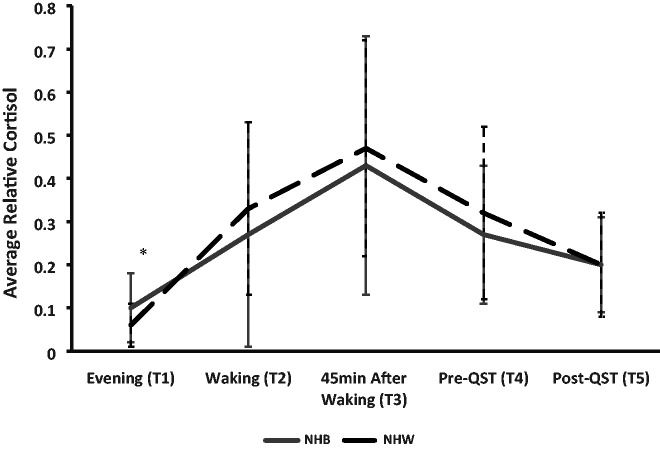
Clinical pain and psychosocial stress were associated with salivary cortisol levels, particularly morning waking and the evening to morning awakening slope. With the inclusion of recognized explanatory variables, the Graded Chronic Pain Scale characteristic pain intensity and financial satisfaction were identified as the primary pain and psychosocial measures associated with cortisol levels. Sociodemographic group differences were indicated such that NHB participants reported higher pain-related disability, higher levels of discrimination, lower financial and material satisfaction, and showed higher evening salivary cortisol levels compared to NHW participants. In combined pain and psychosocial stress analyses, greater financial satisfaction, lower pain intensity, and lower depression were associated with higher morning waking saliva cortisol levels while greater financial satisfaction was the only variable associated with greater evening to morning awakening slope.
Our findings show relationships among clinical pain, psychosocial stress, sociodemographic factors, and salivary cortisol levels. Importantly, with inclusion of recognized explanatory variables, financial satisfaction remained the primary factor accounting for differences in morning waking cortisol and evening to morning awakening cortisol slope in an ethnic/racially diverse group of middle aged and older adults with or at risk for knee osteoarthritis.
心理社会压力与慢性疼痛之间的关系是双向的。更好地理解慢性疼痛、生活压力和种族之间的关系,将有助于识别导致慢性疼痛健康差异的因素,并改善健康结果。本研究旨在评估临床疼痛测量、生活压力、社会人口统计学和唾液皮质醇水平之间的关系。
一项横断面分析,涉及105名年龄在45 - 85岁之间、患有或有膝骨关节炎风险的非西班牙裔白人(NHW)和非西班牙裔黑人(NHB)参与者的数据。数据包括社会人口统计学、临床疼痛、心理社会压力以及在大约12小时内五个时间点的唾液皮质醇水平。进行了非参数相关分析、社会人口统计学组比较和回归分析。
临床疼痛和心理社会压力与唾液皮质醇水平相关,尤其是早晨醒来时以及晚上到早晨觉醒斜率。纳入公认的解释变量后,分级慢性疼痛量表特征性疼痛强度和财务满意度被确定为与皮质醇水平相关的主要疼痛和心理社会测量指标。表明存在社会人口统计学组差异,与NHW参与者相比,NHB参与者报告的疼痛相关残疾更高、歧视水平更高、财务和物质满意度更低,且晚上唾液皮质醇水平更高。在疼痛和心理社会压力综合分析中,更高的财务满意度、更低的疼痛强度和更低的抑郁与更高的早晨醒来时唾液皮质醇水平相关,而更高的财务满意度是与更高的晚上到早晨觉醒斜率相关的唯一变量。
我们的研究结果显示了临床疼痛、心理社会压力、社会人口统计学因素和唾液皮质醇水平之间的关系。重要的是,纳入公认的解释变量后,财务满意度仍然是在一组患有或有膝骨关节炎风险的中老年种族/族裔多样化人群中,解释早晨醒来皮质醇和晚上到早晨觉醒皮质醇斜率差异的主要因素。