Department of Women's and Children's Health, Division Reproductive Health, Karolinska Institutet, Stockholm, Sweden.
Ministry of Health, Santiago de Chile, Chile.
Acta Paediatr. 2021 May;110(5):1461-1467. doi: 10.1111/apa.15685. Epub 2021 Jan 5.
Separating infants and their parents after a Caesarean section is still the routine care worldwide. This study investigated three caregiving models on the wakefulness and physiological parameters of full-term infants after an elective Caesarean section.
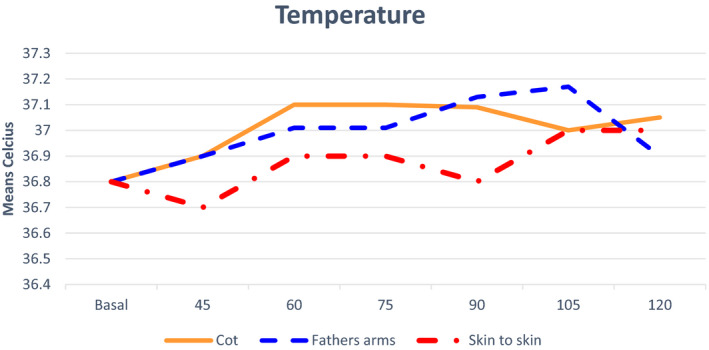
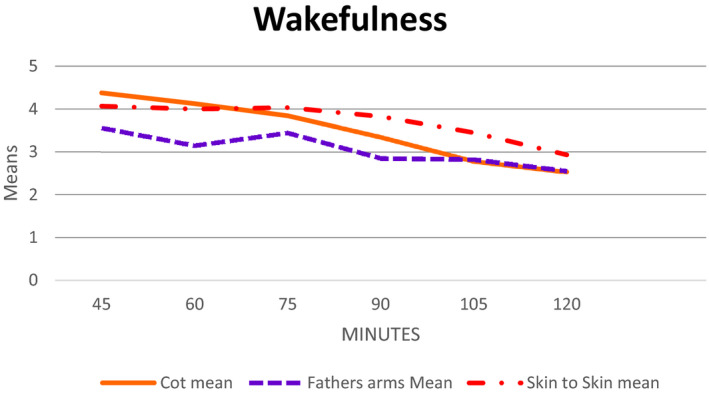
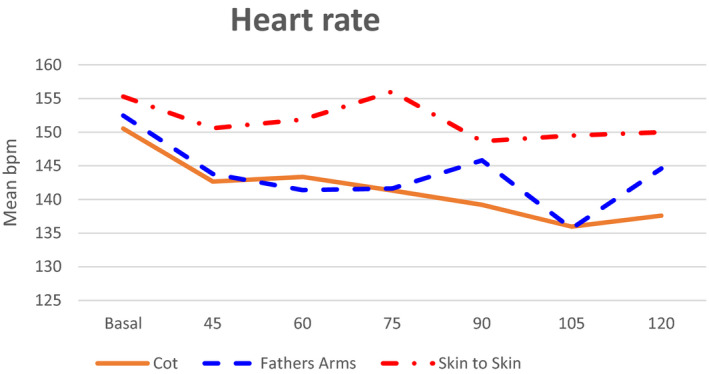
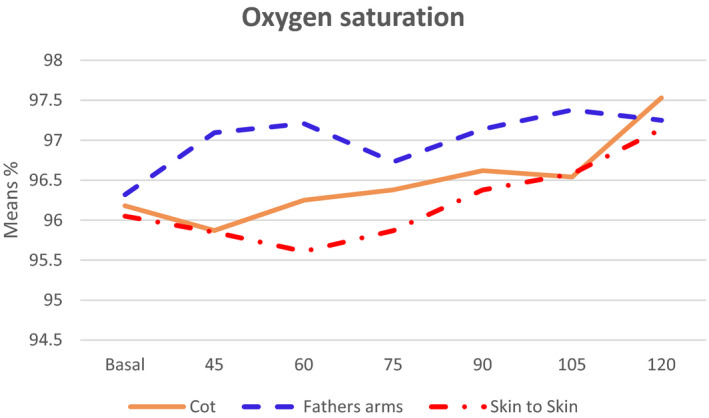
Newborn infants born in a Chilean public hospital in 2009-12 were randomised to three groups: cot, fathers' arms or skin-to-skin contact with their father. They were assessed at 15-minute intervals, from 45 to 120 minutes after the Caesarean section. Their physiological parameters were measured, and their wakefulness was assessed using the Neonatal Behavioural Assessment Scale.
We studied 95 infant (53% girls) born at a mean gestational age of 38.9 ± 0.9 weeks. Heart rates were significantly higher in the skin-to-skin than cot or fathers' arms groups and showed greater stability over time. Wakefulness was initially higher in the skin-to-skin group, but there were no significant differences by the end of the observation. There were no differences between the groups in peripheral oxygen saturation. Skin-to-skin contact had no negative impact on the infants.
The skin-to-skin group showed some advantages over the cot and fathers' arms groups when it came to establishing stable physiological parameters and wakefulness. This approach should be supported during mother-infant separation.
剖宫产后将婴儿与其父母分开仍然是全世界的常规护理。本研究调查了三种护理模式对择期剖宫产足月婴儿觉醒和生理参数的影响。
2009 年 12 月,在智利一家公立医院出生的新生儿被随机分为三组:婴儿床、父亲的手臂或与父亲的皮肤接触。在剖宫产 45 至 120 分钟后,每隔 15 分钟评估一次,测量他们的生理参数,并使用新生儿行为评估量表评估他们的觉醒情况。
我们研究了 95 名婴儿(53%为女孩),平均胎龄为 38.9 ± 0.9 周。皮肤接触组的心率明显高于婴儿床组和父亲手臂组,且随时间的推移更加稳定。皮肤接触组的觉醒初始值较高,但观察结束时无显著差异。三组间外周血氧饱和度无差异。皮肤接触对婴儿没有负面影响。
与婴儿床和父亲手臂组相比,皮肤接触组在建立稳定的生理参数和觉醒方面具有一些优势。在母婴分离期间,应支持这种方法。