Department of Kinesiology, McMaster University, Hamilton, Ontario, Canada.
Faculty of Kinesiology, University of Calgary, Alberta, Canada.
Physiol Rep. 2021 Jan;9(1):e14683. doi: 10.14814/phy2.14683.
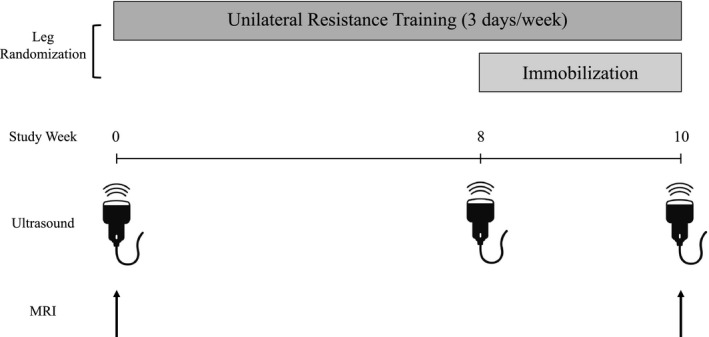
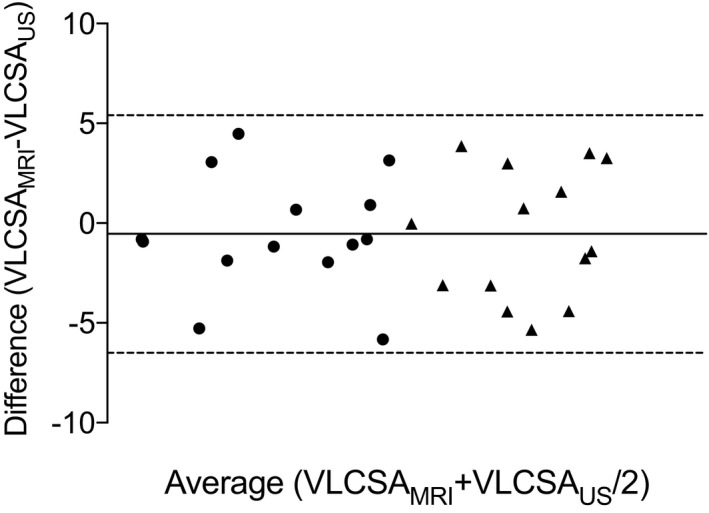
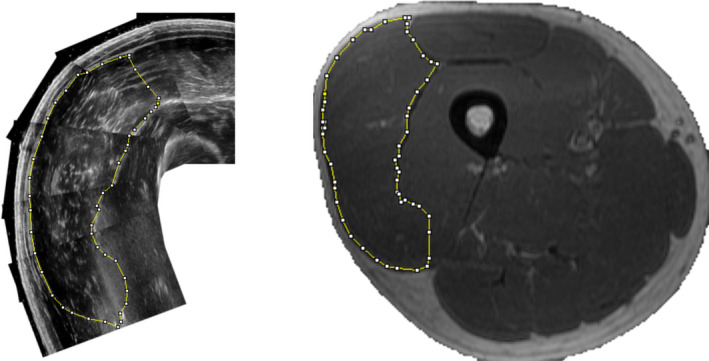
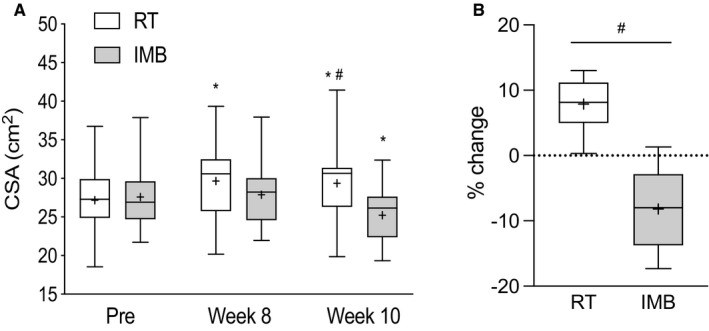
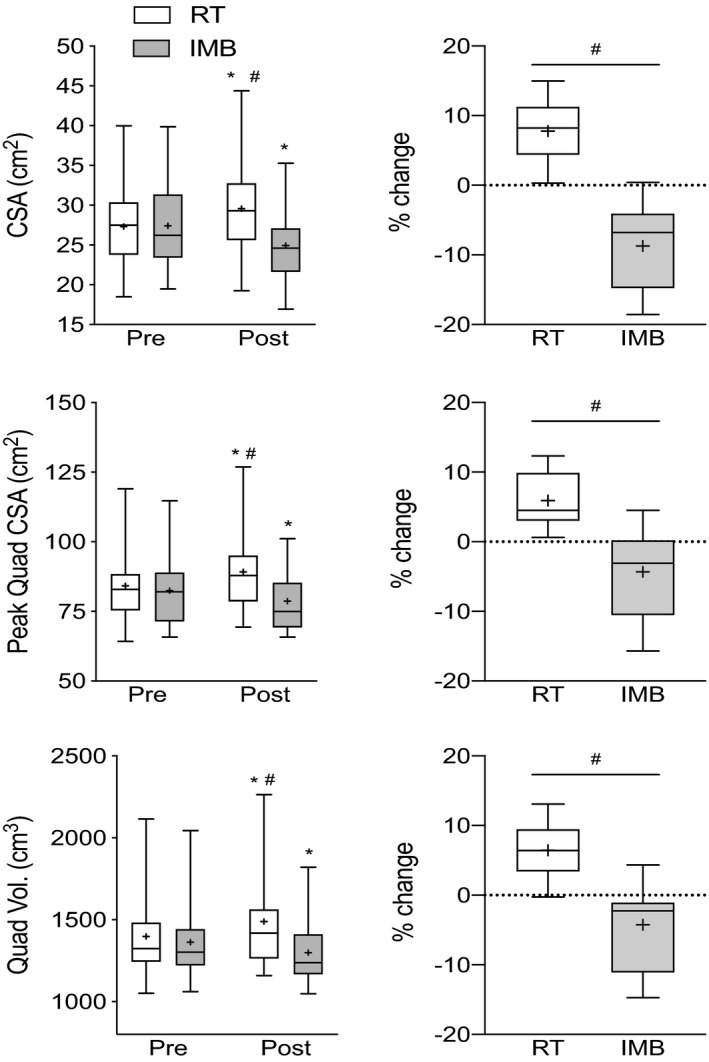
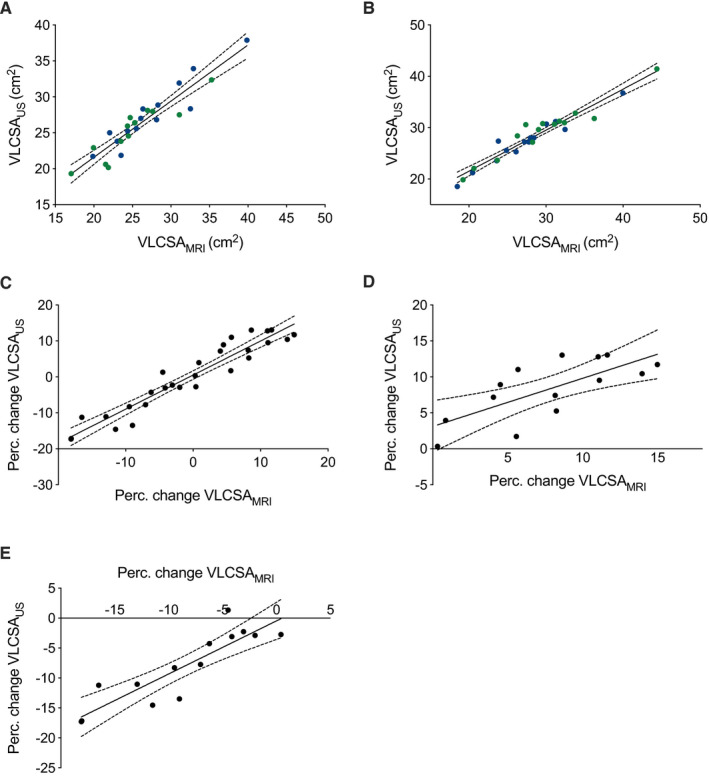
Magnetic resonance imaging (MRI) is the current gold standard for measuring changes in muscle size (cross-sectional area [CSA] and volume) but can be cost-prohibitive and resource-intensive. We evaluated the validity of B-mode ultrasonography (US) as a low-cost alternative to MRI for measuring muscle hypertrophy and atrophy in response to resistance training and immobilization, respectively. Fourteen young men performed 10wk of unilateral resistance training (RT) to induce muscle hypertrophy. In the final two weeks of the 10wk, the subjects' contralateral leg was immobilized (IMB). The cross-sectional area of the vastus lateralis (VLCSA) was measured at the mid-thigh before and after each intervention using MRI (VLCSA ) and US (VLCSA ). The relationship and agreement between methods were assessed. Reliability of US measurements ranged from good to excellent in all comparisons (ICC >0.67). VLCSA significantly increased after 10 weeks of RT (VLCSA : 7.9 ± 3.8%; VLCSA : 7.8 ± 4.5%) and decreased after 2 weeks of IMB (VLCSA : -8.2%±5.8%; VLCSA : -8.7 ± 6.1%). Significant correlations were identified between MRI and US at each time point measured (all r > 0.85) and, importantly, between MRI- and US-derived changes in VLCSA. Bland-Altman analysis revealed minimal bias in US measurements relative to the MRI (-0.5 ± 3.0%) and all measurements were within the upper and lower limits of agreement. Our data suggest that B-mode ultrasonography can be a suitable alternative to MRI for measuring changes in muscle size in response to increased and decreased muscle loading in young men.
磁共振成像(MRI)是目前测量肌肉大小(横截面积[CSA]和体积)变化的金标准,但成本高且资源密集。我们评估了 B 型超声(US)作为 MRI 的低成本替代方法的有效性,用于分别测量抵抗训练和固定引起的肌肉肥大和萎缩。14 名年轻男性进行了 10 周的单侧抵抗训练(RT),以诱导肌肉肥大。在 10 周的最后两周,受试者的对侧腿被固定(IMB)。在每个干预前后,使用 MRI(VLCSA )和 US(VLCSA )在大腿中部测量股外侧肌的横截面积(VLCSA )。评估了方法之间的关系和一致性。在所有比较中,US 测量的可靠性均为良好至极好(ICC>0.67)。经过 10 周的 RT 后,VLCSA 显著增加(VLCSA :7.9 ± 3.8%;VLCSA :7.8 ± 4.5%),经过 2 周的 IMB 后,VLCSA 显著减少(VLCSA :-8.2%±5.8%;VLCSA :-8.7 ± 6.1%)。在每个测量时间点,都确定了 MRI 和 US 之间的显著相关性(所有 r>0.85),并且重要的是,VLCSA 的 MRI 和 US 衍生变化之间存在相关性。Bland-Altman 分析显示,US 测量相对于 MRI 的偏差很小(-0.5 ± 3.0%),所有测量值均在一致性界限的上限和下限内。我们的数据表明,B 型超声可以作为 MRI 的一种合适替代方法,用于测量年轻人肌肉负荷增加和减少时肌肉大小的变化。