• 文献检索
  • 文档翻译
  • 深度研究
  • 学术资讯
  • Suppr Zotero 插件Zotero 插件
  • 邀请有礼
  • 套餐&价格
  • 历史记录
应用&插件
Suppr Zotero 插件Zotero 插件浏览器插件Mac 客户端Windows 客户端微信小程序
定价
高级版会员购买积分包购买API积分包
服务
文献检索文档翻译深度研究API 文档MCP 服务
关于我们
关于 Suppr公司介绍联系我们用户协议隐私条款
关注我们

Suppr 超能文献

核心技术专利:CN118964589B侵权必究
粤ICP备2023148730 号-1Suppr @ 2026

文献检索

告别复杂PubMed语法,用中文像聊天一样搜索,搜遍4000万医学文献。AI智能推荐,让科研检索更轻松。

立即免费搜索

文件翻译

保留排版,准确专业,支持PDF/Word/PPT等文件格式,支持 12+语言互译。

免费翻译文档

深度研究

AI帮你快速写综述,25分钟生成高质量综述,智能提取关键信息,辅助科研写作。

立即免费体验

利用模拟中心评估人工智能驱动的抑郁症治疗临床决策支持系统对医患互动的初步可接受性和影响。

Using a simulation centre to evaluate preliminary acceptability and impact of an artificial intelligence-powered clinical decision support system for depression treatment on the physician-patient interaction.

作者信息

Benrimoh David, Tanguay-Sela Myriam, Perlman Kelly, Israel Sonia, Mehltretter Joseph, Armstrong Caitrin, Fratila Robert, Parikh Sagar V, Karp Jordan F, Heller Katherine, Vahia Ipsit V, Blumberger Daniel M, Karama Sherif, Vigod Simone N, Myhr Gail, Martins Ruben, Rollins Colleen, Popescu Christina, Lundrigan Eryn, Snook Emily, Wakid Marina, Williams Jérôme, Soufi Ghassen, Perez Tamara, Tunteng Jingla-Fri, Rosenfeld Katherine, Miresco Marc, Turecki Gustavo, Gomez Cardona Liliana, Linnaranta Outi, Margolese Howard C

机构信息

Department of Psychiatry, McGill University, Canada; Aifred Heath Inc., Montreal, Canada; and Faculty of Medicine, McGill University, Canada.

Montreal Neurological Institute, McGill University, Canada; and Aifred Health Inc., Montreal, Canada.

出版信息

BJPsych Open. 2021 Jan 6;7(1):e22. doi: 10.1192/bjo.2020.127.

DOI:
10.1192/bjo.2020.127
PMID:33403948
原文链接:https://pmc.ncbi.nlm.nih.gov/articles/PMC8058891/
Abstract

BACKGROUND

Recently, artificial intelligence-powered devices have been put forward as potentially powerful tools for the improvement of mental healthcare. An important question is how these devices impact the physician-patient interaction.

AIMS

Aifred is an artificial intelligence-powered clinical decision support system (CDSS) for the treatment of major depression. Here, we explore the use of a simulation centre environment in evaluating the usability of Aifred, particularly its impact on the physician-patient interaction.

METHOD

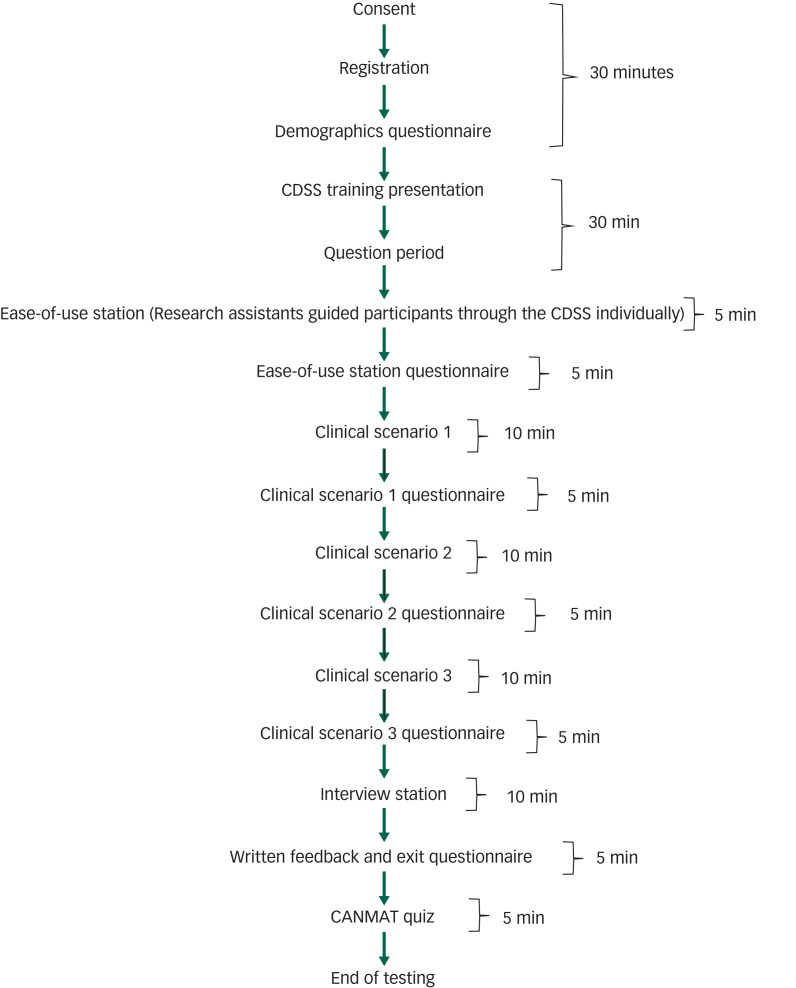
Twenty psychiatry and family medicine attending staff and residents were recruited to complete a 2.5-h study at a clinical interaction simulation centre with standardised patients. Each physician had the option of using the CDSS to inform their treatment choice in three 10-min clinical scenarios with standardised patients portraying mild, moderate and severe episodes of major depression. Feasibility and acceptability data were collected through self-report questionnaires, scenario observations, interviews and standardised patient feedback.

RESULTS

All 20 participants completed the study. Initial results indicate that the tool was acceptable to clinicians and feasible for use during clinical encounters. Clinicians indicated a willingness to use the tool in real clinical practice, a significant degree of trust in the system's predictions to assist with treatment selection, and reported that the tool helped increase patient understanding of and trust in treatment. The simulation environment allowed for the evaluation of the tool's impact on the physician-patient interaction.

CONCLUSIONS

The simulation centre allowed for direct observations of clinician use and impact of the tool on the clinician-patient interaction before clinical studies. It may therefore offer a useful and important environment in the early testing of new technological tools. The present results will inform further tool development and clinician training materials.

摘要

背景

最近,人工智能驱动的设备已被提出作为改善精神卫生保健的潜在有力工具。一个重要的问题是这些设备如何影响医患互动。

目的

Aifred是一种用于治疗重度抑郁症的人工智能驱动的临床决策支持系统(CDSS)。在此,我们探讨使用模拟中心环境来评估Aifred的可用性,特别是其对医患互动的影响。

方法

招募了20名精神科和家庭医学主治医师及住院医师,在临床互动模拟中心与标准化患者完成一项2.5小时的研究。每位医生可以选择在三个10分钟的临床场景中使用CDSS来指导他们的治疗选择,这些场景中有标准化患者分别表现出轻度、中度和重度重度抑郁发作。通过自我报告问卷、场景观察、访谈和标准化患者反馈收集可行性和可接受性数据。

结果

所有20名参与者均完成了研究。初步结果表明,该工具为临床医生所接受,并且在临床会诊期间使用是可行的。临床医生表示愿意在实际临床实践中使用该工具,对系统预测辅助治疗选择有高度信任,并报告该工具有助于增加患者对治疗的理解和信任。模拟环境有助于评估该工具对医患互动的影响。

结论

模拟中心能够在临床研究之前直接观察临床医生对该工具地使用情况及其对医患互动的影响。因此,它可能为新技术工具的早期测试提供一个有用且重要的环境。目前的结果将为进一步的工具开发和临床医生培训材料提供参考。
https://cdn.ncbi.nlm.nih.gov/pmc/blobs/7260/8058891/93c88ac70bce/S2056472420001271_fig1.jpg

相似文献

1
Using a simulation centre to evaluate preliminary acceptability and impact of an artificial intelligence-powered clinical decision support system for depression treatment on the physician-patient interaction.利用模拟中心评估人工智能驱动的抑郁症治疗临床决策支持系统对医患互动的初步可接受性和影响。
BJPsych Open. 2021 Jan 6;7(1):e22. doi: 10.1192/bjo.2020.127.
2
Evaluating the perceived utility of an artificial intelligence-powered clinical decision support system for depression treatment using a simulation center.使用模拟中心评估人工智能驱动的抑郁症治疗临床决策支持系统的感知效用。
Psychiatry Res. 2022 Feb;308:114336. doi: 10.1016/j.psychres.2021.114336. Epub 2021 Dec 11.
3
Evaluating the Clinical Feasibility of an Artificial Intelligence-Powered, Web-Based Clinical Decision Support System for the Treatment of Depression in Adults: Longitudinal Feasibility Study.评估基于网络的人工智能临床决策支持系统用于成人抑郁症治疗的临床可行性:纵向可行性研究
JMIR Form Res. 2021 Oct 25;5(10):e31862. doi: 10.2196/31862.
4
Improving Clinician Decisions and Communication in Critical Care Using Novel Information Technology.利用新型信息技术改善重症监护临床决策和沟通。
Mil Med. 2020 Feb 12;185(1-2):e254-e261. doi: 10.1093/milmed/usz151.
5
Usability Testing of a Complex Clinical Decision Support Tool in the Emergency Department: Lessons Learned.急诊科复杂临床决策支持工具的可用性测试:经验教训
JMIR Hum Factors. 2015 Sep 10;2(2):e14. doi: 10.2196/humanfactors.4537.
6
Assessing the feasibility of a mobile health-supported clinical decision support system for nutritional triage in oncology outpatients using Arden Syntax.评估基于 Arden 语法的移动医疗支持的临床决策支持系统在肿瘤门诊患者营养分诊中的可行性。
Artif Intell Med. 2018 Nov;92:34-42. doi: 10.1016/j.artmed.2015.10.001. Epub 2015 Oct 22.
7
Integrating usability testing and think-aloud protocol analysis with "near-live" clinical simulations in evaluating clinical decision support.将可用性测试和出声思维协议分析与“近乎实时”的临床模拟相结合,评估临床决策支持。
Int J Med Inform. 2012 Nov;81(11):761-72. doi: 10.1016/j.ijmedinf.2012.02.009. Epub 2012 Mar 27.
8
Evaluation of the acceptability and usability of a decision support system to encourage safe and effective use of opioid therapy for chronic, noncancer pain by primary care providers.评估决策支持系统在鼓励初级保健提供者安全有效地使用阿片类药物治疗慢性非癌症疼痛方面的可接受性和可用性。
Pain Med. 2010 Apr;11(4):575-85. doi: 10.1111/j.1526-4637.2010.00818.x. Epub 2010 Mar 1.
9
Human Factors Evaluation of the Universal Anaesthesia Machine: Assessing Equipment with High-Fidelity Simulation Prior to Deployment in a Resource-Constrained Environment.通用麻醉机的人为因素评估:在资源有限的环境中部署之前,使用高保真模拟评估设备。
J Natl Med Assoc. 2019 Oct;111(5):490-499. doi: 10.1016/j.jnma.2019.03.005. Epub 2019 May 9.
10
eHealth System for Collecting and Utilizing Patient Reported Outcome Measures for Personalized Treatment and Care (PROMPT-Care) Among Cancer Patients: Mixed Methods Approach to Evaluate Feasibility and Acceptability.癌症患者中用于个性化治疗和护理的患者报告结局测量收集与利用电子健康系统(PROMPT-Care):评估可行性和可接受性的混合方法
J Med Internet Res. 2017 Oct 2;19(10):e330. doi: 10.2196/jmir.8360.

引用本文的文献

1
Development of the treatment prediction model in the artificial intelligence in depression - medication enhancement study.抑郁症人工智能药物增强研究中治疗预测模型的开发。
Npj Ment Health Res. 2025 Jun 23;4(1):26. doi: 10.1038/s44184-025-00136-8.
2
Barriers to and facilitators of clinician acceptance and use of artificial intelligence in healthcare settings: a scoping review.医疗环境中临床医生接受和使用人工智能的障碍与促进因素:一项范围综述
BMJ Open. 2025 Apr 15;15(4):e092624. doi: 10.1136/bmjopen-2024-092624.
3
Integrating Artificial Intelligence (AI) With Workforce Solutions for Sustainable Care: A Follow Up to Artificial Intelligence and Machine Learning (ML) Based Decision Support Systems in Mental Health.

本文引用的文献

1
Analysis of Features Selected by a Deep Learning Model for Differential Treatment Selection in Depression.用于抑郁症差异治疗选择的深度学习模型所选择特征的分析
Front Artif Intell. 2020 Jan 21;2:31. doi: 10.3389/frai.2019.00031. eCollection 2019.
2
Study protocol for the antidepressant advisor (ADeSS): a decision support system for antidepressant treatment for depression in UK primary care: a feasibility study.抗抑郁药顾问(ADeSS)研究方案:英国初级保健中用于治疗抑郁症的抗抑郁药治疗的决策支持系统:一项可行性研究。
BMJ Open. 2020 May 24;10(5):e035905. doi: 10.1136/bmjopen-2019-035905.
3
Using clinical simulation to study how to improve quality and safety in healthcare.
将人工智能(AI)与劳动力解决方案相结合以实现可持续护理:心理健康领域基于人工智能和机器学习(ML)的决策支持系统的后续研究。
Int J Ment Health Nurs. 2025 Apr;34(2):e70019. doi: 10.1111/inm.70019.
4
The Use of AI in Mental Health Services to Support Decision-Making: Scoping Review.人工智能在心理健康服务中用于支持决策制定的范围审查。
J Med Internet Res. 2025 Jan 24;27:e63548. doi: 10.2196/63548.
5
Designing and testing clinical simulations of an early warning system for implementation in acute care settings.设计并测试用于急症护理环境的早期预警系统的临床模拟。
JAMIA Open. 2024 Oct 16;7(4):ooae092. doi: 10.1093/jamiaopen/ooae092. eCollection 2024 Dec.
6
Quality of interaction between clinicians and artificial intelligence systems. A systematic review.临床医生与人工智能系统之间的交互质量。一项系统评价。
Future Healthc J. 2024 Aug 17;11(3):100172. doi: 10.1016/j.fhj.2024.100172. eCollection 2024 Sep.
7
Availability of Evidence for Predictive Machine Learning Algorithms in Primary Care: A Systematic Review.预测机器学习算法在初级保健中的证据可用性:系统评价。
JAMA Netw Open. 2024 Sep 3;7(9):e2432990. doi: 10.1001/jamanetworkopen.2024.32990.
8
Development of a differential treatment selection model for depression on consolidated and transformed clinical trial datasets.开发一种基于整合和转化临床试验数据集的抑郁症差异化治疗选择模型。
Transl Psychiatry. 2024 Jun 21;14(1):263. doi: 10.1038/s41398-024-02970-4.
9
Automation in Contemporary Clinical Information Systems: a Survey of AI in Healthcare Settings.当代临床信息系统中的自动化:医疗环境中的人工智能调查。
Yearb Med Inform. 2023 Aug;32(1):115-126. doi: 10.1055/s-0043-1768733. Epub 2023 Dec 26.
10
Evidence for Reduced Sensory Precision and Increased Reliance on Priors in Hallucination-Prone Individuals in a General Population Sample.在一般人群样本中,易出现幻觉的个体表现出感觉精度降低和对先验信息依赖增加的证据。
Schizophr Bull. 2024 Mar 7;50(2):349-362. doi: 10.1093/schbul/sbad136.
利用临床模拟研究如何提高医疗保健的质量和安全性。
BMJ Simul Technol Enhanc Learn. 2020 Mar 4;6(2):87-94. doi: 10.1136/bmjstel-2018-000370. Epub 2018 Sep 29.
4
Comparative Efficacy and Acceptability of 21 Antidepressant Drugs for the Acute Treatment of Adults With Major Depressive Disorder: A Systematic Review and Network Meta-Analysis.21种抗抑郁药物治疗成人重度抑郁症急性发作的疗效与可接受性比较:一项系统评价与网状Meta分析
Focus (Am Psychiatr Publ). 2018 Oct;16(4):420-429. doi: 10.1176/appi.focus.16407. Epub 2018 Oct 18.
5
The Shared Decision-Making Process in the Pharmacological Management of Depression.抑郁症药物治疗中的共同决策过程。
Patient. 2020 Feb;13(1):23-30. doi: 10.1007/s40271-019-00383-w.
6
Simulation-based clinical systems testing for healthcare spaces: from intake through implementation.针对医疗空间的基于模拟的临床系统测试:从引入到实施
Adv Simul (Lond). 2019 Aug 2;4:19. doi: 10.1186/s41077-019-0108-7. eCollection 2019.
7
Impact of pharmacogenomics on clinical outcomes in major depressive disorder in the GUIDED trial: A large, patient- and rater-blinded, randomized, controlled study.在 GUIDED 试验中,药物基因组学对重度抑郁症临床结局的影响:一项大型、患者和评定者设盲、随机、对照研究。
J Psychiatr Res. 2019 Apr;111:59-67. doi: 10.1016/j.jpsychires.2019.01.003. Epub 2019 Jan 4.
8
Personalized prediction of antidepressant v. placebo response: evidence from the EMBARC study.个体化预测抗抑郁药与安慰剂反应:来自 EMBARC 研究的证据。
Psychol Med. 2019 May;49(7):1118-1127. doi: 10.1017/S0033291718001708. Epub 2018 Jul 2.
9
Antidepressant drug-specific prediction of depression treatment outcomes from genetic and clinical variables.抗抑郁药特异性预测遗传和临床变量与抑郁治疗结局的关系。
Sci Rep. 2018 Apr 3;8(1):5530. doi: 10.1038/s41598-018-23584-z.
10
Undiagnosed depression: A community diagnosis.未确诊的抑郁症:一种社区诊断。
SSM Popul Health. 2017 Jul 28;3:633-638. doi: 10.1016/j.ssmph.2017.07.012. eCollection 2017 Dec.