Department of Obstetrics and Gynecology, Rambam Health Care Campus, Rambam Medical Center, 8 Ha'alya St., 3109601, Haifa, Israel.
Department of Neuroscience, Rappaport Faculty of Medicine, Technion - Israel Institute of Technology, Haifa, Israel.
Inflammation. 2021 Jun;44(3):956-964. doi: 10.1007/s10753-020-01390-y. Epub 2021 Jan 6.
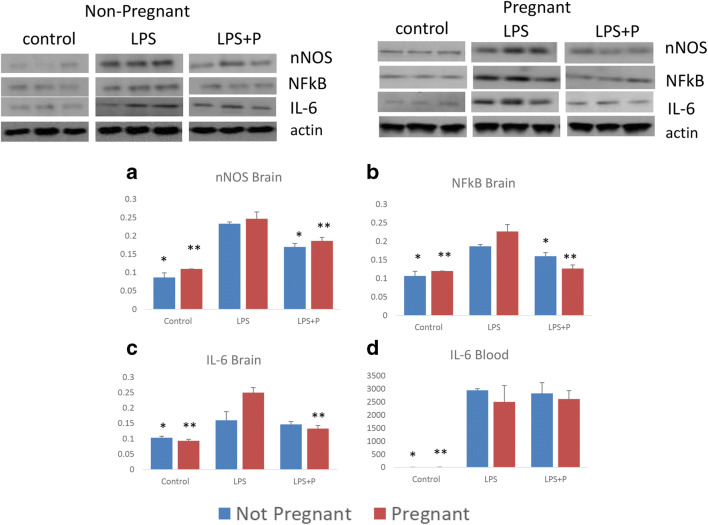
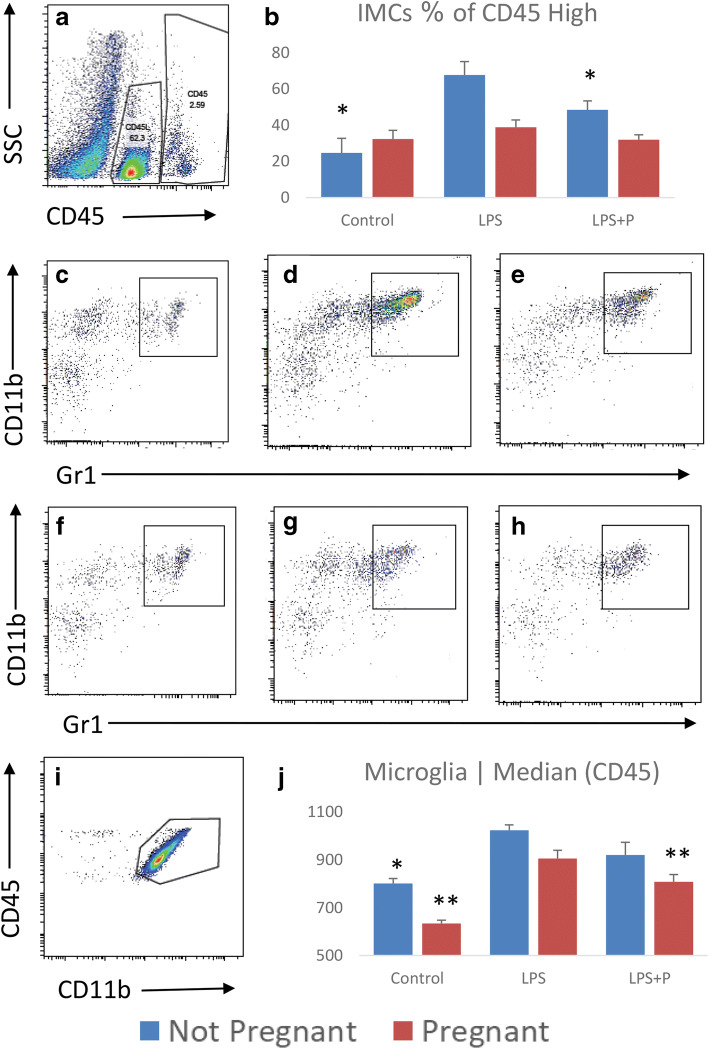
Progesterone has been shown to regulate immunity during pregnancy, and progesterone administration may reduce inflammation-induced preterm labor. We sought to determine the maternal brain immune response to LPS-induced inflammation in pregnant and non-pregnant mice and whether additional progesterone supplementation attenuates this response. Pregnant (P: n = 9) and non-pregnant mice (NP: n = 9) were randomized to pretreatment with vaginal progesterone/carrier (Replens), daily from days 13 to 16. On days 15 and 16, LPS/saline was administered by intraperitoneal injection (Replens + saline n = 3; Replens + LPS n = 3; progesterone + LPS n = 3). Mice were sacrificed on day 16 and maternal serum analyzed for IL-6 levels and brains analyzed for nNOS, NF-kB, IL-6 protein levels and for immature myeloid cells (IMCs) and microglial activity. LPS significantly increased brain nNOS, NF-kB, and IL-6 in both NP and P mice, with significantly greater responses in P mice. In both NP and P groups, progesterone significantly attenuated LPS-induced increase of nNOS and NF-kB, however with no effect on serum IL-6. In the NP brains, LPS significantly increased IMC population and progesterone reduced the IMC phenotype to levels similar to controls. In P mice, neither LPS nor LPS + progesterone altered the brain IMC population. LPS significantly increased the microglial activity in both NP and P groups, which was attenuated by progesterone. Progesterone attenuates brain inflammatory response to LPS in both NP and P mice although it has no effect on systemic inflammation. In NP mice, progesterone attenuated the increase in brain IMC following LPS administration. Our results suggest that endogenous progesterone during pregnancy may protect the brain from LPS-induced inflammation.
孕激素已被证明可调节孕期免疫,孕激素的应用可能减少炎症诱发的早产。我们旨在确定 LPS 诱导的炎症在妊娠和非妊娠小鼠母体大脑中的免疫反应,以及额外的孕激素补充是否能减轻这种反应。将妊娠(P:n=9)和非妊娠(NP:n=9)小鼠随机分为阴道用孕激素/载体(Replens)预处理组,从第 13 天至第 16 天每天一次。第 15 天和第 16 天,通过腹腔内注射 LPS/盐水(Replens+盐水 n=3;Replens+LPS n=3;孕激素+LPS n=3)进行处理。第 16 天处死小鼠,分析母鼠血清中 IL-6 水平和大脑中 nNOS、NF-kB、IL-6 蛋白水平以及未成熟髓样细胞(IMC)和小胶质细胞活性。LPS 显著增加了 NP 和 P 组小鼠大脑中的 nNOS、NF-kB 和 IL-6,P 组小鼠的反应更为显著。在 NP 和 P 两组中,孕激素均显著减轻了 LPS 诱导的 nNOS 和 NF-kB 增加,但对血清 IL-6 无影响。在 NP 大脑中,LPS 显著增加了 IMC 群体,而孕激素使 IMC 表型降低至与对照组相似的水平。在 P 组小鼠中,LPS 或 LPS+孕激素均未改变大脑 IMC 群体。LPS 显著增加了 NP 和 P 两组的小胶质细胞活性,孕激素则减轻了这一作用。孕激素减轻了 NP 和 P 两组 LPS 诱导的大脑炎症反应,尽管它对全身炎症没有影响。在 NP 小鼠中,孕激素减轻了 LPS 给药后大脑 IMC 的增加。我们的结果表明,妊娠期间内源性孕激素可能保护大脑免受 LPS 诱导的炎症。