Department of Information Science and Media Studies, University of Bergen, Bergen, Norway.
Institute of Biomedical Informatics, Moi University, Eldoret, Kenya.
BMC Med Inform Decis Mak. 2021 Jan 6;21(1):6. doi: 10.1186/s12911-020-01367-9.
The ability to report complete, accurate and timely data by HIV care providers and other entities is a key aspect in monitoring trends in HIV prevention, treatment and care, hence contributing to its eradication. In many low-middle-income-countries (LMICs), aggregate HIV data reporting is done through the District Health Information Software 2 (DHIS2). Nevertheless, despite a long-standing requirement to report HIV-indicator data to DHIS2 in LMICs, few rigorous evaluations exist to evaluate adequacy of health facility reporting at meeting completeness and timeliness requirements over time. The aim of this study is to conduct a comprehensive assessment of the reporting status for HIV-indicators, from the time of DHIS2 implementation, using Kenya as a case study.
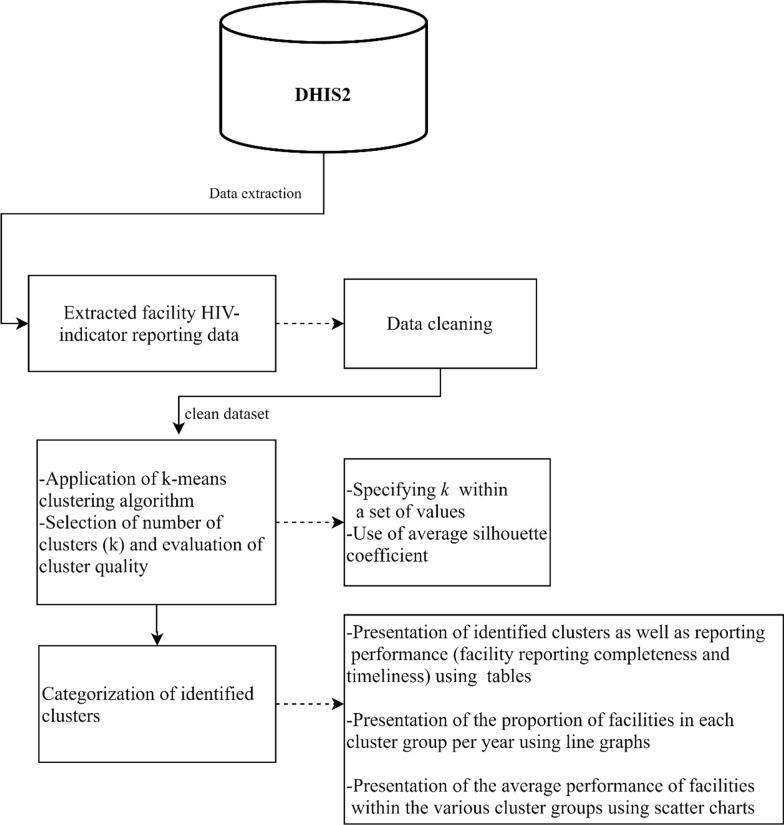
A retrospective observational study was conducted to assess reporting performance of health facilities providing any of the HIV services in all 47 counties in Kenya between 2011 and 2018. Using data extracted from DHIS2, K-means clustering algorithm was used to identify homogeneous groups of health facilities based on their performance in meeting timeliness and completeness facility reporting requirements for each of the six programmatic areas. Average silhouette coefficient was used in measuring the quality of the selected clusters.
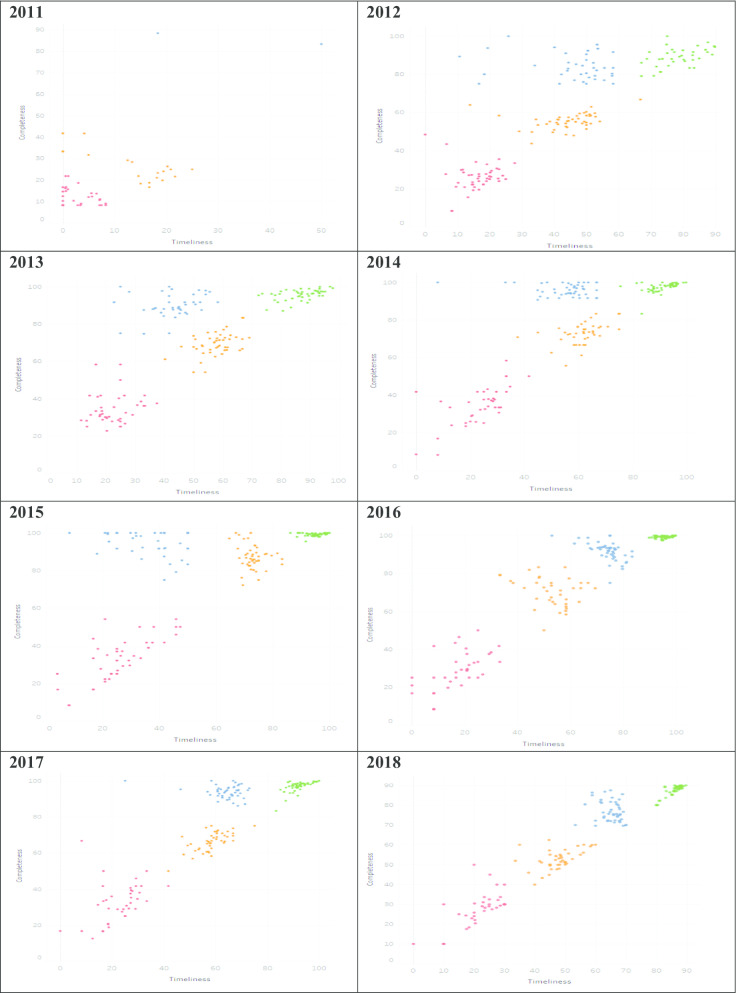
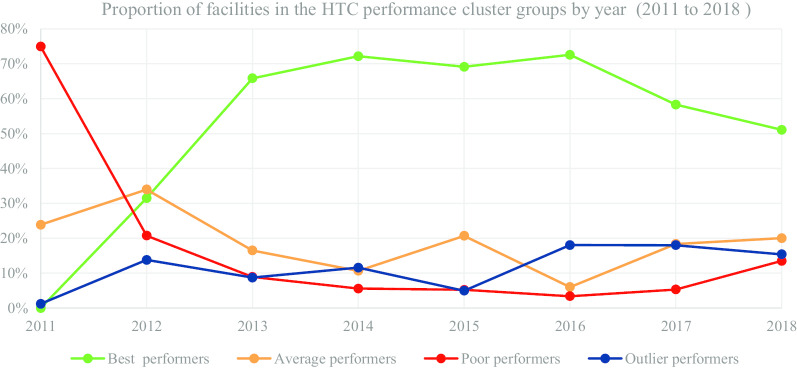
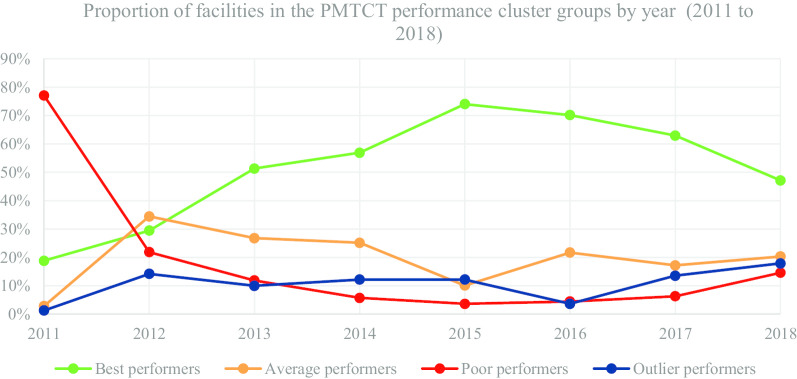
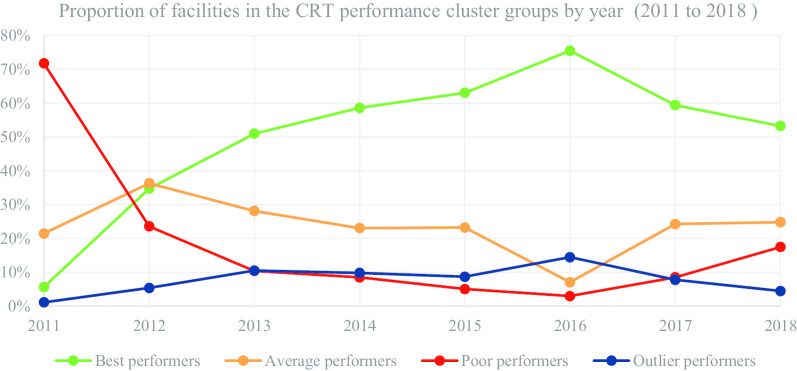
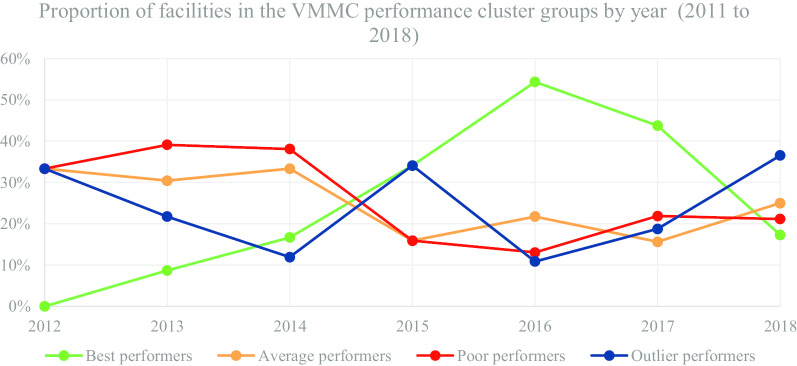
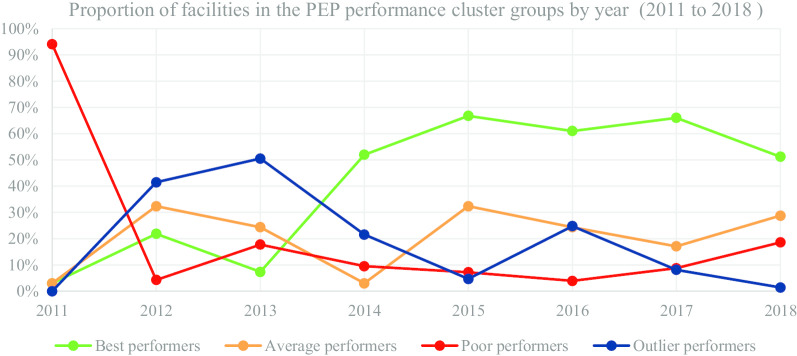
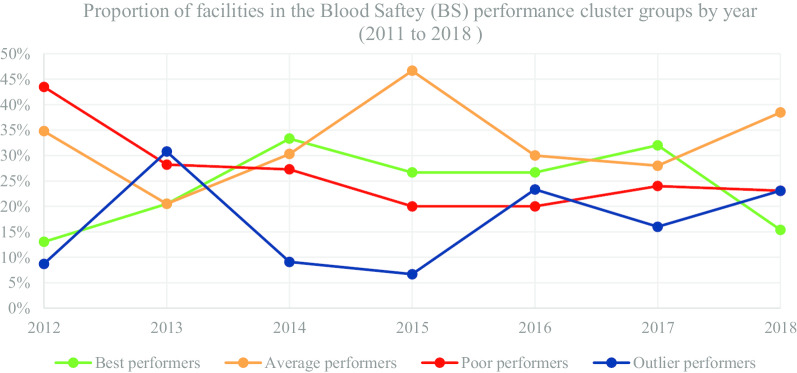
Based on percentage average facility reporting completeness and timeliness, four homogeneous groups of facilities were identified namely: best performers, average performers, poor performers and outlier performers. Apart from blood safety reports, a distinct pattern was observed in five of the remaining reports, with the proportion of best performing facilities increasing and the proportion of poor performing facilities decreasing over time. However, between 2016 and 2018, the proportion of best performers declined in some of the programmatic areas. Over the study period, no distinct pattern or trend in proportion changes was observed among facilities in the average and outlier groups.
The identified clusters revealed general improvements in reporting performance in the various reporting areas over time, but with noticeable decrease in some areas between 2016 and 2018. This signifies the need for continuous performance monitoring with possible integration of machine learning and visualization approaches into national HIV reporting systems.
HIV 护理提供者和其他实体报告完整、准确和及时数据的能力是监测 HIV 预防、治疗和护理趋势的关键方面,从而有助于消除 HIV。在许多中低收入国家(LMICs),聚合 HIV 数据通过 District Health Information Software 2(DHIS2)报告。然而,尽管长期以来一直要求在 LMICs 中向 DHIS2 报告 HIV 指标数据,但很少有严格的评估来评估卫生机构报告随时间推移满足完整性和及时性要求的充分性。本研究旨在使用肯尼亚作为案例研究,对自 DHIS2 实施以来 HIV 指标报告状况进行全面评估。
对 2011 年至 2018 年间肯尼亚所有 47 个县提供任何 HIV 服务的卫生机构的报告绩效进行回顾性观察研究。使用从 DHIS2 中提取的数据,使用 K-均值聚类算法根据其在满足六个方案领域的及时性和完整性机构报告要求方面的表现,对卫生机构进行同质分组。使用平均轮廓系数来衡量所选聚类的质量。
根据平均设施报告完整性和及时性的百分比,确定了四个同质设施组,即:最佳表现者、平均表现者、表现不佳者和异常表现者。除血液安全报告外,其余五项报告中观察到一个明显的模式,最佳表现者的比例随着时间的推移而增加,表现不佳者的比例随着时间的推移而减少。然而,在 2016 年至 2018 年间,一些方案领域的最佳表现者比例下降。在整个研究期间,平均和异常组设施的比例变化没有明显的模式或趋势。
所确定的集群显示出随着时间的推移,各报告领域的报告绩效普遍提高,但在 2016 年至 2018 年间,一些领域的报告绩效明显下降。这表明需要持续进行绩效监测,并可能将机器学习和可视化方法纳入国家 HIV 报告系统。