• 文献检索
  • 文档翻译
  • 深度研究
  • 学术资讯
  • Suppr Zotero 插件Zotero 插件
  • 邀请有礼
  • 套餐&价格
  • 历史记录
应用&插件
Suppr Zotero 插件Zotero 插件浏览器插件Mac 客户端Windows 客户端微信小程序
定价
高级版会员购买积分包购买API积分包
服务
文献检索文档翻译深度研究API 文档MCP 服务
关于我们
关于 Suppr公司介绍联系我们用户协议隐私条款
关注我们

Suppr 超能文献

核心技术专利:CN118964589B侵权必究
粤ICP备2023148730 号-1Suppr @ 2026

文献检索

告别复杂PubMed语法,用中文像聊天一样搜索,搜遍4000万医学文献。AI智能推荐,让科研检索更轻松。

立即免费搜索

文件翻译

保留排版,准确专业,支持PDF/Word/PPT等文件格式,支持 12+语言互译。

免费翻译文档

深度研究

AI帮你快速写综述,25分钟生成高质量综述,智能提取关键信息,辅助科研写作。

立即免费体验

肯尼亚通过地区卫生信息系统 2 报告疟疾指标数据的完整性,2011-2015 年。

Completeness of malaria indicator data reporting via the District Health Information Software 2 in Kenya, 2011-2015.

机构信息

Kenya Medical Research Institute-Wellcome Trust Research Programme, Nairobi, Kenya.

National Malaria Control Programme, Ministry of Health, Nairobi, Kenya.

出版信息

Malar J. 2017 Aug 17;16(1):344. doi: 10.1186/s12936-017-1973-y.

DOI:10.1186/s12936-017-1973-y
PMID:28818071
原文链接:https://pmc.ncbi.nlm.nih.gov/articles/PMC5561621/
Abstract

BACKGROUND

Health facility-based data reported through routine health information systems form the primary data source for programmatic monitoring and evaluation in most developing countries. The adoption of District Health Information Software (DHIS2) has contributed to improved availability of routine health facility-based data in many low-income countries. An assessment of malaria indicators data reported by health facilities in Kenya during the first 5 years of implementation of DHIS2, from January 2011 to December 2015, was conducted.

METHODS

Data on 19 malaria indicators reported monthly by health facilities were extracted from the online Kenya DHIS2 database. Completeness of reporting was analysed for each of the 19 malaria indicators and expressed as the percentage of data values actually reported over the expected number; all health facilities were expected to report data for each indicator for all 12 months in a year.

RESULTS

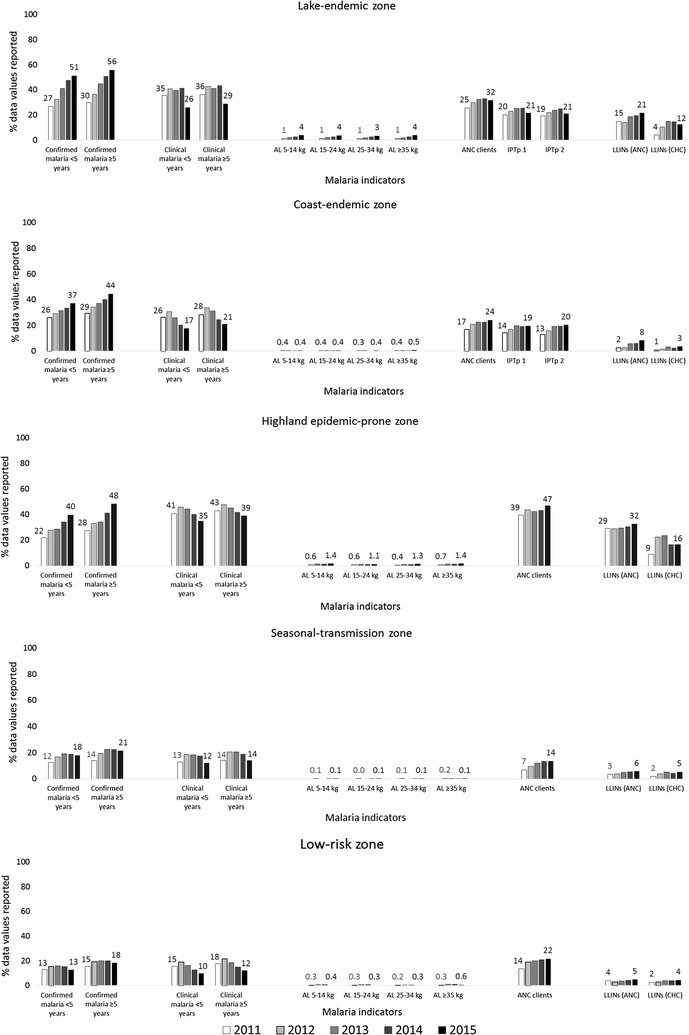
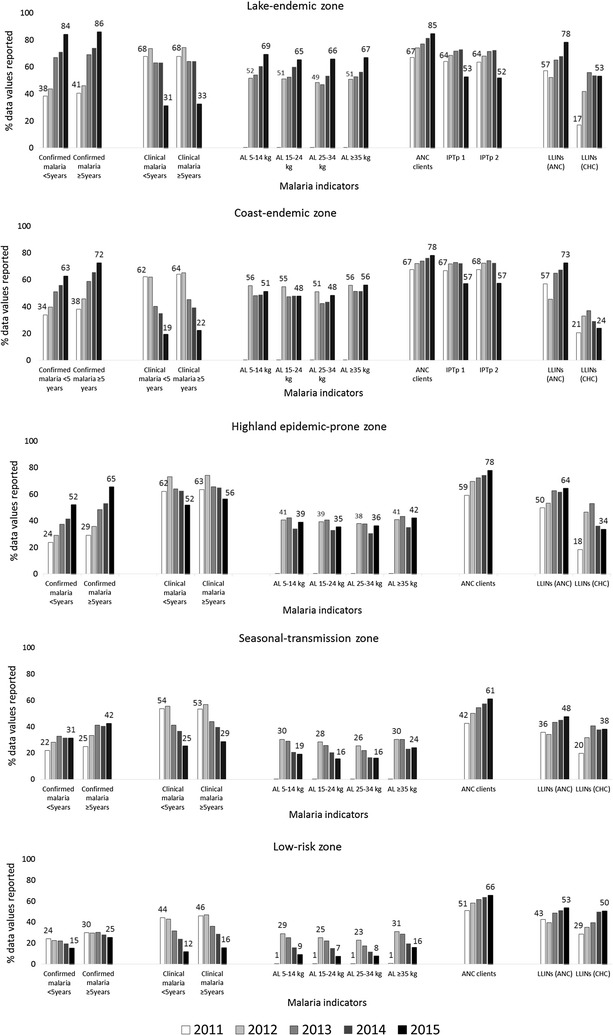
Malaria indicators data were analysed for 6235 public and 3143 private health facilities. Between 2011 and 2015, completeness of reporting in the public sector increased significantly for confirmed malaria cases across all age categories (26.5-41.9%, p < 0.0001, in children aged <5 years; 30.6-51.4%, p < 0.0001, in persons aged ≥5 years). Completeness of reporting of new antenatal care (ANC) clients increased from 53.7 to 70.5%, p < 0.0001). Completeness of reporting of intermittent preventive treatment in pregnancy (IPTp) decreased from 64.8 to 53.7%, p < 0.0001 for dose 1 and from 64.6 to 53.4%, p < 0.0001 for dose 2. Data on malaria tests performed and test results were not available in DHIS2 from 2011 to 2014. In 2015, sparse data on microscopy (11.5% for children aged <5 years; 11.8% for persons aged ≥5 years) and malaria rapid diagnostic tests (RDTs) (8.1% for all ages) were reported. In the private sector, completeness of reporting increased significantly for confirmed malaria cases across all age categories (16.7-23.1%, p < 0.0001, in children aged <5 years; 19.4-28.6%, p < 0.0001, in persons aged ≥5 years). Completeness of reporting also improved for new ANC clients (16.2-23.6%, p < 0.0001), and for IPTp doses 1 and 2 (16.6-20.2%, p < 0.0001 and 15.5-20.5%, p < 0.0001, respectively). In 2015, less than 3% of data values for malaria tests performed were reported in DHIS2 from the private sector.

CONCLUSIONS

There have been sustained improvements in the completeness of data reported for most key malaria indicators since the adoption of DHIS2 in Kenya in 2011. However, major data gaps were identified for the malaria-test indicator and overall low reporting across all indicators from private health facilities. A package of proven DHIS2 implementation interventions and performance-based incentives should be considered to improve private-sector data reporting.

摘要

背景

在大多数发展中国家,基于卫生机构的卫生信息系统报告的数据是规划监测和评价的主要数据源。在许多低收入国家,采用地区卫生信息系统(DHIS2)有助于提高常规卫生机构数据的可用性。对肯尼亚在实施 DHIS2 的头 5 年(2011 年 1 月至 2015 年 12 月)期间卫生机构报告的疟疾指标数据进行了评估。

方法

从在线肯尼亚 DHIS2 数据库中提取了 19 项每月由卫生机构报告的疟疾指标数据。分析了每个疟疾指标的报告完整性,并表示为实际报告的数据值与预期数据值之比;所有卫生机构均应在一年中的 12 个月内报告每个指标的数据。

结果

分析了 6235 家公立和 3143 家私立卫生机构的疟疾指标数据。2011 年至 2015 年期间,公立部门报告的确诊疟疾病例完整性显著提高(所有年龄组 26.5-41.9%,p<0.0001,<5 岁儿童;30.6-51.4%,p<0.0001,≥5 岁人群)。新产前保健(ANC)客户的报告完整性从 53.7%增加到 70.5%(p<0.0001)。妊娠间歇性预防治疗(IPTp)的报告完整性从 64.8%下降到 53.7%(第 1 剂,p<0.0001)和 64.6%下降到 53.4%(第 2 剂,p<0.0001)。2011 年至 2014 年,DHIS2 中未提供疟疾检测和检测结果的数据。2015 年,仅报告了少量显微镜检查(<5 岁儿童 11.5%;≥5 岁人群 11.8%)和疟疾快速诊断检测(RDTs)(所有年龄段 8.1%)的数据。在私立部门,所有年龄组的确诊疟疾病例报告完整性均显著提高(<5 岁儿童 16.7-23.1%,p<0.0001;≥5 岁人群 19.4-28.6%,p<0.0001)。新 ANC 客户的报告完整性也得到了改善(16.2-23.6%,p<0.0001),第 1 和第 2 剂 IPTp 的报告完整性也得到了改善(16.6-20.2%,p<0.0001 和 15.5-20.5%,p<0.0001)。2015 年,DHIS2 中私立部门报告的疟疾检测数据值不到 3%。

结论

自 2011 年肯尼亚采用 DHIS2 以来,大多数关键疟疾指标的数据报告完整性持续提高。然而,疟疾检测指标和整体低报告率仍然存在重大数据差距,所有私立卫生机构的所有指标均如此。应考虑实施经证实的 DHIS2 干预措施和基于绩效的激励措施,以改善私立部门的数据报告。
https://cdn.ncbi.nlm.nih.gov/pmc/blobs/7189/5561621/956909f75c4b/12936_2017_1973_Fig2_HTML.jpg
https://cdn.ncbi.nlm.nih.gov/pmc/blobs/7189/5561621/d379e84e13f0/12936_2017_1973_Fig1_HTML.jpg
https://cdn.ncbi.nlm.nih.gov/pmc/blobs/7189/5561621/956909f75c4b/12936_2017_1973_Fig2_HTML.jpg
https://cdn.ncbi.nlm.nih.gov/pmc/blobs/7189/5561621/d379e84e13f0/12936_2017_1973_Fig1_HTML.jpg
https://cdn.ncbi.nlm.nih.gov/pmc/blobs/7189/5561621/956909f75c4b/12936_2017_1973_Fig2_HTML.jpg

相似文献

1
Completeness of malaria indicator data reporting via the District Health Information Software 2 in Kenya, 2011-2015.肯尼亚通过地区卫生信息系统 2 报告疟疾指标数据的完整性,2011-2015 年。
Malar J. 2017 Aug 17;16(1):344. doi: 10.1186/s12936-017-1973-y.
2
A data quality assessment of the first four years of malaria reporting in the Senegal DHIS2, 2014-2017.2014-2017 年塞内加尔 DHIS2 疟疾报告的头四年数据质量评估。
BMC Health Serv Res. 2022 Jan 2;22(1):18. doi: 10.1186/s12913-021-07364-6.
3
Coverage of routine reporting on malaria parasitological testing in Kenya, 2015-2016.2015 - 2016年肯尼亚疟疾寄生虫学检测常规报告的覆盖情况。
Glob Health Action. 2017;10(1):1413266. doi: 10.1080/16549716.2017.1413266.
4
Data cleaning process for HIV-indicator data extracted from DHIS2 national reporting system: a case study of Kenya.从 DHIS2 国家报告系统中提取的艾滋病毒指标数据的数据清理流程:肯尼亚案例研究。
BMC Med Inform Decis Mak. 2020 Nov 13;20(1):293. doi: 10.1186/s12911-020-01315-7.
5
Evaluating performance of health care facilities at meeting HIV-indicator reporting requirements in Kenya: an application of K-means clustering algorithm.评估肯尼亚医疗机构满足艾滋病毒指标报告要求的绩效:K-均值聚类算法的应用。
BMC Med Inform Decis Mak. 2021 Jan 6;21(1):6. doi: 10.1186/s12911-020-01367-9.
6
Evaluation of the malaria reporting system supported by the District Health Information System 2 in Solomon Islands.所罗门群岛基于地区卫生信息系统 2 的疟疾报告系统评估。
Malar J. 2020 Oct 17;19(1):372. doi: 10.1186/s12936-020-03442-y.
7
Improvements in malaria surveillance through the electronic Integrated Disease Surveillance and Response (eIDSR) system in mainland Tanzania, 2013-2021.通过坦桑尼亚大陆电子综合疾病监测和应对(eIDSR)系统提高疟疾监测水平,2013-2021 年。
Malar J. 2022 Nov 8;21(1):321. doi: 10.1186/s12936-022-04353-w.
8
Automating indicator data reporting from health facility EMR to a national aggregate data system in Kenya: An Interoperability field-test using OpenMRS and DHIS2.将肯尼亚医疗机构电子病历中的指标数据报告自动化至国家汇总数据系统:使用OpenMRS和DHIS2的互操作性现场测试。
Online J Public Health Inform. 2016 Sep 15;8(2):e188. doi: 10.5210/ojphi.v8i2.6722. eCollection 2016.
9
"Every day they keep adding new tools but they don't take any away": Producing indicators for intermittent preventive treatment for malaria in pregnancy (IPTp) from routine data in Kenya.“他们每天都在不断增加新工具,却没有淘汰任何旧工具”:利用肯尼亚的常规数据生成孕期疟疾间歇预防性治疗(IPTp)的指标。
PLoS One. 2018 Jan 3;13(1):e0189699. doi: 10.1371/journal.pone.0189699. eCollection 2018.
10
Impact of Electronic Medical Records Systems in Reporting HIV Health Data Indicators in Kenya.电子病历系统对肯尼亚报告艾滋病毒健康数据指标的影响。
Stud Health Technol Inform. 2022 May 25;294:234-238. doi: 10.3233/SHTI220444.

引用本文的文献

1
Factors affecting integration of an early warning system for antimalarial drug resistance within a routine surveillance system in a pre-elimination setting in Sub-Saharan Africa.撒哈拉以南非洲消除疟疾前环境下,影响常规监测系统中抗疟药物耐药性早期预警系统整合的因素。
PLoS One. 2025 Jun 3;20(6):e0305885. doi: 10.1371/journal.pone.0305885. eCollection 2025.
2
Characterization of Malaria Outbreak in Marsabit County, Kenya, March 2024.2024年3月肯尼亚马萨比特县疟疾疫情特征分析
Am J Trop Med Hyg. 2025 May 6;113(1):49-56. doi: 10.4269/ajtmh.24-0681. Print 2025 Jul 2.
3
Assessing the adoption and utilization of the Rwanda COVID-19 data analytics system: a mixed methods approach.

本文引用的文献

1
The critical role of acute flaccid paralysis surveillance in the Global Polio Eradication Initiative.急性弛缓性麻痹监测在全球根除脊髓灰质炎行动中的关键作用。
Int Health. 2017 May 1;9(3):156-163. doi: 10.1093/inthealth/ihx016.
2
A national health facility survey of malaria infection among febrile patients in Kenya, 2014.2014年肯尼亚发热患者疟疾感染情况全国卫生机构调查。
Malar J. 2016 Dec 8;15(1):591. doi: 10.1186/s12936-016-1638-2.
3
Using pay for performance incentives (P4P) to improve management of suspected malaria fevers in rural Kenya: a cluster randomized controlled trial.
评估卢旺达新冠疫情数据分析系统的采用情况与使用情况:一种混合方法研究。
Oxf Open Digit Health. 2024 Aug 28;2:oqae034. doi: 10.1093/oodh/oqae034. eCollection 2024.
4
A scoping review of the methods used to estimate health facility catchment populations for child health indicators in sub-Saharan Africa.对撒哈拉以南非洲地区用于估算儿童健康指标的卫生设施服务人口的方法进行的一项范围综述。
Popul Health Metr. 2025 Mar 29;23(1):11. doi: 10.1186/s12963-025-00374-0.
5
Malaria and missed school days: exploring school absenteeism patterns and local strategies in Odisha, India.疟疾与缺课天数:探究印度奥里萨邦的学校缺勤模式及地方策略
Front Public Health. 2025 Feb 27;13:1502247. doi: 10.3389/fpubh.2025.1502247. eCollection 2025.
6
Subnational tailoring of malaria interventions to prioritize the malaria response in Guinea.根据国家以下各级情况定制疟疾干预措施,以优先应对几内亚的疟疾问题。
Malar J. 2025 Feb 25;24(1):62. doi: 10.1186/s12936-025-05302-z.
7
Quality of routine malaria data captured at primary health facilities in the Hohoe Municipality, Ghana.加纳霍霍埃市初级卫生设施收集的常规疟疾数据质量。
Sci Rep. 2025 Feb 4;15(1):4293. doi: 10.1038/s41598-024-78886-2.
8
Neonatal indicator data in Tanzania District Health Information System: evaluation of availability and quality of selected newborn indicators, 2015-2022.坦桑尼亚地区卫生信息系统中的新生儿指标数据:2015 - 2022年选定新生儿指标的可得性与质量评估
BMC Pediatr. 2025 Jan 23;23(Suppl 2):658. doi: 10.1186/s12887-025-05417-x.
9
Uses of private health provider data for governance in low-income and middle-income countries: results from a scoping review.私营医疗服务提供者数据在中低收入国家治理中的使用:一项范围综述的结果。
BMJ Open. 2024 Nov 17;14(11):e083096. doi: 10.1136/bmjopen-2023-083096.
10
Truth is relative; Client report versus provider report, a post-modern analysis of data from a trial in the private retail medicine sector.真理是相对的;客户报告与提供者报告,对私营零售医疗行业一项试验数据的后现代分析。
Res Sq. 2024 Oct 21:rs.3.rs-5005686. doi: 10.21203/rs.3.rs-5005686/v1.
运用绩效薪酬激励措施(P4P)改善肯尼亚农村地区疑似疟疾发热的管理:一项整群随机对照试验。
BMC Med. 2015 Oct 16;13:268. doi: 10.1186/s12916-015-0497-y.
4
Toward utilization of data for program management and evaluation: quality assessment of five years of health management information system data in Rwanda.迈向数据用于项目管理与评估:卢旺达五年健康管理信息系统数据的质量评估
Glob Health Action. 2014 Nov 19;7:25829. doi: 10.3402/gha.v7.25829. eCollection 2014.
5
Assessing the ability of health information systems in hospitals to support evidence-informed decisions in Kenya.评估肯尼亚医院健康信息系统支持基于证据的决策的能力。
Glob Health Action. 2014 Jul 31;7:24859. doi: 10.3402/gha.v7.24859. eCollection 2014.
6
Strengthening district-based health reporting through the district health management information software system: the Ugandan experience.通过地区卫生管理信息软件系统加强基于地区的卫生报告:乌干达的经验。
BMC Med Inform Decis Mak. 2014 May 13;14:40. doi: 10.1186/1472-6947-14-40.
7
Declining malaria in Africa: improving the measurement of progress.非洲疟疾减少:改善进展衡量标准。
Malar J. 2014 Jan 30;13:39. doi: 10.1186/1475-2875-13-39.
8
Where is information quality lost at clinical level? A mixed-method study on information systems and data quality in three urban Kenyan ANC clinics.信息质量在临床层面丢失在哪里?一项关于肯尼亚三个城市 ANC 诊所信息系统和数据质量的混合方法研究。
Glob Health Action. 2013 Aug 29;6:21424. doi: 10.3402/gha.v6i0.21424.
9
Monitoring child survival in 'real time' using routine health facility records: results from Malawi.利用常规卫生机构记录实时监测儿童生存状况:来自马拉维的结果。
Trop Med Int Health. 2013 Oct;18(10):1231-9. doi: 10.1111/tmi.12167. Epub 2013 Aug 1.
10
Improving public health information: a data quality intervention in KwaZulu-Natal, South Africa.改善公共卫生信息:南非夸祖鲁-纳塔尔的数据质量干预。
Bull World Health Organ. 2012 Mar 1;90(3):176-82. doi: 10.2471/BLT.11.092759. Epub 2011 Dec 5.