Zhang YunZheng, Wang ZiHao, Zhang Jin, Wang CuiCui, Wang YuShan, Chen Hao, Shan LuHe, Huo JiaNing, Gu JiaHui, Ma Xiaoxin
Department of Obstetrics and Gynecology, Shengjing Hospital of China Medical University, 39 Huaxiang Road, Shenyang, 110021, People's Republic of China.
J Transl Med. 2021 Jan 6;19(1):10. doi: 10.1186/s12967-020-02660-x.
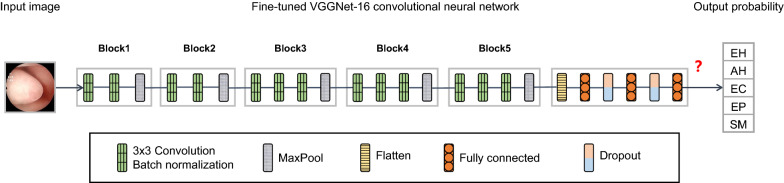
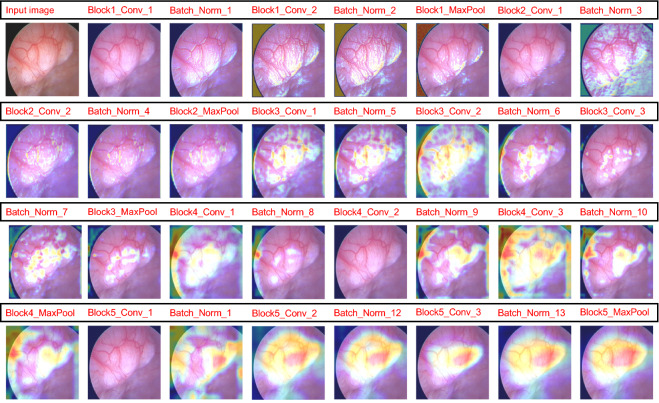
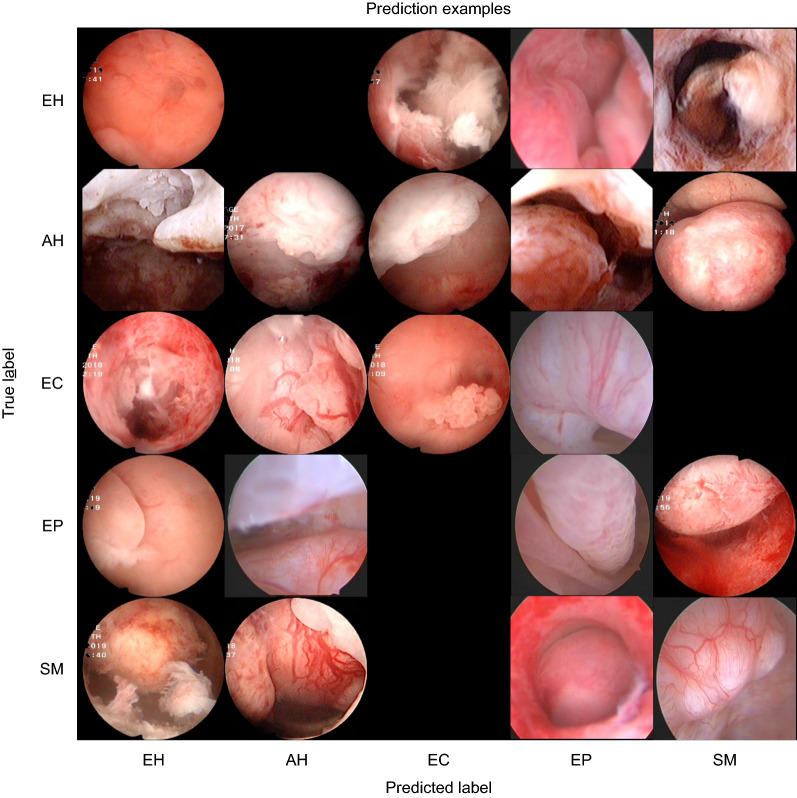
Hysteroscopy is a commonly used technique for diagnosing endometrial lesions. It is essential to develop an objective model to aid clinicians in lesion diagnosis, as each type of lesion has a distinct treatment, and judgments of hysteroscopists are relatively subjective. This study constructs a convolutional neural network model that can automatically classify endometrial lesions using hysteroscopic images as input.
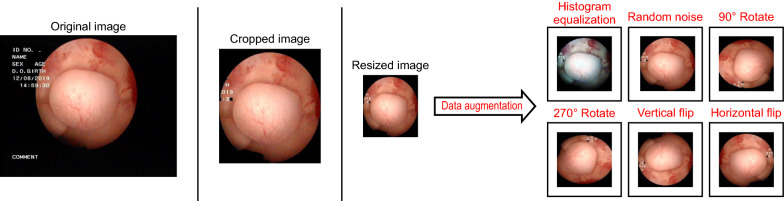
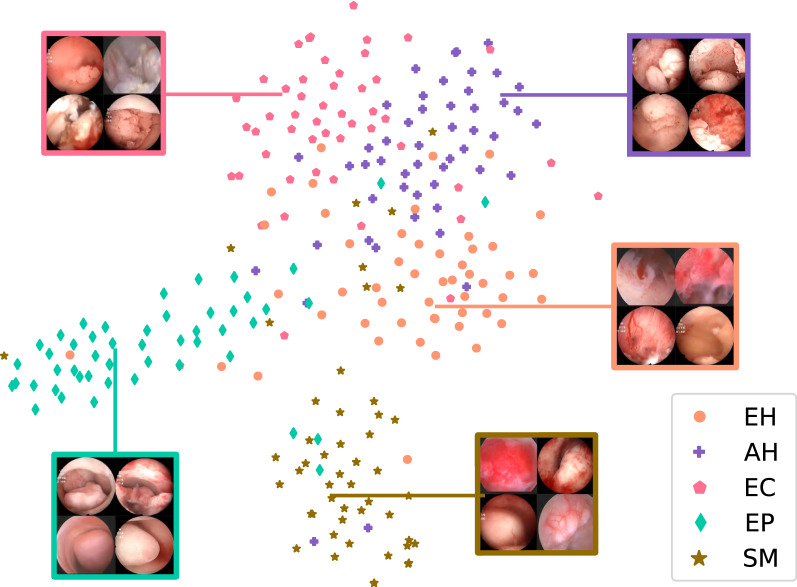
All histopathologically confirmed endometrial lesion images were obtained from the Shengjing Hospital of China Medical University, including endometrial hyperplasia without atypia, atypical hyperplasia, endometrial cancer, endometrial polyps, and submucous myomas. The study included 1851 images from 454 patients. After the images were preprocessed (histogram equalization, addition of noise, rotations, and flips), a training set of 6478 images was input into a tuned VGGNet-16 model; 250 images were used as the test set to evaluate the model's performance. Thereafter, we compared the model's results with the diagnosis of gynecologists.
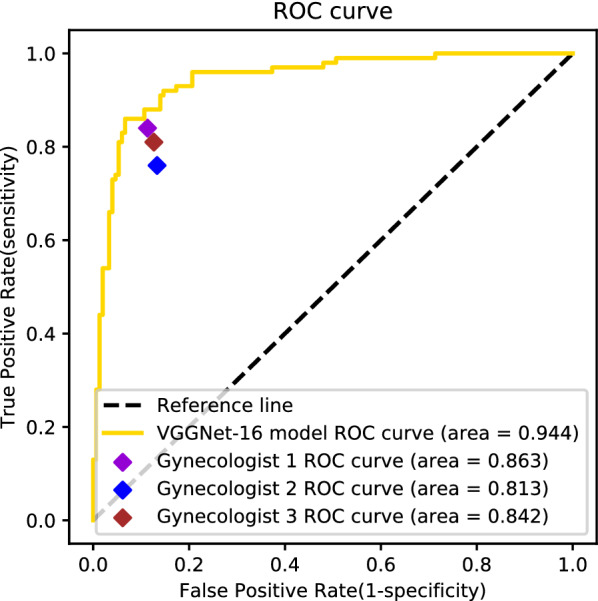
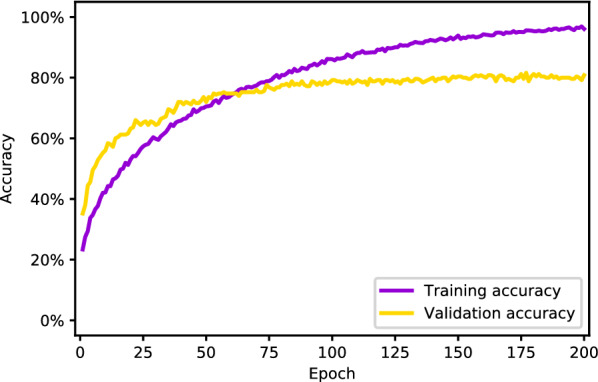
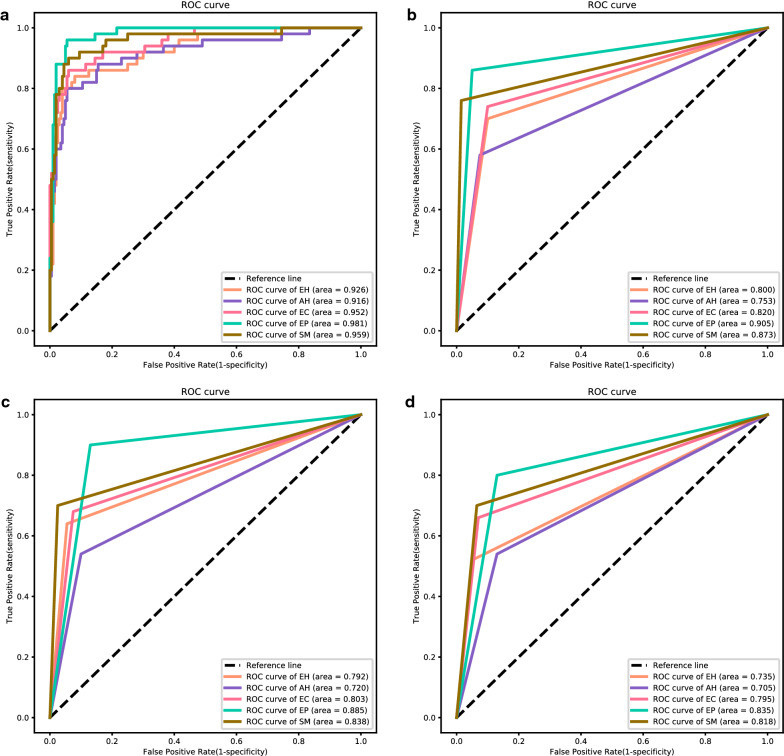
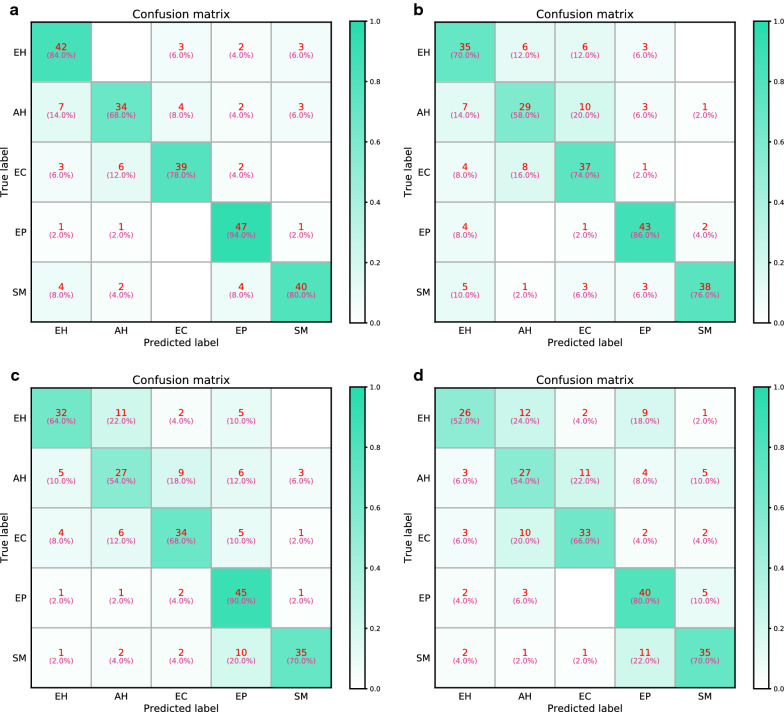
The overall accuracy of the VGGNet-16 model in classifying endometrial lesions is 80.8%. Its sensitivity to endometrial hyperplasia without atypia, atypical hyperplasia, endometrial cancer, endometrial polyp, and submucous myoma is 84.0%, 68.0%, 78.0%, 94.0%, and 80.0%, respectively; for these diagnoses, the model's specificity is 92.5%, 95.5%, 96.5%, 95.0%, and 96.5%, respectively. When classifying lesions as benign or as premalignant/malignant, the VGGNet-16 model's accuracy, sensitivity, and specificity are 90.8%, 83.0%, and 96.0%, respectively. The diagnostic performance of the VGGNet-16 model is slightly better than that of the three gynecologists in both classification tasks. With the aid of the model, the overall accuracy of the diagnosis of endometrial lesions by gynecologists can be improved.
The VGGNet-16 model performs well in classifying endometrial lesions from hysteroscopic images and can provide objective diagnostic evidence for hysteroscopists.
宫腔镜检查是诊断子宫内膜病变的常用技术。由于每种病变类型都有独特的治疗方法,且宫腔镜检查医生的判断相对主观,因此开发一种客观模型以协助临床医生进行病变诊断至关重要。本研究构建了一种卷积神经网络模型,该模型可以将宫腔镜图像作为输入自动对子宫内膜病变进行分类。
所有经组织病理学确诊的子宫内膜病变图像均来自中国医科大学盛京医院,包括无异型性的子宫内膜增生、不典型增生、子宫内膜癌、子宫内膜息肉和黏膜下肌瘤。该研究纳入了来自454例患者的1851张图像。在对图像进行预处理(直方图均衡化、添加噪声、旋转和翻转)后,将6478张图像的训练集输入到经过调优的VGGNet-16模型中;250张图像用作测试集以评估模型的性能。此后,我们将模型的结果与妇科医生的诊断进行了比较。
VGGNet-16模型对子宫内膜病变进行分类的总体准确率为80.8%。其对无异型性的子宫内膜增生、不典型增生、子宫内膜癌、子宫内膜息肉和黏膜下肌瘤的敏感性分别为84.0%、68.0%、78.0%、94.0%和80.0%;对于这些诊断,模型的特异性分别为92.5%、95.5%、96.5%、95.0%和96.5%。当将病变分类为良性或癌前/恶性时,VGGNet-16模型的准确率、敏感性和特异性分别为90.8%、83.0%和96.0%。在两项分类任务中,VGGNet-16模型的诊断性能均略优于三位妇科医生。借助该模型,可以提高妇科医生对子宫内膜病变诊断的总体准确率。
VGGNet-16模型在对宫腔镜图像中的子宫内膜病变进行分类方面表现良好,可为宫腔镜检查医生提供客观的诊断依据。