• 文献检索
  • 文档翻译
  • 深度研究
  • 学术资讯
  • Suppr Zotero 插件Zotero 插件
  • 邀请有礼
  • 套餐&价格
  • 历史记录
应用&插件
Suppr Zotero 插件Zotero 插件浏览器插件Mac 客户端Windows 客户端微信小程序
定价
高级版会员购买积分包购买API积分包
服务
文献检索文档翻译深度研究API 文档MCP 服务
关于我们
关于 Suppr公司介绍联系我们用户协议隐私条款
关注我们

Suppr 超能文献

核心技术专利:CN118964589B侵权必究
粤ICP备2023148730 号-1Suppr @ 2026

文献检索

告别复杂PubMed语法,用中文像聊天一样搜索,搜遍4000万医学文献。AI智能推荐,让科研检索更轻松。

立即免费搜索

文件翻译

保留排版,准确专业,支持PDF/Word/PPT等文件格式,支持 12+语言互译。

免费翻译文档

深度研究

AI帮你快速写综述,25分钟生成高质量综述,智能提取关键信息,辅助科研写作。

立即免费体验

医院层面颅内压监测在重型颅脑创伤中的应用及其功能结局:一项前瞻性多中心观察性研究的事后分析。

Hospital-level intracranial pressure monitoring utilization and functional outcome in severe traumatic brain injury: a post hoc analysis of prospective multicenter observational study.

机构信息

Emergency Medical Center, Kagawa University Hospital, 1750-1 Ikenobe, Kita, Miki, Kagawa, 761-0793, Japan.

出版信息

Scand J Trauma Resusc Emerg Med. 2021 Jan 6;29(1):5. doi: 10.1186/s13049-020-00825-7.

DOI:10.1186/s13049-020-00825-7
PMID:33407751
原文链接:https://pmc.ncbi.nlm.nih.gov/articles/PMC7789401/
Abstract

BACKGROUND

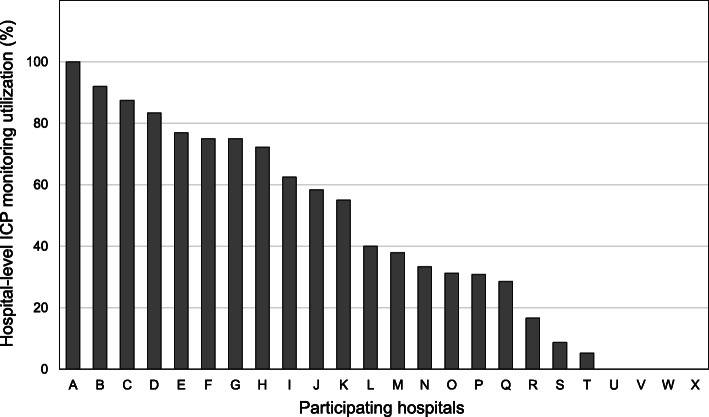
Several observational studies have shown that hospital-level intracranial pressure (ICP) monitoring utilization varies considerably in patients with severe traumatic brain injury (TBI). However, the relationship between hospital-level ICP monitoring utilization and clinical functional outcomes is unknown. This study examined whether patients with severe TBI treated at hospitals with high ICP monitoring utilization have better functional outcomes.

METHODS

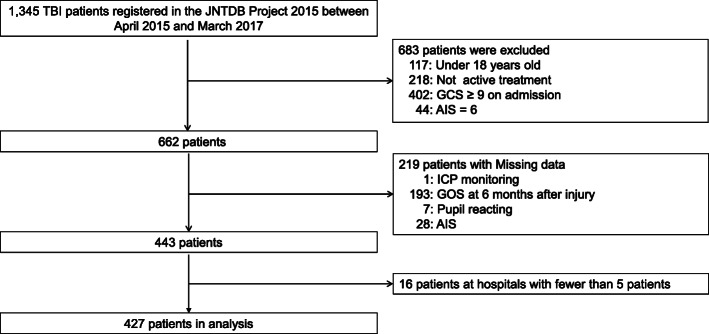
A post hoc analysis of the data from a prospective multicenter cohort study in Japan was undertaken, and included severe TBI patients (Glasgow Come Scale score ≤ 8). The primary exposure was hospital-level ICP monitoring utilization. Patients treated at hospitals with more than 80% ICP monitoring utilization were assigned to a high group and the others to a low group. The primary endpoint was a favorable functional outcome at 6 months after injury, defined as a Glasgow Outcome Scale score of good recovery or moderate disability. We conducted multiple logistic regression analyses adjusted for potential confounders.

RESULTS

Of the 427 included patients, 60 were assigned to the high group and 367 to the low group. Multiple logistic regression analysis revealed that patients in the high group had significantly better functional outcome (adjusted odds ratio [OR]: 2.36; 95% confidence interval [CI]: 1.17-4.76; p = 0.016). Multiple logistic regression analysis adjusted for additional confounders supported this result (adjusted OR: 2.30; 95% CI: 1.07-4.92; p = 0.033).

CONCLUSION

Treatment at hospitals with high ICP monitoring utilization for severe TBI patients could be associated with better functional outcome.

摘要

背景

几项观察性研究表明,在患有严重创伤性脑损伤(TBI)的患者中,医院级别的颅内压(ICP)监测使用率差异很大。然而,医院级别的 ICP 监测使用率与临床功能结局之间的关系尚不清楚。本研究旨在探讨在 ICP 监测使用率较高的医院接受治疗的严重 TBI 患者的功能结局是否更好。

方法

对日本一项前瞻性多中心队列研究的数据进行了事后分析,纳入严重 TBI 患者(格拉斯哥昏迷量表评分≤8 分)。主要暴露因素为医院级别的 ICP 监测使用率。将 ICP 监测使用率超过 80%的医院的患者分配到高使用率组,其他医院的患者分配到低使用率组。主要结局为伤后 6 个月时的良好功能结局,定义为格拉斯哥预后量表评分良好恢复或中度残疾。我们进行了多变量逻辑回归分析,调整了潜在混杂因素。

结果

在纳入的 427 例患者中,60 例患者被分配到高使用率组,367 例患者被分配到低使用率组。多变量逻辑回归分析显示,高使用率组患者的功能结局显著更好(调整后的优势比 [OR]:2.36;95%置信区间 [CI]:1.17-4.76;p=0.016)。调整其他混杂因素后的多变量逻辑回归分析也支持这一结果(调整后的 OR:2.30;95% CI:1.07-4.92;p=0.033)。

结论

对严重 TBI 患者在 ICP 监测使用率较高的医院进行治疗可能与更好的功能结局相关。
https://cdn.ncbi.nlm.nih.gov/pmc/blobs/ca0f/7789401/e3a5cb99f3a6/13049_2020_825_Fig3_HTML.jpg
https://cdn.ncbi.nlm.nih.gov/pmc/blobs/ca0f/7789401/e35b7a7d209e/13049_2020_825_Fig1_HTML.jpg
https://cdn.ncbi.nlm.nih.gov/pmc/blobs/ca0f/7789401/82a90cb75f85/13049_2020_825_Fig2_HTML.jpg
https://cdn.ncbi.nlm.nih.gov/pmc/blobs/ca0f/7789401/e3a5cb99f3a6/13049_2020_825_Fig3_HTML.jpg
https://cdn.ncbi.nlm.nih.gov/pmc/blobs/ca0f/7789401/e35b7a7d209e/13049_2020_825_Fig1_HTML.jpg
https://cdn.ncbi.nlm.nih.gov/pmc/blobs/ca0f/7789401/82a90cb75f85/13049_2020_825_Fig2_HTML.jpg
https://cdn.ncbi.nlm.nih.gov/pmc/blobs/ca0f/7789401/e3a5cb99f3a6/13049_2020_825_Fig3_HTML.jpg

相似文献

1
Hospital-level intracranial pressure monitoring utilization and functional outcome in severe traumatic brain injury: a post hoc analysis of prospective multicenter observational study.医院层面颅内压监测在重型颅脑创伤中的应用及其功能结局:一项前瞻性多中心观察性研究的事后分析。
Scand J Trauma Resusc Emerg Med. 2021 Jan 6;29(1):5. doi: 10.1186/s13049-020-00825-7.
2
Role of Intracranial Pressure Monitoring in Management of Patients with Severe Traumatic Brain Injury: Results of a Large Level I Trauma Center in Southern Iran.颅内压监测在重度创伤性脑损伤患者管理中的作用:伊朗南部一家大型一级创伤中心的研究结果
World Neurosurg. 2016 Oct;94:120-125. doi: 10.1016/j.wneu.2016.06.122. Epub 2016 Jul 5.
3
Intracranial pressure monitoring in patients with acute brain injury in the intensive care unit (SYNAPSE-ICU): an international, prospective observational cohort study.重症监护病房中急性脑损伤患者的颅内压监测(SYNAPSE-ICU):一项国际、前瞻性观察性队列研究。
Lancet Neurol. 2021 Jul;20(7):548-558. doi: 10.1016/S1474-4422(21)00138-1.
4
The effect of ICP monitoring in severe traumatic brain injury: a propensity score-weighted and adjusted regression approach.ICP 监测对严重创伤性脑损伤的影响:倾向评分加权和调整回归方法。
J Neurosurg. 2018 Dec 21;131(6):1896-1904. doi: 10.3171/2018.7.JNS18270. Print 2019 Dec 1.
5
Therapeutic hypothermia to reduce intracranial pressure after traumatic brain injury: the Eurotherm3235 RCT.颅脑创伤后降低颅内压的治疗性低温:Eurotherm3235 RCT 研究。
Health Technol Assess. 2018 Aug;22(45):1-134. doi: 10.3310/hta22450.
6
Intraventricular intracranial pressure monitoring improves the outcome of older adults with severe traumatic brain injury: an observational, prospective study.脑室内颅内压监测可改善老年重度创伤性脑损伤患者的预后:一项观察性前瞻性研究。
BMC Anesthesiol. 2016 Jul 11;16(1):35. doi: 10.1186/s12871-016-0199-9.
7
Assessment of intracranial pressure monitoring in patients with moderate traumatic brain injury: A retrospective cohort study.评估中度创伤性脑损伤患者的颅内压监测:一项回顾性队列研究。
Clin Neurol Neurosurg. 2020 Feb;189:105538. doi: 10.1016/j.clineuro.2019.105538. Epub 2019 Oct 31.
8
Primary External Ventricular Drainage Catheter Versus Intraparenchymal ICP Monitoring: Outcome Analysis.原发性外部脑室引流导管与脑内 ICP 监测:结果分析。
Neurocrit Care. 2019 Aug;31(1):11-21. doi: 10.1007/s12028-019-00712-9.
9
Effects and Clinical Characteristics of Intracranial Pressure Monitoring-Targeted Management for Subsets of Traumatic Brain Injury: An Observational Multicenter Study.颅内压监测目标管理对创伤性脑损伤亚组的影响和临床特征:一项观察性多中心研究。
Crit Care Med. 2015 Jul;43(7):1405-14. doi: 10.1097/CCM.0000000000000965.
10
Intracranial pressure monitoring in severe traumatic brain injuries: a closer look at level 1 trauma centers in the United States.严重创伤性脑损伤的颅内压监测:深入研究美国的一级创伤中心
Injury. 2017 Sep;48(9):1944-1950. doi: 10.1016/j.injury.2017.04.033. Epub 2017 Apr 20.

引用本文的文献

1
Intracranial pressure monitoring and treatment practices in severe traumatic brain injury between low-and middle-income countries and high-income countries: Data or dogma?低收入和中等收入国家与高收入国家在重度创伤性脑损伤中的颅内压监测与治疗实践:数据还是教条?
Surg Neurol Int. 2024 Oct 11;15:368. doi: 10.25259/SNI_251_2024. eCollection 2024.
2
Intracranial pressure monitoring for severe traumatic brain injury: A retrospective study of 273 consecutive patients.严重创伤性脑损伤的颅内压监测:对273例连续患者的回顾性研究。
Surg Neurol Int. 2024 Jun 21;15:208. doi: 10.25259/SNI_221_2024. eCollection 2024.
3
Non-invasive monitoring of intracranial pressure changes: healthy volunteers study.

本文引用的文献

1
Risk of Deterioration of Geriatric Traumatic Brain Injury in Patients Treated with Antithrombotic Drugs.接受抗血栓药物治疗的老年创伤性脑损伤患者病情恶化的风险
World Neurosurg. 2019 Jul;127:e1221-e1227. doi: 10.1016/j.wneu.2019.04.108. Epub 2019 Apr 19.
2
Tranexamic acid for hyperacute primary IntraCerebral Haemorrhage (TICH-2): an international randomised, placebo-controlled, phase 3 superiority trial.氨甲环酸治疗超急性原发性脑出血(TICH-2):一项国际随机、安慰剂对照、3 期优效性试验。
Lancet. 2018 May 26;391(10135):2107-2115. doi: 10.1016/S0140-6736(18)31033-X. Epub 2018 May 16.
3
Traumatic brain injury: integrated approaches to improve prevention, clinical care, and research.
颅内压变化的无创监测:健康志愿者研究。
Front Physiol. 2023 Aug 8;14:1208010. doi: 10.3389/fphys.2023.1208010. eCollection 2023.
4
Current Status of Intracranial Pressure Monitoring in Patients with Severe Traumatic Brain Injury in Korea : A Post Hoc Analysis of Korea Neurotrauma Databank Project with a Nationwide Survey.韩国重型颅脑损伤患者颅内压监测的现状:韩国神经创伤数据库项目的事后分析及全国性调查
J Korean Neurosurg Soc. 2023 Aug;66(5):543-551. doi: 10.3340/jkns.2023.0019. Epub 2023 Apr 4.
5
Intracranial-Pressure-Monitoring-Assisted Management Associated with Favorable Outcomes in Moderate Traumatic Brain Injury Patients with a GCS of 9-11.颅内压监测辅助管理与格拉斯哥昏迷评分9 - 11分的中度创伤性脑损伤患者的良好预后相关。
J Clin Med. 2022 Nov 10;11(22):6661. doi: 10.3390/jcm11226661.
创伤性脑损伤:改善预防、临床护理和研究的综合方法。
Lancet Neurol. 2017 Dec;16(12):987-1048. doi: 10.1016/S1474-4422(17)30371-X. Epub 2017 Nov 6.
4
Directions for Use of Intracranial Pressure Monitoring in the Treatment of Severe Traumatic Brain Injury Using Data from The Japan Neurotrauma Data Bank.利用日本神经创伤数据库的数据指导颅内压监测在重型颅脑损伤治疗中的应用
J Neurotrauma. 2017 Jul 15;34(14):2230-2234. doi: 10.1089/neu.2016.4948. Epub 2017 Apr 26.
5
Effects of Intracranial Pressure Monitoring on Mortality in Patients with Severe Traumatic Brain Injury: A Meta-Analysis.颅内压监测对重型颅脑损伤患者死亡率的影响:一项荟萃分析
PLoS One. 2016 Dec 28;11(12):e0168901. doi: 10.1371/journal.pone.0168901. eCollection 2016.
6
Trial of Decompressive Craniectomy for Traumatic Intracranial Hypertension.创伤性颅内高压减压性颅骨切除术试验
N Engl J Med. 2016 Sep 22;375(12):1119-30. doi: 10.1056/NEJMoa1605215. Epub 2016 Sep 7.
7
Traumatic brain injury: pathophysiology for neurocritical care.创伤性脑损伤:神经危重症监护的病理生理学。
J Intensive Care. 2016 Apr 27;4:29. doi: 10.1186/s40560-016-0138-3. eCollection 2016.
8
Outcome and Refractory Factor of Intensive Treatment for Geriatric Traumatic Brain Injury: Analysis of 1165 Cases Registered in the Japan Neurotrauma Data Bank.老年创伤性脑损伤强化治疗的结局及难治因素:对日本神经创伤数据库登记的1165例病例的分析
World Neurosurg. 2016 Feb;86:127-133.e1. doi: 10.1016/j.wneu.2015.09.105. Epub 2015 Oct 13.
9
A Propensity Score Analysis of the Impact of Invasive Intracranial Pressure Monitoring on Outcomes after Severe Traumatic Brain Injury.有创颅内压监测对重度创伤性脑损伤后结局影响的倾向评分分析
J Neurotrauma. 2016 May 1;33(9):853-8. doi: 10.1089/neu.2015.4015. Epub 2015 Oct 8.
10
Compliance With Evidence-Based Guidelines and Interhospital Variation in Mortality for Patients With Severe Traumatic Brain Injury.严重创伤性脑损伤患者的循证指南依从性与医院间死亡率的差异。
JAMA Surg. 2015 Oct;150(10):965-72. doi: 10.1001/jamasurg.2015.1678.