Unizony Sebastian, McCulley Timothy J, Spiera Robert, Pei Jinglan, Sidiropoulos Paris N, Best Jennie H, Birchwood Christine, Pavlov Andrey, Stone John H
Massachusetts General Hospital Rheumatology Unit, Harvard Medical School, 55 Fruit Street, Boston, MA, 02114-2696, USA.
Wilmer Eye Institute, Johns Hopkins University School of Medicine, Baltimore, MD, USA.
Arthritis Res Ther. 2021 Jan 6;23(1):8. doi: 10.1186/s13075-020-02377-8.
Placebo-controlled clinical trials have demonstrated the efficacy of tocilizumab (TCZ) for remission maintenance and glucocorticoid sparing in patients with giant cell arteritis (GCA). However, limited data exist on the effectiveness and safety of TCZ for GCA in real-world clinical practice.
This was a retrospective, single-center analysis of patients with GCA treated with intravenous or subcutaneous TCZ (2010-2018). Outcomes evaluated before and after TCZ initiation included occurrence of flare, time to flare, annualized flare rate, flare characteristics (i.e., polymyalgia rheumatica [PMR] symptoms, cranial manifestations), prednisone use, and safety. Flare was defined as the recurrence of unequivocal GCA manifestations requiring treatment intensification. Subgroup analyses of patients with PMR or visual manifestations at GCA diagnosis were performed.
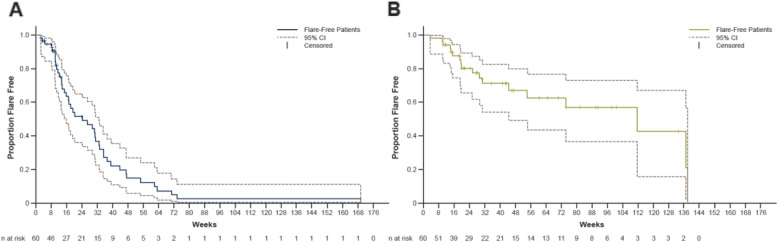
Sixty patients with GCA were included. The median (IQR) disease duration before and after the start of TCZ was 0.6 (0.2-1.6) and 0.5 (0.3-1.4) years, respectively. At least 1 flare was observed in 43 patients (71.7%) before and in 18 (30.0%) after TCZ initiation. Median (IQR) time to flare was 0.5 (0.3-0.7) years before TCZ treatment and 2.1 (0.6-2.6) years after TCZ initiation (HR 0.22; 95% CI 0.10-0.50; p = 0.0003). The annualized flare rate significantly decreased following TCZ use (before TCZ 1.4 [95% CI 1.0-2.1]; after TCZ 0.6 [95% CI 0.3-1.0] events/year; p < 0.001). Similar improvements were observed in patients with visual manifestations or PMR symptoms at GCA diagnosis. TCZ reduced the incidence of new visual manifestations, and no flares associated with permanent vision loss occurred while patients were receiving TCZ. Mean (SD) prednisone dose at TCZ onset and at the end of follow-up was 30 (18.3) and 5 (6.9) mg/day, respectively (p < 0.0001). After TCZ initiation, 46.6% of patients successfully discontinued prednisone. The incidence of adverse events, primarily attributed to glucocorticoids, was similar before and after TCZ initiation.
In this real-world setting, TCZ improved GCA clinical outcomes significantly and demonstrated effectiveness in the subgroups of patients with PMR symptoms and GCA-related visual manifestations at GCA diagnosis. No new cases of blindness occurred after TCZ initiation. Adverse events, many attributable to glucocorticoids, were comparable before and after TCZ treatment.
安慰剂对照临床试验已证明托珠单抗(TCZ)在巨细胞动脉炎(GCA)患者中维持缓解及减少糖皮质激素用量方面的疗效。然而,在真实世界临床实践中,关于TCZ治疗GCA的有效性和安全性的数据有限。
这是一项对2010 - 2018年接受静脉或皮下注射TCZ治疗的GCA患者进行的回顾性单中心分析。在开始使用TCZ之前和之后评估的结果包括病情复发的发生情况、复发时间、年化复发率、复发特征(即风湿性多肌痛[PMR]症状、颅部表现)、泼尼松的使用情况及安全性。病情复发定义为明确的GCA表现复发且需要强化治疗。对GCA诊断时伴有PMR或视觉表现的患者进行亚组分析。
纳入60例GCA患者。开始使用TCZ之前和之后的疾病持续时间中位数(IQR)分别为0.6(0.2 - 1.6)年和0.5(0.3 - 1.4)年。在开始使用TCZ之前,43例患者(71.7%)至少有1次病情复发,而在开始使用TCZ之后为18例(30.0%)。病情复发的中位时间(IQR)在TCZ治疗前为0.5(0.3 - 0.7)年,在开始使用TCZ之后为2.1(0.6 - 2.6)年(HR 0.22;95% CI 0.10 - 0.50;p = 0.0003)。使用TCZ后年化复发率显著降低(TCZ治疗前为1.4 [95% CI 1.0 - 2.1];TCZ治疗后为0.6 [95% CI 0.3 - 1.0]次/年;p < 0.001)。在GCA诊断时伴有视觉表现或PMR症状的患者中也观察到了类似的改善。TCZ降低了新的视觉表现的发生率,并且在患者接受TCZ治疗期间未发生与永久性视力丧失相关的病情复发。开始使用TCZ时及随访结束时泼尼松的平均(SD)剂量分别为30(18.3)mg/天和5(6.9)mg/天(p < 0.0001)。开始使用TCZ后,46.6%的患者成功停用了泼尼松。不良事件的发生率在开始使用TCZ之前和之后相似,主要归因于糖皮质激素。
在这个真实世界环境中,TCZ显著改善了GCA的临床结局,并在GCA诊断时伴有PMR症状和GCA相关视觉表现的患者亚组中显示出有效性。开始使用TCZ后未出现新的失明病例。不良事件在TCZ治疗前后相当,许多不良事件归因于糖皮质激素。