Ribeirão Preto Nursing School, University of São Paulo, Campus Universitário, s/n Monte Alegre, Ribeirão Prêto, São Paulo, 14048-900, Brazil.
Social Medicine Department, Ribeirão Preto Medical School, University of São Paulo, Ribeirão Prêto, Brazil.
Antimicrob Resist Infect Control. 2021 Jan 6;10(1):6. doi: 10.1186/s13756-020-00877-5.
BACKGROUND/OBJECTIVE: After wearing powdered gloves, healthcare workers (HCW) are supposed to wash their hands instead of using alcohol-based hand-rub (ABHR). Washing hands takes longer than using ABHR, and the use of powdered gloves may be an obstacle to hand-hygiene compliance. This study aimed to evaluate the impact of replacing powdered gloves with powder-free gloves on hand-hygiene compliance among HCW of an intensive care unit (ICU).
A quasi-experimental study was conducted in a general ICU of a tertiary care university hospital in Brazil. From June 1st to July 15th, 2017, all HCW were provided with powdered latex gloves only for all clinical procedures. From July 15th to August 31st, 2017, HCW were provided with nitrile powder-free gloves only. Hand-hygiene compliance was assessed through direct observation, and evaluated according to the World Health Organization Hand Hygiene guidelines. We calculated that a sample size of 544 hand hygiene opportunities needed to be observed per period. Data analysis were performed using the STATA SE® version 14, and we compared the individual's percentage of compliance using the t test for paired data before and after the intervention.
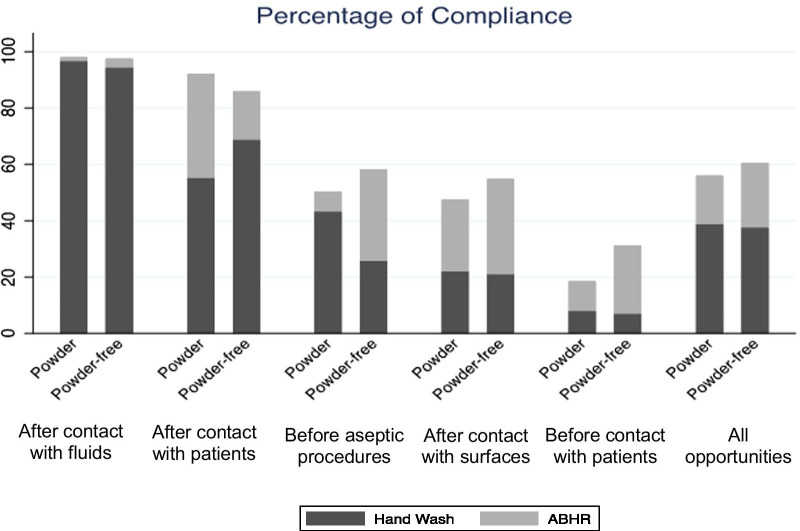
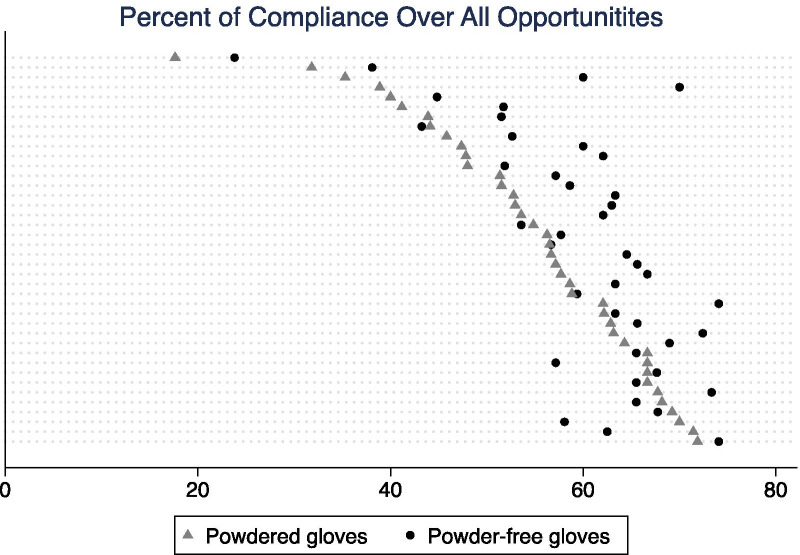
Overall, 40 HCW were assessed before and after the introduction of nitrile powder-free gloves, with 1114 and 1139 observations of hand hygiene opportunities, respectively. The proportion of compliance with hand hygiene was 55% (95% confidence interval [CI] 51-59%) using powdered latex gloves and 60% (95% CI 57-63%) using powder-free gloves. The difference in proportions between the two types of gloves was 5.1% (95% CI 2.5-7.6%, p < 0.001).
Our data indicate that replacing powdered gloves with powder-free gloves positively influenced hand-hygiene compliance by HCW in an ICU setting.
背景/目的:医护人员(HCW)在佩戴粉手套后,应洗手而不是使用醇基手部消毒剂(ABHR)。洗手比使用 ABHR 耗时更长,而粉手套的使用可能会成为手部卫生依从性的障碍。本研究旨在评估在重症监护病房(ICU)的 HCW 中,用无粉手套替代粉手套对其手部卫生依从性的影响。
这是在巴西一家三级保健大学附属医院的普通 ICU 中进行的准实验研究。2017 年 6 月 1 日至 7 月 15 日,所有 HCW 在所有临床操作中均使用乳胶粉手套。2017 年 7 月 15 日至 8 月 31 日,HCW 仅使用丁腈无粉手套。通过直接观察评估手部卫生依从性,并根据世界卫生组织手部卫生指南进行评估。我们计算出每个时间段需要观察 544 次手部卫生机会,以评估样本量。使用 STATA SE®版本 14 进行数据分析,并使用配对数据的 t 检验比较干预前后个人的依从性百分比。
总共对引入丁腈无粉手套前后的 40 名 HCW 进行了评估,分别观察了 1114 次和 1139 次手部卫生机会。使用乳胶粉手套时,手部卫生依从率为 55%(95%置信区间 [CI] 51-59%),使用无粉手套时为 60%(95% CI 57-63%)。两种手套的比例差异为 5.1%(95% CI 2.5-7.6%,p<0.001)。
我们的数据表明,在 ICU 环境中,用无粉手套替代粉手套可显著提高 HCW 的手部卫生依从性。