Eppley Institute for Research in Cancer and Allied Diseases, Fred & Pamela Buffet Cancer Center, University of Nebraska Medical Center, Omaha, NE 68198, USA.
Department of Genetics, Cell Biology, and Anatomy, University of Nebraska Medical Center, Omaha, NE 68198, USA.
Biol Open. 2021 Jan 6;10(1):bio057232. doi: 10.1242/bio.057232.
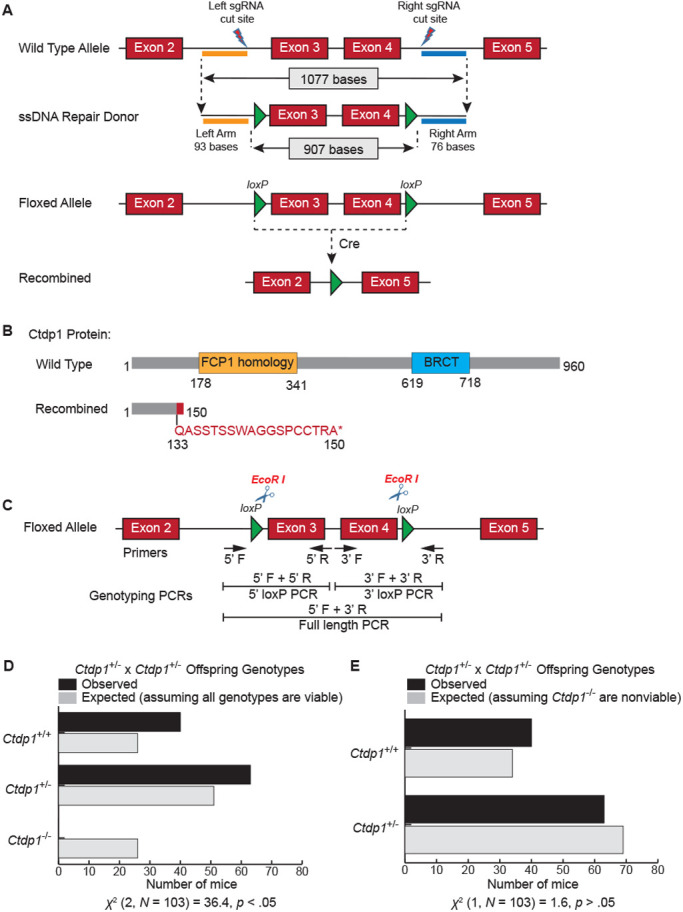
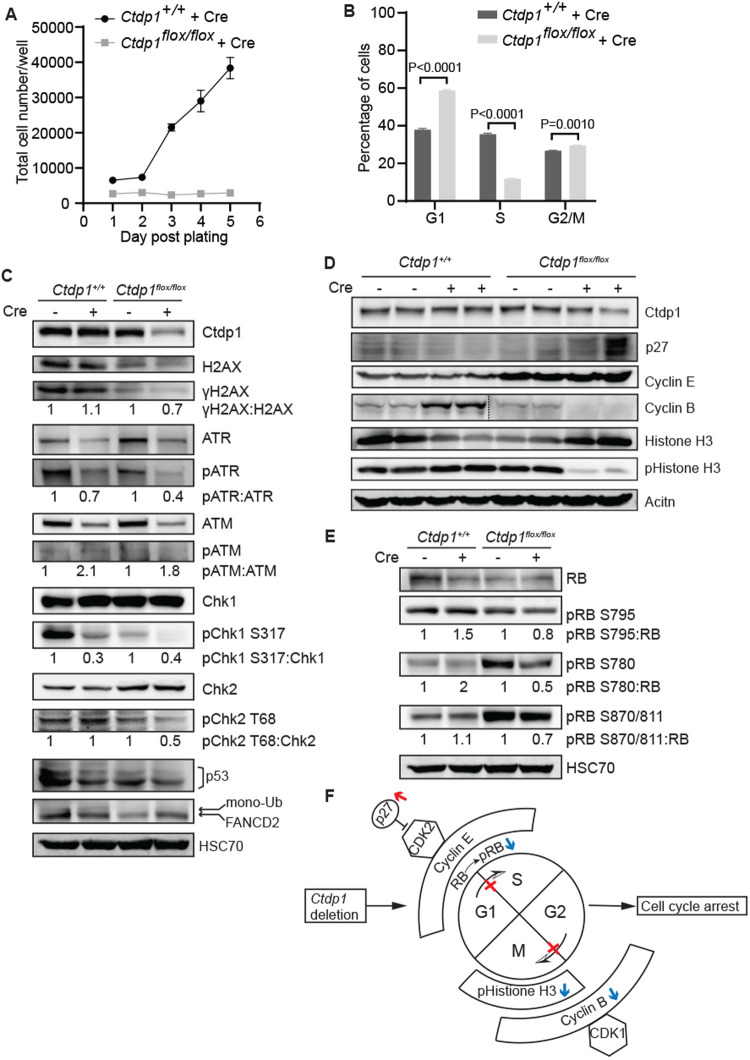
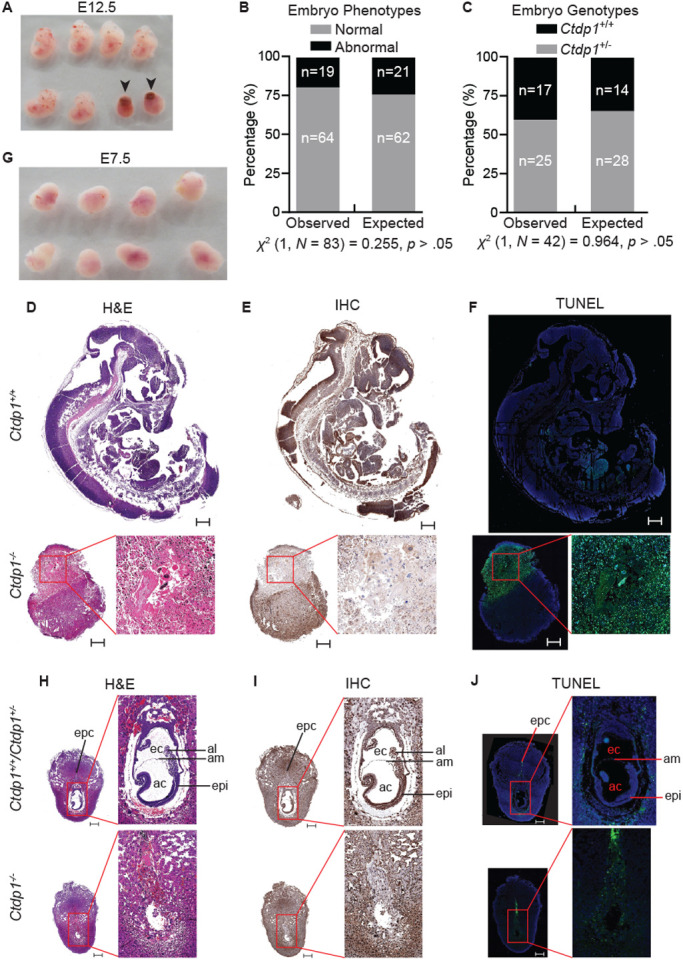
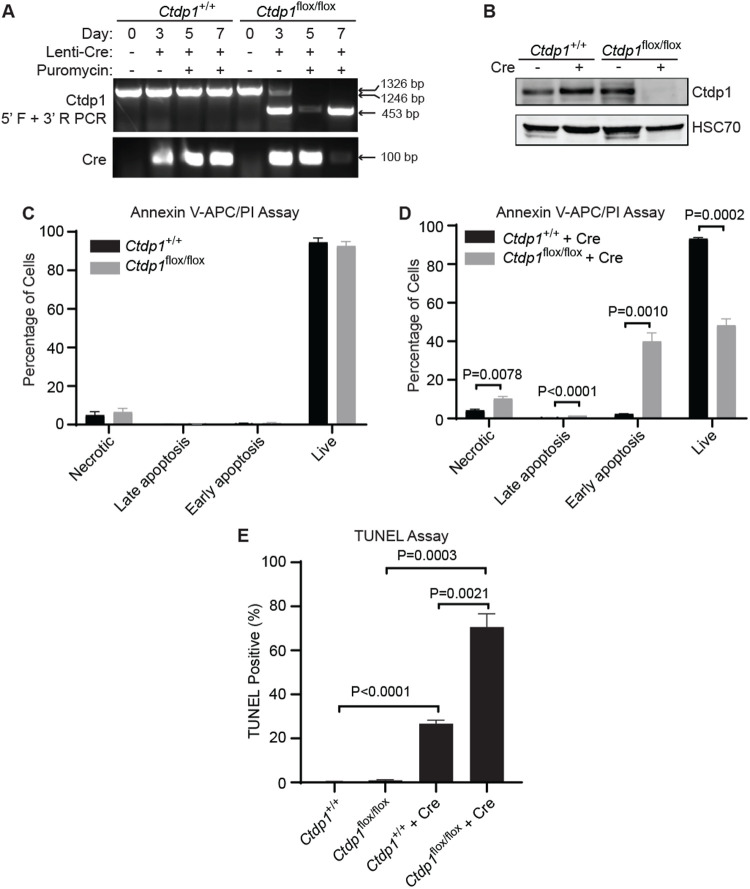
RNA polymerase II subunit A Carboxy-Terminal Domain Phosphatase 1 (CTDP1), a member of the haloacid dehalogenase superfamily phosphatases, has a defined role in transcriptional regulation, but emerging evidence suggests an expanded functional repertoire in the cell cycle and DNA damage response. In humans, a splice site mutation in gives rise to the rare Congenital Cataracts Facial Dysmorphism and Neuropathy syndrome, and recent evidence from our lab indicates CTDP1 is required for breast cancer growth and proliferation. To explore the physiological function of CTDP1 in a mammalian system, we generated a conditional knockout mouse model by insertion of sites upstream of exon 3 and downstream of exon 4. Biallelic deletion of results in lethality before embryonic day 7.5, with morphological features indicating embryo cell death and resorption. However, mice are haplosufficient for phenotypic traits including body weight, hematological parameters, exploratory and locomotive functions. To investigate the potential mechanisms of the embryonic death caused by biallelic knockout, mouse embryonic fibroblasts (MEFs) were established from and mice. Lentivirus delivered Cre-mediated biallelic deletion of in MEFs results in cell death preceded by impaired proliferation characterized by an increase in G1- and G2-phase populations and a reduction in the S-phase population. These cell cycle alterations caused by deletion of are associated with an increase in p27 protein expression and a decrease in phosphorylated RB, phosphorylated Histone H3, and Cyclin B expression. Together, these results reveal that plays an essential role in early mouse embryo development and cell growth and survival in part by regulating the cell cycle.
RNA 聚合酶 II 亚基 A 羧基末端结构域磷酸酶 1(CTDP1)是卤代酸脱卤酶超家族磷酸酶的成员,在转录调控中具有明确的作用,但新出现的证据表明它在细胞周期和 DNA 损伤反应中具有扩展的功能谱。在人类中,在 中剪接位点的突变导致罕见的先天性白内障面部畸形和神经病综合征,我们实验室最近的证据表明 CTDP1 是乳腺癌生长和增殖所必需的。为了在哺乳动物系统中探索 CTDP1 的生理功能,我们通过在exon3 的上游和exon4 的下游插入 位点生成了一个条件性 敲除小鼠模型。 的双等位基因缺失导致胚胎第 7.5 天前的致死性,其形态特征表明胚胎细胞死亡和吸收。然而, 小鼠在表型特征方面是半合子充足的,包括体重、血液学参数、探索和运动功能。为了研究双等位基因 敲除引起胚胎死亡的潜在机制,我们从小鼠中建立了 和 胚胎成纤维细胞(MEFs)。MEFs 中的 lentivirus 传递 Cre 介导的 双等位基因缺失导致细胞死亡,之前的增殖受损特征是 G1 和 G2 期细胞群增加和 S 期细胞群减少。由 缺失引起的这些细胞周期改变与 p27 蛋白表达增加和磷酸化 RB、磷酸化组蛋白 H3 和 Cyclin B 表达减少有关。总之,这些结果表明 在早期小鼠胚胎发育和细胞生长和存活中发挥着重要作用,部分是通过调节细胞周期来实现的。